Liu Yiyan
Nuclear Medicine Service, Department of Radiology, University Hospital, UMDNJ, Newark, New Jersey, USA.
World J Surg Oncol. 2008 Jun 19;6:64. doi: 10.1186/1477-7819-6-64.
FDG PET-CT is generally not suitable for diagnosing prostate cancer because of low glycolysis of the tumor cells. Neuroendocrine differentiation of the prostate cancer is often associated with early visceral metastasis and dismal prognosis, which is resulted from changed metabolic and regulatory pathways.
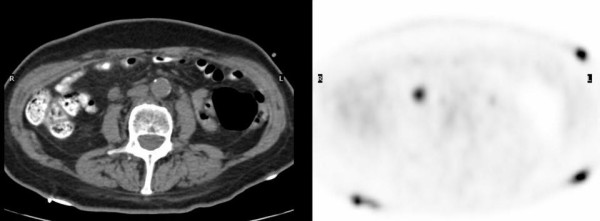
A case is reported in this paper that FDG PET-CT demonstrates intense uptake of neuroendocrine tumor of the prostate and multiple metastases.
There is high glycolysis and strong FDG-avidity of neuroendocrine tumor of the prostate, which is similar to that of high grade of neuroendocrine tumor in other tissue and organs. In some selected cases of prostate neuroendocrine cancer, whole body FDG PET-CT may be helpful for detection of metastatic disease.
由于肿瘤细胞糖酵解水平低,氟代脱氧葡萄糖正电子发射断层扫描-计算机断层扫描(FDG PET-CT)通常不适用于诊断前列腺癌。前列腺癌的神经内分泌分化常与早期内脏转移及不良预后相关,这是由代谢和调节途径改变所致。
本文报告1例FDG PET-CT显示前列腺神经内分泌肿瘤摄取增强及多发转移的病例。
前列腺神经内分泌肿瘤具有高糖酵解和强FDG摄取性,这与其他组织和器官的高级别神经内分泌肿瘤相似。在部分选定的前列腺神经内分泌癌病例中,全身FDG PET-CT可能有助于检测转移性疾病。