Gudmundsdóttir Kristín B, Kristinsson Jakob, Sigurdarson Sigurdur, Eiríksson Tryggvi, Jóhannesson Torkell
Chief Veterinary Office, Section for Animal Diseases, Institute for Experimental Pathology, University of Iceland, Keldur v/Vesturlandsveg, 110 Reykjavík, Iceland.
Acta Vet Scand. 2008 Jun 23;50(1):23. doi: 10.1186/1751-0147-50-23.
Preliminary studies indicated decreased glutathione peroxidase (GPX) activity in blood of ewes on scrapie-afflicted farms. Other studies have shown decreased GPX activity in brain of prion-infected mice and in prion-infected cells in vitro. The aim of this study was to examine the GPX activity in blood as well as the distribution of GPX-activity levels from ewes on farms in scrapie-afflicted areas in Iceland.
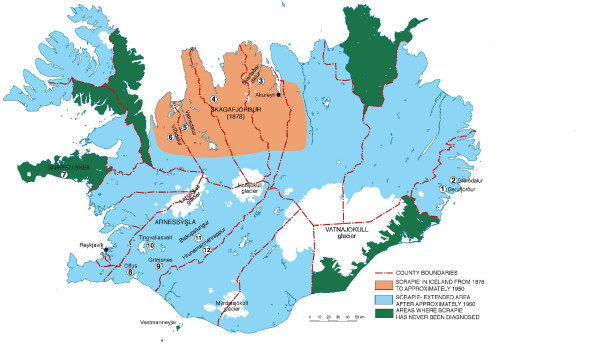
Blood samples were collected from 635 ewes (non-pregnant [n = 297] and pregnant [n = 338]) on 40 farms in scrapie-afflicted areas during the years 2001-2005, for analysis of GPX activity. The farms were divided into three categories: 1. Scrapie-free farms (n = 14); 2. Scrapie-prone farms (earlier scrapie-afflicted, restocked farms) (n = 12); 3. Scrapie-afflicted farms (n = 14). For comparison, 121 blood samples were also collected from non-pregnant ewes on one farm (farm A) in a scrapie-free area (scrapie never registered). Chi-square test was used to test for normal distribution of GPX-results, and Kruskal-Wallis test to compare GPX-results between categories.
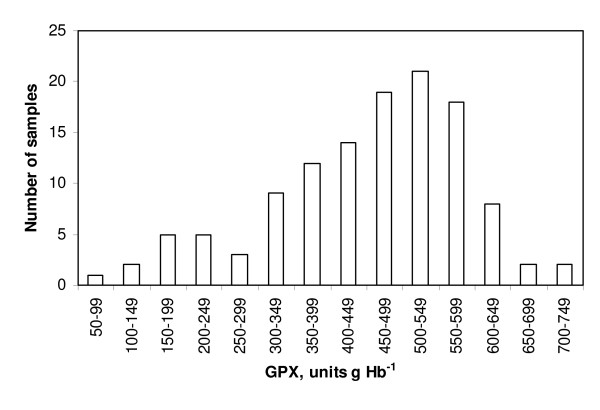
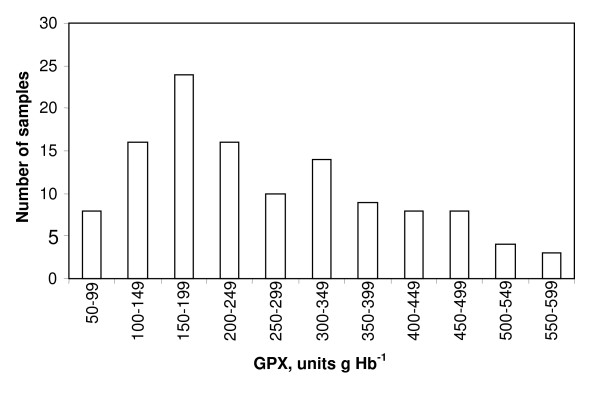
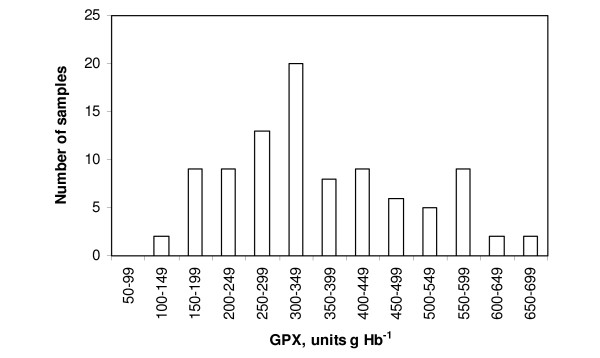
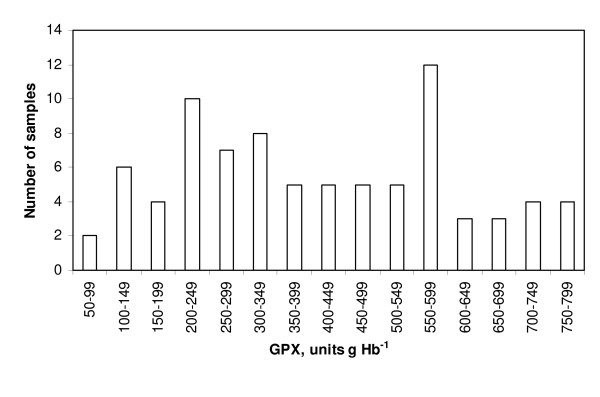
The GPX-results appeared to be biphasically distributed in ewes in all three scrapie categories and on farm A. The presumptive breaking point was about 300 units g Hb-1. About 30-50% of the GPX-results from ewes in all three scrapie categories were below 300 units g Hb-1 but only about 13% of the GPX-results from ewes on farm A. The mean GPX activity was highest on farm A, and was significantly lower on scrapie-prone farms than on scrapie-free or scrapie-afflicted farms (non-pregnant and pregnant ewes: P < 0.005, respectively; non-pregnant and pregnant ewes combined: P < 0.0005).
初步研究表明,在感染羊瘙痒病农场的母羊血液中,谷胱甘肽过氧化物酶(GPX)活性降低。其他研究显示,在朊病毒感染的小鼠大脑以及体外朊病毒感染的细胞中,GPX活性也降低。本研究的目的是检测冰岛羊瘙痒病疫区农场母羊血液中的GPX活性以及GPX活性水平的分布情况。
在2001年至2005年期间,从冰岛羊瘙痒病疫区40个农场的635只母羊(未怀孕母羊[n = 297]和怀孕母羊[n = 338])采集血样,用于分析GPX活性。这些农场分为三类:1. 无羊瘙痒病农场(n = 14);2. 易感染羊瘙痒病农场(曾感染羊瘙痒病,重新放养的农场)(n = 12);3. 感染羊瘙痒病农场(n = 14)。为作比较,还从一个无羊瘙痒病地区(从未记录过羊瘙痒病)的一个农场(农场A)的未怀孕母羊采集了121份血样。采用卡方检验来检测GPX结果的正态分布,并采用Kruskal-Wallis检验来比较不同类别之间的GPX结果。
在所有三个羊瘙痒病类别以及农场A的母羊中,GPX结果似乎呈双相分布。推测的断点约为300单位g Hb-1。在所有三个羊瘙痒病类别中,约30%-50%的母羊GPX结果低于300单位g Hb-1,但在农场A的母羊中,这一比例仅约为13%。农场A的平均GPX活性最高,易感染羊瘙痒病农场的平均GPX活性显著低于无羊瘙痒病农场或感染羊瘙痒病农场(未怀孕和怀孕母羊:P分别< 0.005;未怀孕和怀孕母羊合并:P < 0.0005)。
1)冰岛母羊血液中GPX结果的分布显然具有双相特征;2)无羊瘙痒病地区一个农场的母羊GPX结果高于羊瘙痒病疫区农场的母羊;3)曾感染羊瘙痒病且重新放养的农场中GPX活性水平显著最低,这可能与这些农场散发性羊瘙痒病的复发有关;4)有必要进一步研究GPX活性在冰岛羊瘙痒病发生过程中可能发挥的作用。