Sadler Anthony J, Williams Bryan R G
Monash Institute of Medical Research, Monash University, Clayton, Victoria 3168, Australia.
Nat Rev Immunol. 2008 Jul;8(7):559-68. doi: 10.1038/nri2314.
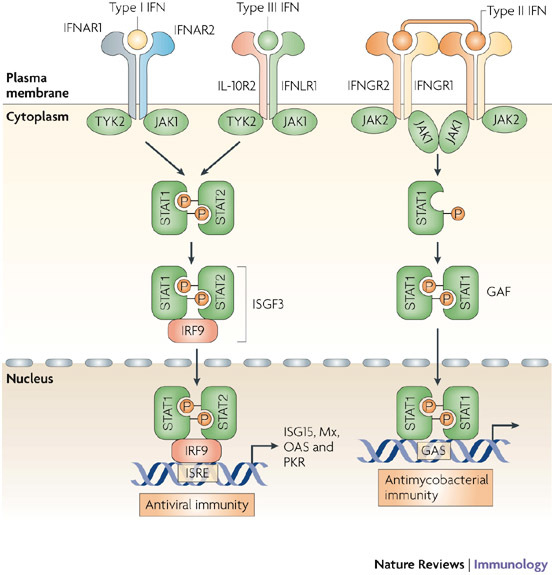
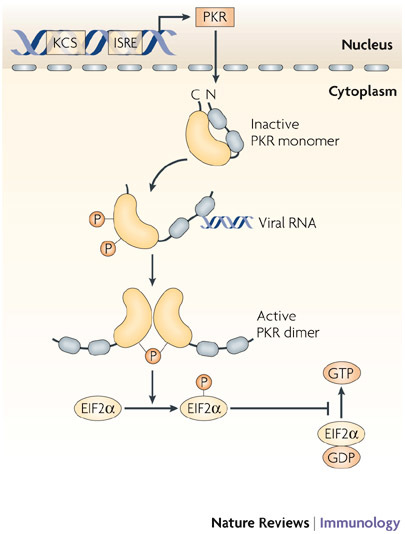
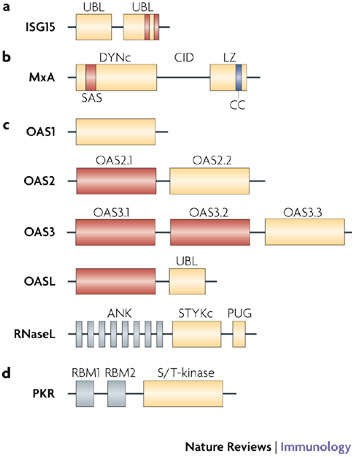
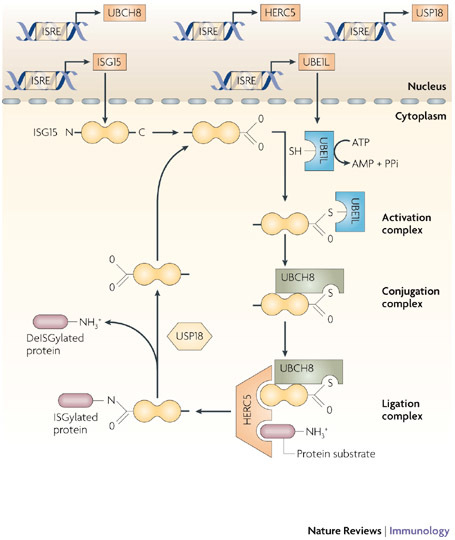
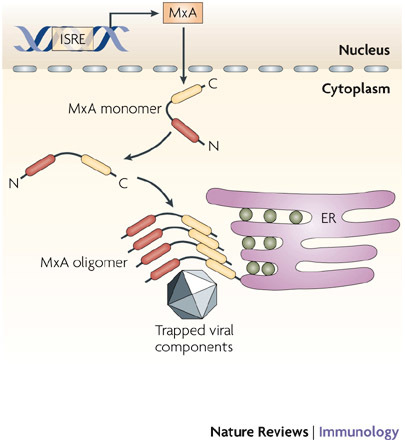
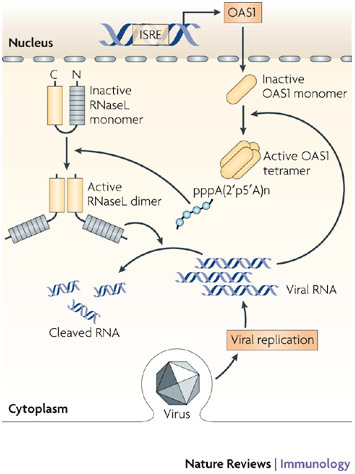
Since the discovery of interferons (IFNs), considerable progress has been made in describing the nature of the cytokines themselves, the signalling components that direct the cell response and their antiviral activities. Gene targeting studies have distinguished four main effector pathways of the IFN-mediated antiviral response: the Mx GTPase pathway, the 2',5'-oligoadenylate-synthetase-directed ribonuclease L pathway, the protein kinase R pathway and the ISG15 ubiquitin-like pathway. As discussed in this Review, these effector pathways individually block viral transcription, degrade viral RNA, inhibit translation and modify protein function to control all steps of viral replication. Ongoing research continues to expose additional activities for these effector proteins and has revealed unanticipated functions of the antiviral response.
自从发现干扰素(IFNs)以来,在描述细胞因子本身的性质、指导细胞反应的信号传导成分及其抗病毒活性方面已经取得了相当大的进展。基因靶向研究已经区分出干扰素介导的抗病毒反应的四个主要效应途径:Mx GTP酶途径、2',5'-寡腺苷酸合成酶导向的核糖核酸酶L途径、蛋白激酶R途径和ISG15类泛素途径。如本综述中所讨论的,这些效应途径分别阻断病毒转录、降解病毒RNA、抑制翻译并改变蛋白质功能,以控制病毒复制的所有步骤。正在进行的研究继续揭示这些效应蛋白的其他活性,并揭示了抗病毒反应的意外功能。