Kowalski M L, Wolska A, Grzegorczyk J, Hilt J, Jarzebska M, Drobniewski M, Synder M, Kurowski M
Department of Immunology, Rheumatology and Allergy, Chair of Immunology, Medical University of Lodz, Pomorska 251, 92-213 Lodz, Poland.
Mediators Inflamm. 2008;2008:132732. doi: 10.1155/2008/132732.
Cell signaling via Toll-like receptors (TLRs) leads to synovial inflammation in rheumatoid arthritis (RA). We aimed to assess effects of TLR2 and TLR4 stimulation on proinflammatory cytokine production by peripheral blood mononuclear cells (PBMCs) from patients with recent-onset RA, osteoarthrosis (OA), and healthy control (HC).
PBMCs were stimulated with LPS, biglycan and cytokine mix. Cytokines were analyzed in supernatants with ELISA. Expression of toll-like receptors mRNA in leukocytes was analyzed using real-time qPCR.
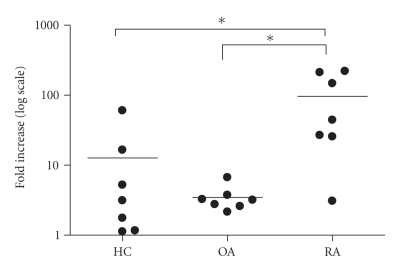
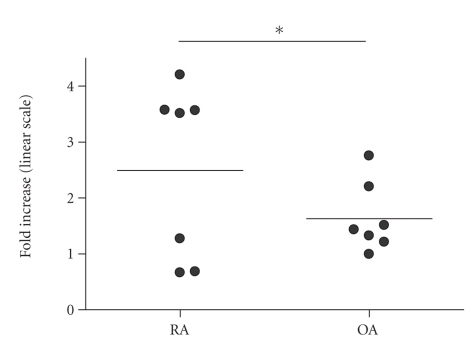
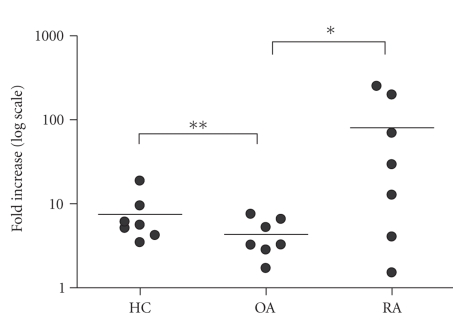
PBMCs from RA patients spontaneously produced less IL-6 and TNFalpha than cells from OA and HC subjects. LPS increased cytokines' production in all groups. In RA patients increase was dramatic (30 to 48-fold and 17 to 31-fold, for respective cytokines) compared to moderate (2 to 8-fold) in other groups. LPS induced 15-HETE generation in PBMCs from RA (mean 251%) and OA patients (mean 43%), although only in OA group, the increase was significant. TLR2 and TLR4 gene expressions decreased in response to cytokine mix, while LPS enhanced TLR2 expression in HC and depressed TLR4 expression in OA patients.
PBMCs from recent-onset RA patients are overresponsive to stimulation with bacterial lipopolysaccharide. TLR expression is differentially regulated in healthy and arthritic subjects.
通过Toll样受体(TLR)进行的细胞信号传导会导致类风湿性关节炎(RA)中的滑膜炎症。我们旨在评估TLR2和TLR4刺激对近期发病的RA患者、骨关节炎(OA)患者和健康对照(HC)外周血单核细胞(PBMC)促炎细胞因子产生的影响。
用脂多糖、双糖链蛋白聚糖和细胞因子混合物刺激PBMC。用酶联免疫吸附测定法(ELISA)分析上清液中的细胞因子。使用实时定量聚合酶链反应(qPCR)分析白细胞中Toll样受体mRNA的表达。
RA患者的PBMC自发产生的白细胞介素-6(IL-6)和肿瘤坏死因子α(TNFα)比OA患者和HC受试者的细胞少。脂多糖增加了所有组中细胞因子的产生。与其他组中适度增加(2至8倍)相比,RA患者中细胞因子的增加幅度很大(分别为30至48倍和17至31倍)。脂多糖诱导RA患者(平均251%)和OA患者(平均43%)的PBMC产生15-羟基二十碳四烯酸(15-HETE),不过仅在OA组中,增加具有显著性。细胞因子混合物会使TLR2和TLR4基因表达下降,而脂多糖会增强HC中的TLR2表达,并降低OA患者中的TLR4表达。
近期发病的RA患者的PBMC对细菌脂多糖刺激反应过度。在健康和患关节炎的受试者中,TLR表达受到不同的调节。