Waddell Jaylyn, Shors Tracey J
Department of Psychology and Center for Collaborative Neuroscience, Rutgers University, Piscataway, NJ 08854, USA.
Eur J Neurosci. 2008 Jun;27(11):3020-8. doi: 10.1111/j.1460-9568.2008.06222.x.
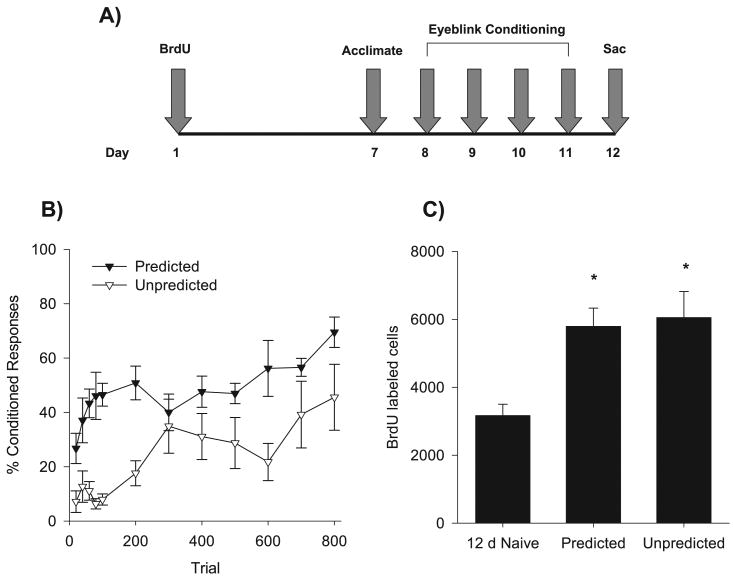
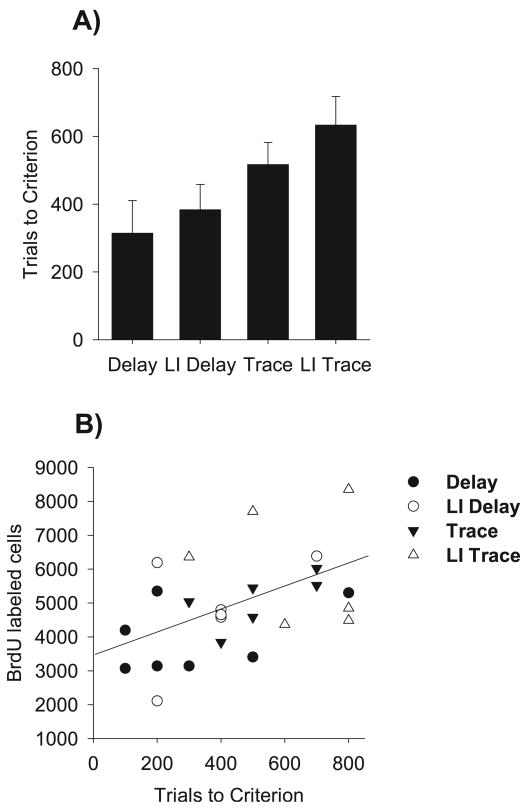
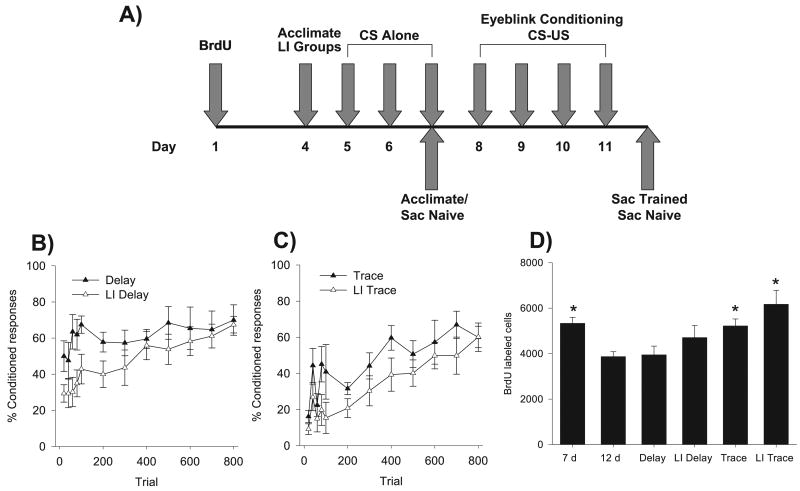
Though the role of the hippocampus in processes of learning and memory is well established, the role of new neurons generated there is less understood. Training on some associative learning tasks increases the likelihood that new cells in the subgranular zone of the dentate gyrus will survive. In the rat, an effective training procedure is trace eyeblink conditioning, in which a conditioned stimulus (CS) is paired with an aversive stimulation to the eyelid (unconditioned stimulus; US), but the stimuli are separated by a temporal gap. Here, we manipulated the asymptote or rate of acquisition during trace conditioning, and examined survival of cells generated 1 week before training. Acquisition was disrupted by decreasing associative strength by insertion of unpredicted USs or slowed with latent inhibition. The number of cells was increased in animals that were trained with trace conditioning, irrespective of the decrease in associative strength or slowed acquisition. Disrupting acquisition with unsignaled USs still increased cell numbers, suggesting that the learning effect on cell survival is not dependent on reliable expression of the conditioned response. Further, animals in the latent inhibition conditions that learned but required more trials also retained more of the new cells than animals requiring fewer trials. The number of cells that survived after the effective training procedures was similar to the number of cells that were available for rescue at the beginning of training. Thus, learning can rescue the majority of cells expressed at the beginning of training, and does so most effectively when acquisition requires many trials.
虽然海马体在学习和记忆过程中的作用已得到充分证实,但其产生的新神经元的作用却鲜为人知。对一些联想学习任务的训练会增加齿状回颗粒下区新细胞存活的可能性。在大鼠中,一种有效的训练方法是痕迹眨眼条件反射,即条件刺激(CS)与对眼睑的厌恶性刺激(非条件刺激;US)配对,但刺激之间有时间间隔。在此,我们在痕迹条件反射过程中操纵了渐近线或习得率,并检查了训练前1周产生的细胞的存活情况。通过插入不可预测的非条件刺激来降低联想强度或通过潜伏抑制减缓习得过程,会干扰习得。无论联想强度降低或习得减缓,接受痕迹条件反射训练的动物体内的细胞数量都会增加。用无信号的非条件刺激破坏习得过程仍然会增加细胞数量,这表明学习对细胞存活的影响并不依赖于条件反应的可靠表达。此外,在潜伏抑制条件下学习但需要更多试验的动物比需要较少试验的动物保留的新细胞也更多。有效训练程序后存活的细胞数量与训练开始时可被挽救的细胞数量相似。因此,学习可以挽救训练开始时表达的大多数细胞,并且在习得需要多次试验时最为有效。