Satoh Minoru, Fujimoto Sohachi, Arakawa Sayaka, Yada Toyotaka, Namikoshi Tamehachi, Haruna Yoshisuke, Horike Hideyuki, Sasaki Tamaki, Kashihara Naoki
Division of Nephrology, Department of Internal Medicine, Kawasaki Medical School, Kurashiki, Okayama 701-0192, Japan.
Nephrol Dial Transplant. 2008 Dec;23(12):3806-13. doi: 10.1093/ndt/gfn357. Epub 2008 Jul 2.
Recent studies showed that angiotensin II type 1 receptor blocker (ARB) slows progression of chronic renal disease in patients with type 2 diabetes, regardless of changes in blood pressure. We showed that the imbalance of nitric oxide (NO) and reactive oxygen species (ROS) due to endothelial NO synthase (eNOS) uncoupling contributed to renal dysfunction in the diabetic nephropathy. The aim of this study was to determine the effects of ARB on uncoupled eNOS in rat diabetic nephropathy.
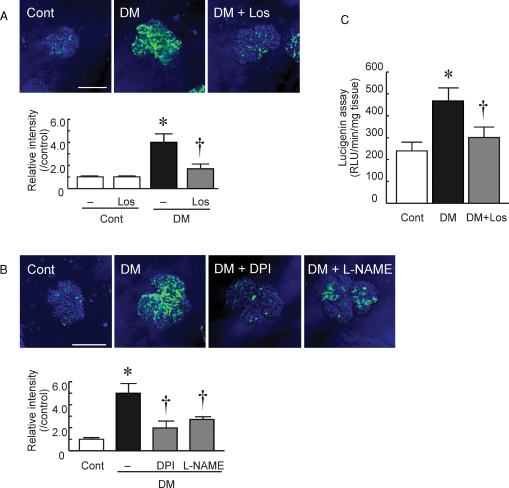
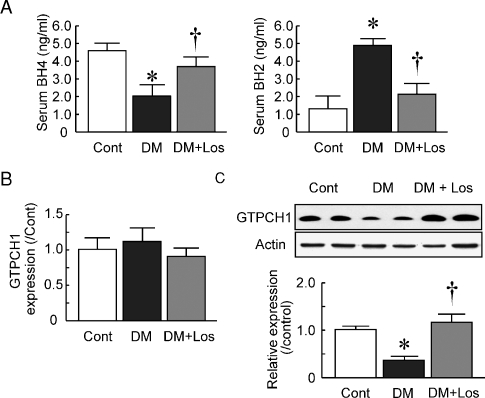
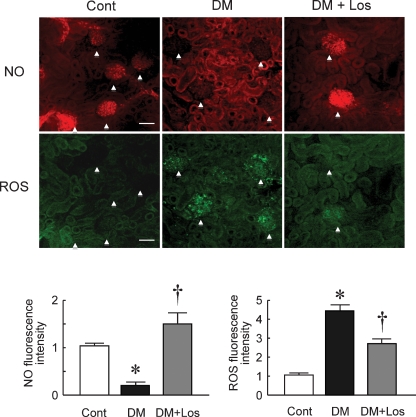
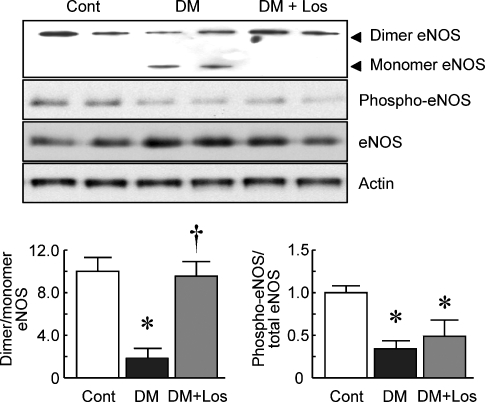
Diabetes was induced in Sprague-Dawley rats with streptozotocin (65 mg/ kg body weight). After 6 weeks, rats were divided into saline (DM; n = 11) and ARB, losartan groups (DM+Los; n = 11). After 2-week treatment, glomerular ROS production was assessed by 2',7'-dichlorofluorescin diacetate (DCFH-DA)-derived chemiluminescence. Renal NO and ROS production were imaged by confocal laser microscopy after renal perfusion with DCFH-DA and diaminorhodamine-4M acetoxymethyl ester with L-arginine. The dimeric form of eNOS was measured by low-temperature sodium dodecyl sulfate-polyacrylamide gel electrophoresis. Serum tetrahydrobiopterin (BH4) concentrations were determined by high-performance liquid chromatography. Protein and mRNA expression of GTP cyclohydrolase 1 (GTPCH1), key enzyme of BH4 synthesis, were examined.
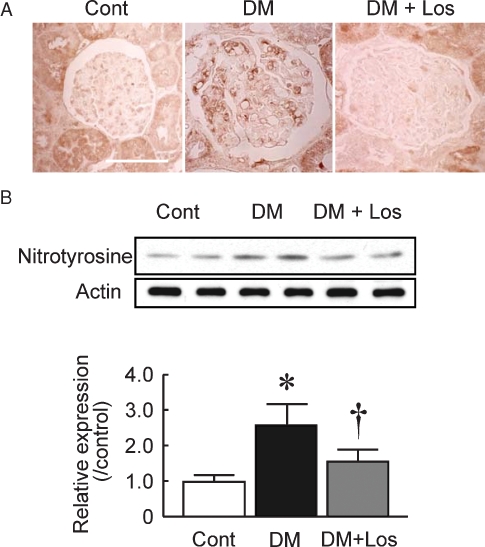
Losartan attenuated glomerular ROS production in DM. Accelerated ROS production and diminished bioavailable NO caused by NOS uncoupling were noted in DM glomeruli. Losartan reversed the decreased GTPCH1 and decreased dimeric form of eNOS and glomerular NO production by increased BH4 bioavailability.
ARB improved the NOS uncoupling in diabetic nephropathy by increasing BH4 bioavailability.
近期研究表明,1型血管紧张素II受体阻滞剂(ARB)可减缓2型糖尿病患者慢性肾病的进展,而与血压变化无关。我们发现,内皮型一氧化氮合酶(eNOS)解偶联导致的一氧化氮(NO)和活性氧(ROS)失衡是糖尿病肾病肾功能障碍的原因之一。本研究旨在确定ARB对大鼠糖尿病肾病中解偶联eNOS的影响。
用链脲佐菌素(65mg/kg体重)诱导Sprague-Dawley大鼠患糖尿病。6周后,将大鼠分为生理盐水组(DM;n = 11)和ARB(氯沙坦)组(DM+Los;n = 11)。治疗2周后,用2',7'-二氯荧光素二乙酸酯(DCFH-DA)衍生的化学发光法评估肾小球ROS生成。在用DCFH-DA和二氨基罗丹明-4M乙酰氧基甲酯与L-精氨酸对肾脏进行灌注后,通过共聚焦激光显微镜对肾脏NO和ROS生成进行成像。通过低温十二烷基硫酸钠-聚丙烯酰胺凝胶电泳测量eNOS的二聚体形式。用高效液相色谱法测定血清四氢生物蝶呤(BH4)浓度。检测BH4合成关键酶GTP环水解酶1(GTPCH1)的蛋白质和mRNA表达。
氯沙坦可减轻DM组肾小球ROS生成。在DM组肾小球中,发现由NOS解偶联导致的ROS生成加速和生物可利用NO减少。氯沙坦通过增加BH4的生物利用度,逆转了GTPCH1的降低、eNOS二聚体形式的减少以及肾小球NO生成的减少。
ARB通过增加BH4的生物利用度改善糖尿病肾病中的NOS解偶联。