Seers Kate, Crichton Nicola, Martin June, Coulson Katrina, Carroll Dawn
RCN Research Institute, School of Health & Social Studies, University of Warwick, Coventry, CV4 7AL, UK.
BMC Nurs. 2008 Jul 4;7:10. doi: 10.1186/1472-6955-7-10.
Massage is increasingly used to manage chronic pain but its benefit has not been clearly established. The aim of the study is to determine the effectiveness of a single session of nurse-administered massage for the short term relief of chronic non-malignant pain and anxiety.
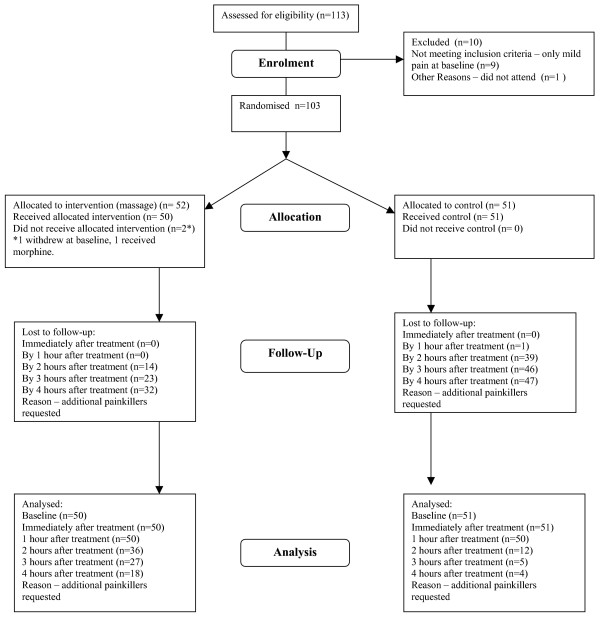
A randomised controlled trial design was used, in which the patients were assigned to a massage or control group. The massage group received a 15 minute manual massage and the control group a 15 minute visit to talk about their pain. Adult patients attending a pain relief unit with a diagnosis of chronic pain whose pain was described as moderate or severe were eligible for the study. An observer blind to the patients' treatment group carried out assessments immediately before (baseline), after treatment and 1, 2, 3 and 4 hours later. Pain was assessed using 100 mm visual analogue scale and the McGill Pain Questionnaire. Pain Relief was assessed using a five point verbal rating scale. Anxiety was assessed with the Spielberger short form State-Trait Anxiety Inventory.
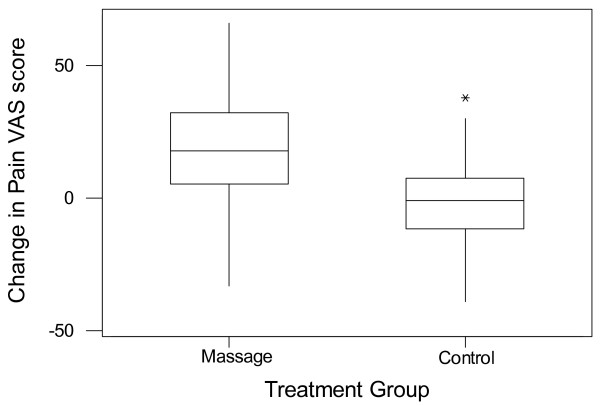
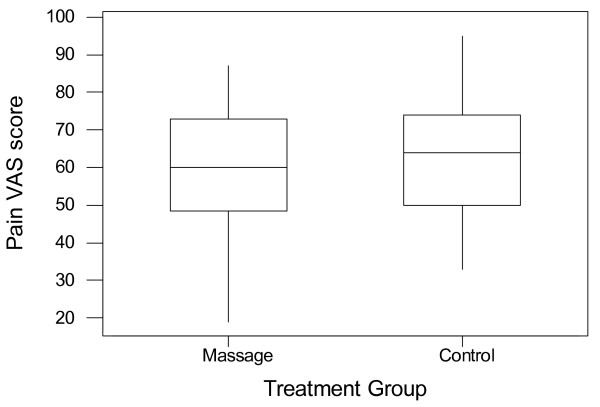
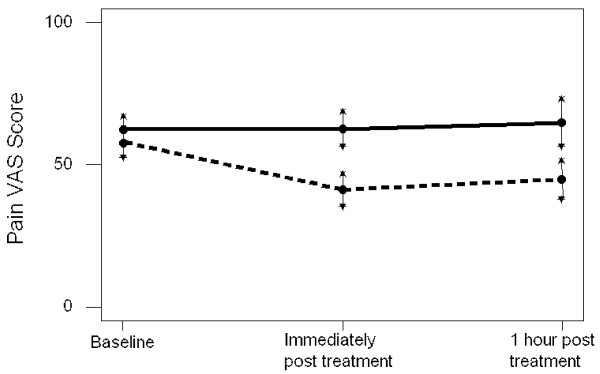
101 patients were randomised and evaluated, 50 in the massage and 51 in the control group. There were no statistically significant differences between the groups at baseline interview. Patients in the massage but not the control group had significantly less pain compared to baseline immediately after and one hour post treatment. 95% confidence interval for the difference in mean pain reduction at one hour post treatment between the massage and control groups is 5.47 mm to 24.70 mm. Patients in the massage but not the control group had a statistically significant reduction in anxiety compared to baseline immediately after and at 1 hour post treatment.
Massage is effective in the short term for chronic pain of moderate to severe intensity.
[ISRCTN98406653].
按摩越来越多地用于管理慢性疼痛,但其益处尚未得到明确证实。本研究的目的是确定由护士实施的单次按摩对慢性非恶性疼痛和焦虑的短期缓解效果。
采用随机对照试验设计,将患者分为按摩组或对照组。按摩组接受15分钟的手法按摩,对照组进行15分钟的疼痛交流问诊。就诊于疼痛缓解单元、诊断为慢性疼痛且疼痛描述为中度或重度的成年患者符合本研究条件。一名对患者治疗组不知情的观察者在治疗前(基线)、治疗后以及治疗后1、2、3和4小时进行评估。使用100毫米视觉模拟量表和麦吉尔疼痛问卷评估疼痛。使用五点口头评定量表评估疼痛缓解情况。使用斯皮尔伯格状态-特质焦虑量表简表评估焦虑。
101名患者被随机分组并进行评估,按摩组50名,对照组51名。在基线访谈时,两组之间无统计学显著差异。与基线相比,按摩组患者在治疗后即刻和治疗后1小时疼痛明显减轻,而对照组未出现此情况。按摩组与对照组在治疗后1小时平均疼痛减轻差异的95%置信区间为5.47毫米至24.70毫米。与基线相比,按摩组患者在治疗后即刻和治疗后1小时焦虑有统计学显著降低,而对照组未出现此情况。
按摩对中度至重度强度的慢性疼痛在短期内有效。
[ISRCTN98406653]