de Lima Vazquez Vinicius, Sachetto Teoclito, Perpetuo Natalia Martins, Carvalho Andre Lopes
Department of Surgery, Hospital de Cancer de Barretos, Rua Antenor Duarte Villela, 1331 Barretos-SP, 14784-400, Brazil.
World J Surg Oncol. 2008 Jul 4;6:73. doi: 10.1186/1477-7819-6-73.
Squamous cell carcinoma (SCC) of the skin of the trunk and extremities may present lymph node metastasis with difficult disease control and poor survival. The purpose of this study was to identify risk factors for lymph node metastasis and outcome.
PATIENTS/METHODS: Retrospective review of 57 patients with locally advanced SCC of the trunk and extremities was performed and several clinical variables including age, gender, ethnicity, previously injured skin (burns, scars, ulcers and others), patient origin (rural or urban), anatomic site and treatment were studied.
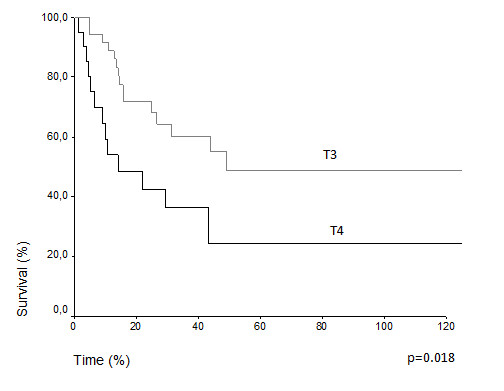
Fifteen patients presented with previous skin lesions. Thirty-six were classified as T3 tumors and 21 as T4; 46 were N0, and 11, N1. Eleven N0 patients presented lymph node metastasis during follow up. Univariate analysis identified previous skin lesions (ulcers and scars) as risk factor for lymph node metastasis (p = 0.047). Better survival was demonstrated for T3 (p = 0.018) classification. N0 patients who presented lymph node metastasis during follow up (submitted to lymphadenectomy) had similar survival to patients without lymph node recurrence (p = 0.219).
Local advanced tumors are at risk of lymph node metastasis. Increased risk is associated to previous lesions at tumor site. T4 classification have worse prognosis. Lymph node recurrences in N0 patients, once treated, did not affect survival. For these patients, we propose close follow up and prompt treatment of lymph node metastasis. These results do not support indication for elective lymphadenectomy or sentinel node mapping. Further prospective studies must address this issue.
躯干和四肢皮肤鳞状细胞癌(SCC)可能出现淋巴结转移,疾病控制困难且生存率低。本研究的目的是确定淋巴结转移的危险因素及预后情况。
患者/方法:对57例躯干和四肢局部晚期鳞状细胞癌患者进行回顾性分析,研究了包括年龄、性别、种族、既往皮肤损伤(烧伤、瘢痕、溃疡等)、患者来源(农村或城市)、解剖部位和治疗等多个临床变量。
15例患者有既往皮肤病变。36例被分类为T3肿瘤,21例为T4;46例为N0,11例为N1。11例N0患者在随访期间出现淋巴结转移。单因素分析确定既往皮肤病变(溃疡和瘢痕)是淋巴结转移的危险因素(p = 0.047)。T3分类显示出更好的生存率(p = 0.018)。随访期间出现淋巴结转移(接受淋巴结清扫术)的N0患者与无淋巴结复发的患者生存率相似(p = 0.219)。
局部晚期肿瘤有淋巴结转移风险。风险增加与肿瘤部位既往病变有关。T4分类预后较差。N0患者一旦发生淋巴结复发,经治疗后不影响生存率。对于这些患者,我们建议密切随访并及时治疗淋巴结转移。这些结果不支持选择性淋巴结清扫术或前哨淋巴结定位的指征。需要进一步的前瞻性研究来解决这个问题。