Centro di Medicina del Dolore 'Mario Tiengo' Osp Maggiore Policlinico Mangiagalli Regina Elena, Milano, Dipartimento di Prevenzione ASL Provincia Milano 1, Centro collaborante OMS per la Medicina Tradizionale - Università degli Studi Milano and Centro per lo Studio e la Prevenzione Oncologica, Firenze, Italia.
Evid Based Complement Alternat Med. 2008 Jun;5(2):227-30. doi: 10.1093/ecam/nem020.
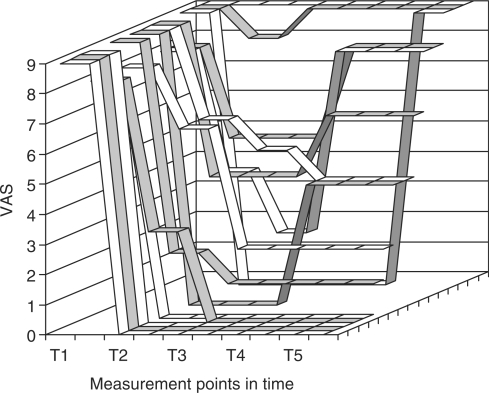
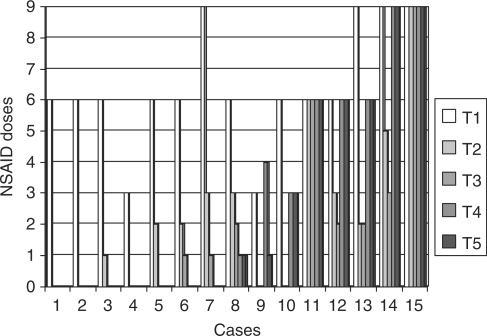
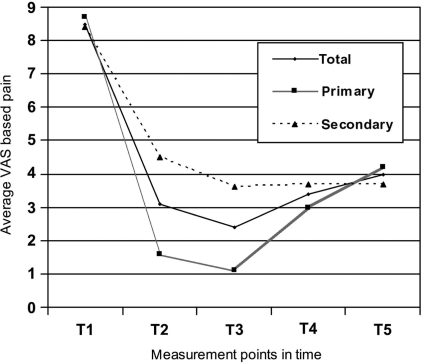
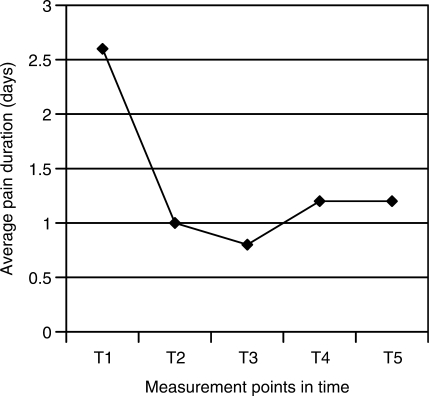
We evaluated the effect of acupuncture on NSAID resistant dysmenorrhea related pain [measured according to Visual Analogue Scale (VAS)] in 15 consecutive patients. Pain was measured at baseline (T1), mid treatment (T2), end of treatment (T3) and 3 (T4) and 6 months (T5) after the end of treatment. Substantial reduction of pain and NSAID assumption was observed in 13 of 15 patients (87%). Pain intensity was significantly reduced with respect to baseline (average VAS = 8.5), by 64, 72, 60 or 53% at T2, T3, T4 or T5. Greater reduction of pain was observed for primary as compared with secondary dysmenorrhea. Average pain duration at baseline (2.6 days) was significantly reduced by 62, 69, 54 or 54% at T2, T3, T4 or T5. Average NSAID use was significantly reduced by 63, 74, 58 or 58% at T2, T3, T4 or T5, respectively, and ceased totally in 7 patients, still asymptomatic 6 months after treatment. Our findings suggest that acupuncture may be indicated to treat dysmenorrhea related pain, in particular in those subjects in whom NSAID or oral contraceptives are contraindicated or refused.
我们评估了针刺治疗非甾体抗炎药(NSAID)抵抗性痛经相关疼痛(根据视觉模拟量表(VAS)测量)的效果,共纳入了 15 例连续患者。在基线(T1)、治疗中期(T2)、治疗结束时(T3)以及治疗结束后 3 个月(T4)和 6 个月(T5)时测量疼痛。15 例患者中有 13 例(87%)疼痛显著减轻且 NSAID 用量减少。与基线相比(平均 VAS=8.5),T2、T3、T4 和 T5 时疼痛强度分别降低了 64%、72%、60%或 53%。原发性痛经患者的疼痛减轻幅度大于继发性痛经患者。基线时平均疼痛持续时间(2.6 天)在 T2、T3、T4 和 T5 时分别降低了 62%、69%、54%或 54%。T2、T3、T4 和 T5 时 NSAID 的平均用量分别降低了 63%、74%、58%或 58%,7 例患者完全停止使用 NSAID,且在治疗结束后 6 个月仍无症状。我们的研究结果表明,针刺可能适用于治疗痛经相关疼痛,尤其是在 NSAID 或口服避孕药禁忌或被拒绝的患者中。