Wu Te-Chang, Guo Wan-Yuo, Wu Hsiu-Mei, Chang Feng-Chi, Shiau Cheng-Ying, Chung Wen-Yuh
Department of Radiology, Chi-Mei Foundation Hospital, Tainan, Taiwan.
Korean J Radiol. 2008 Jul;9 Suppl(Suppl):S65-7. doi: 10.3348/kjr.2008.9.s.s65.
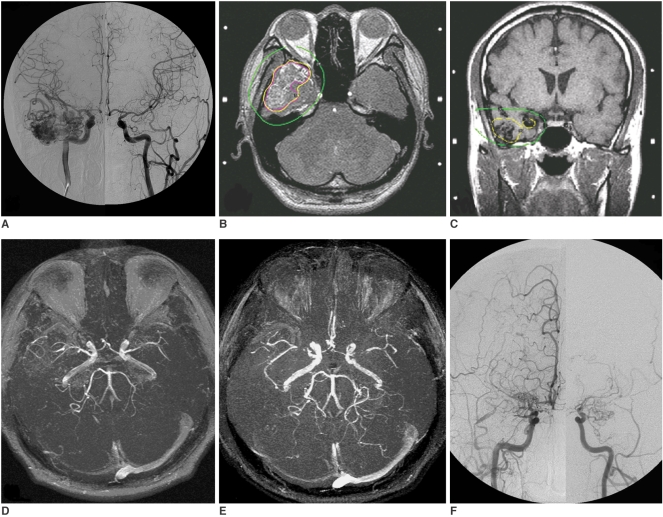
A 36-year-old man was diagnosed with a right temporal lobe grade II cerebral arteriovenous malformation (cAVM) and was treated with radiosurgery. At nine months after the cAVM radiosurgery, the patient began to develop bilateral focal narrowing at the M1 segments of the bilateral middle cerebral arteries. The narrowing progressively deteriorated as was demonstrated on longitudinal serial follow-up MR imaging. X-ray angiography performed at 51 months after radiosurgery confirmed that the cAVM was cured and a diagnosis of moyamoya disease. To the best of our knowledge, this is the first case of cAVM-associated moyamoya disease that developed after radiosurgery. Given the chronological sequence of disease development and radiation dose distribution of radiosurgery, it is proposed that humoral or unknown predisposing factors, rather than direct radiation effects, are the cause of moyamoya disease associated with cAVM.
一名36岁男性被诊断为右侧颞叶II级脑动静脉畸形(cAVM),并接受了放射外科治疗。在cAVM放射外科治疗九个月后,患者开始出现双侧大脑中动脉M1段的双侧局灶性狭窄。如纵向系列随访磁共振成像所示,狭窄逐渐恶化。放射外科治疗51个月后进行的X线血管造影证实cAVM已治愈,并诊断为烟雾病。据我们所知,这是首例放射外科治疗后发生的与cAVM相关的烟雾病病例。鉴于疾病发展的时间顺序和放射外科的辐射剂量分布,有人提出,与cAVM相关的烟雾病的病因是体液或未知的易感因素,而非直接辐射效应。