Hall Kara L, Stokols Daniel, Moser Richard P, Taylor Brandie K, Thornquist Mark D, Nebeling Linda C, Ehret Carolyn C, Barnett Matthew J, McTiernan Anne, Berger Nathan A, Goran Michael I, Jeffery Robert W
Division of Cancer Control and Population Sciences, National Cancer Institute, NIH, Bethesda, Maryland 20850, USA.
Am J Prev Med. 2008 Aug;35(2 Suppl):S161-72. doi: 10.1016/j.amepre.2008.03.035.
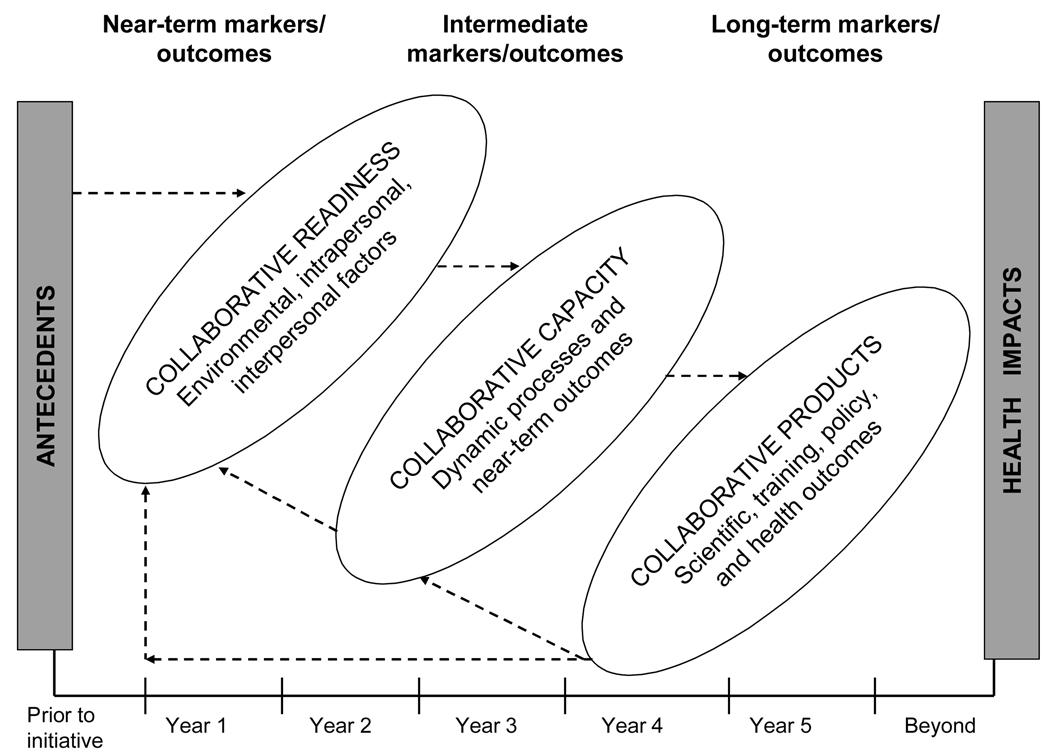
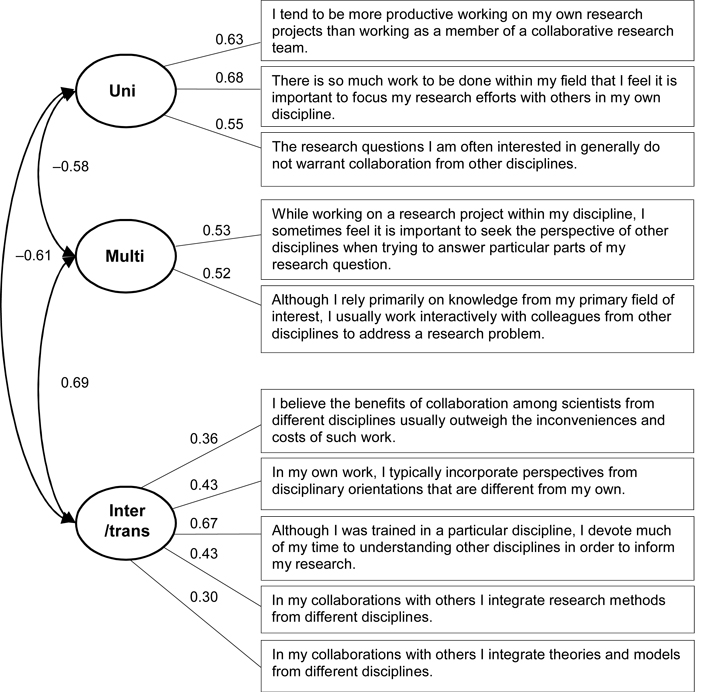
Growing interest in promoting cross-disciplinary collaboration among health scientists has prompted several federal agencies, including the NIH, to establish large, multicenter initiatives intended to foster collaborative research and training. In order to assess whether these initiatives are effective in promoting scientific collaboration that ultimately results in public health improvements, it is necessary to develop new strategies for evaluating research processes and products as well as the longer-term societal outcomes associated with these programs. Ideally, evaluative measures should be administered over the entire course of large initiatives, including their near-term and later phases. The present study focuses on the development of new tools for assessing the readiness for collaboration among health scientists at the outset (during the first year) of their participation in the National Cancer Institute's Transdisciplinary Research on Energetics and Cancer (TREC) initiative. Indexes of collaborative readiness, along with additional measures of near-term collaborative processes, were administered as part of the TREC Year-One evaluation survey. Additionally, early progress toward scientific collaboration and integration was assessed, using a protocol for evaluating written research products. Results from the Year-One survey and the ratings of written products provide evidence of cross-disciplinary collaboration among participants during the first year of the initiative, and also reveal opportunities for enhancing collaborative processes and outcomes during subsequent phases of the project. The implications of these findings for future evaluations of team science initiatives are discussed.
健康科学家对促进跨学科合作的兴趣日益浓厚,这促使包括美国国立卫生研究院(NIH)在内的几个联邦机构发起了一些大型多中心项目,旨在促进合作研究与培训。为了评估这些项目是否能有效地促进科学合作并最终改善公众健康,有必要制定新的策略来评估研究过程和成果,以及与这些项目相关的长期社会影响。理想情况下,评估措施应在大型项目的整个过程中实施,包括近期和后期阶段。本研究重点在于开发新工具,以评估健康科学家在参与美国国立癌症研究所的能量与癌症跨学科研究(TREC)项目初期(第一年)的合作准备情况。作为TREC项目第一年评估调查的一部分,实施了合作准备指数以及近期合作过程的其他衡量指标。此外,使用一份评估书面研究成果的方案,对科学合作与整合的早期进展进行了评估。第一年调查的结果以及书面成果的评分,为该项目第一年参与者之间的跨学科合作提供了证据,同时也揭示了在项目后续阶段加强合作过程和成果的机会。本文讨论了这些发现对未来团队科学项目评估的启示。