Costi John J, Stokes Ian A, Gardner-Morse Mack G, Iatridis James C
Department of Orthopaedics and Rehabilitation, University of Vermont, Burlington.
Spine (Phila Pa 1976). 2008 Jul 15;33(16):1731-8. doi: 10.1097/BRS.0b013e31817bb116.
Nondestructive displacement-controlled dynamic testing of cadaver material, with repeated measures design and randomized sequence of tests.
To determine whether the frequency-dependent changes in disc stiffness and phase angle between load and displacement differ between the 6 principal directions of displacement, and whether these differences are greater in deformation directions associated with greater intradiscal fluid flow.
Prior studies of time-dependent behavior of discs have focused on compression. Comparing different deformation directions allows effects of fluid flow to be distinguished from effects of the solid phase viscoelasticity.
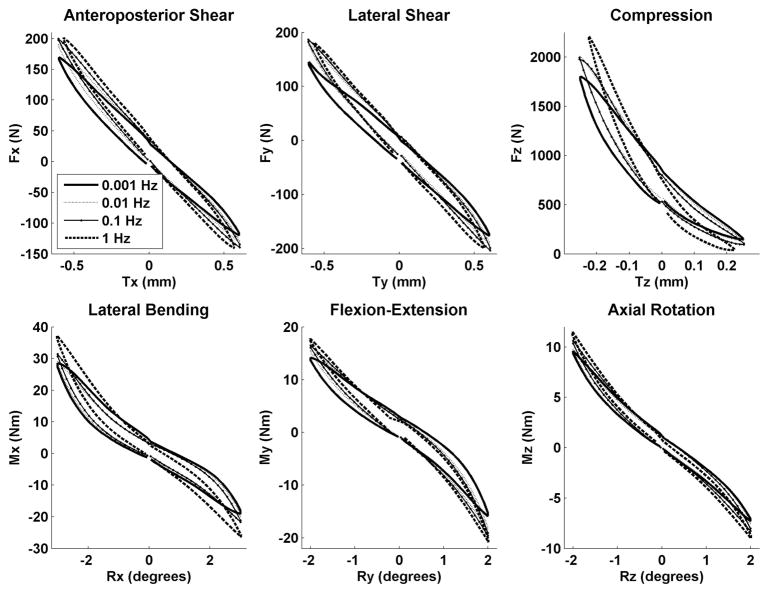
Vertebra-disc-vertebra preparations (N = 9) from human lumbar spines were subjected to each of 3 displacements and 3 rotations (6 degree of freedom) at each of 4 frequencies (0.001, 0.01, 0.1, and 1 Hz) after equilibration overnight under a 0.4 MPa preload in a bath of phosphate buffered saline at 37 degrees C with protease inhibitors. The forces and torques were recorded along with the applied translation or rotation. The stiffness (force/displacement or torque/rotation) and the phase angle (between each force and displacement) were calculated for each degree of freedom from recorded data.
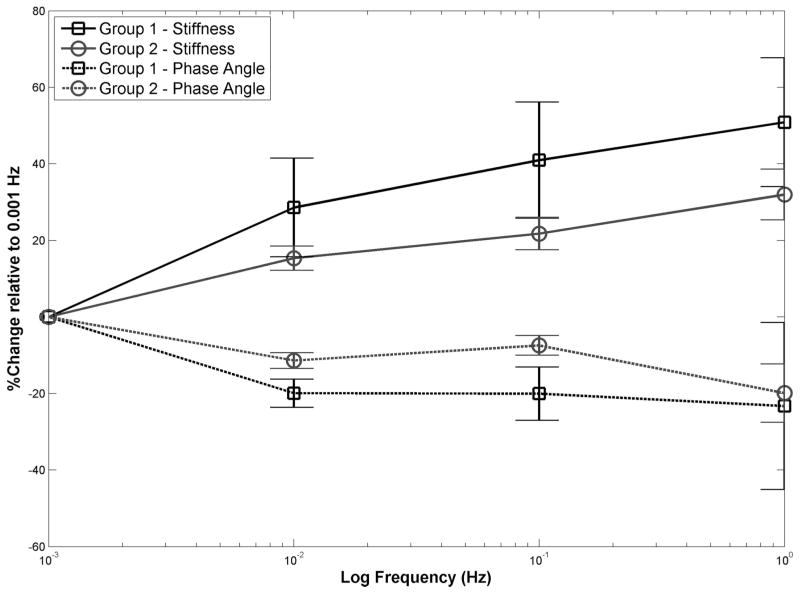
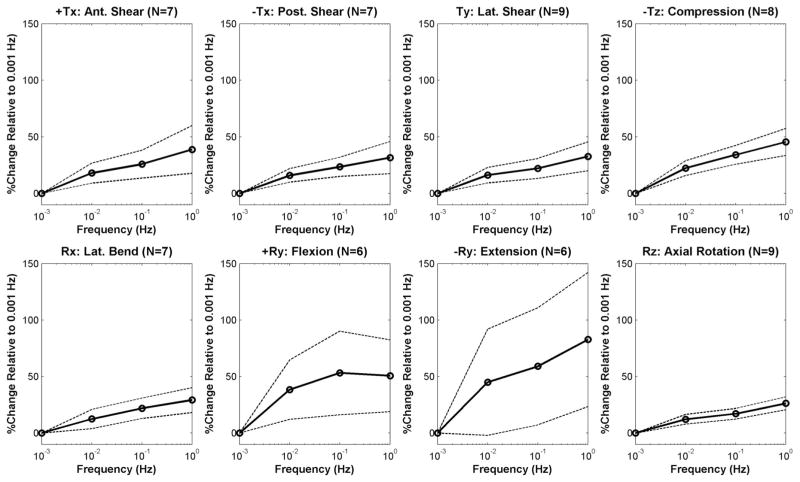
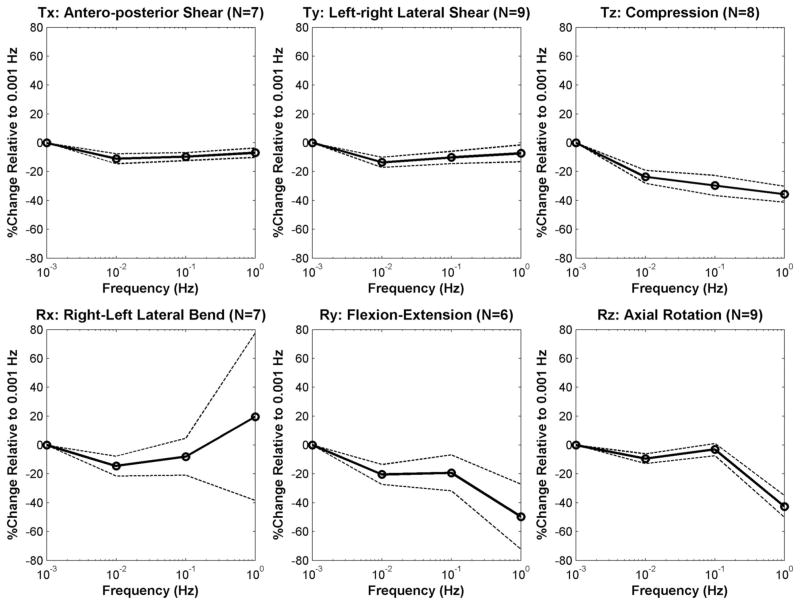
Disc stiffness increased linearly with the log-frequency. The increases over the four decades of frequency were 35%, 33%, and 26% for AP shear, lateral shear, and torsion respectively, and were 45%, 29%, 51%, and 83% for compression, lateral bending, flexion, and extension. The phase angle (a measure of energy absorption) averaged 6.2, 5.1, and 5.1 degrees in AP shear, lateral shear, and torsion, respectively, and 7.0, 7.0, and 8.6 degrees for compression, lateral bending, and flexion-extension. There were no consistent variations of phase angle with frequency.
The stiffness increase and phase angle decrease with frequency were greater for deformation modes in which fluid flow effects are thought to be greater.
对尸体材料进行无损位移控制动态测试,采用重复测量设计和随机测试顺序。
确定椎间盘刚度和载荷与位移之间相位角的频率依赖性变化在六个主要位移方向上是否存在差异,以及这些差异在与椎间盘内更大液体流动相关的变形方向上是否更大。
先前关于椎间盘时间依赖性行为的研究主要集中在压缩方面。比较不同的变形方向可以将液体流动的影响与固相粘弹性的影响区分开来。
从人类腰椎获取的椎骨 - 椎间盘 - 椎骨标本(N = 9)在含有蛋白酶抑制剂的37℃磷酸盐缓冲盐水浴中,在0.4 MPa预载荷下平衡过夜后,在4个频率(0.001、0.01、0.1和1 Hz)下分别进行3种位移和3种旋转(6个自由度)。记录力和扭矩以及施加的平移或旋转。根据记录数据计算每个自由度的刚度(力/位移或扭矩/旋转)和相位角(每个力与位移之间)。
椎间盘刚度随对数频率呈线性增加。在四个频率十年中,前后剪切、侧向剪切和扭转的增加分别为35%、33%和26%,压缩、侧弯、前屈和后伸的增加分别为45%、29%、51%和83%。相位角(能量吸收的度量)在前后剪切、侧向剪切和扭转中分别平均为6.2、5.1和5.1度,在压缩、侧弯和屈伸中分别为7.0、7.0和8.6度。相位角随频率没有一致的变化。
对于被认为液体流动效应更大的变形模式,刚度随频率的增加和相位角随频率的减小更大。