Akizawa Yoriko, Koizumi Sadayuki, Itokawa Yoshinori, Ojima Toshiyuki, Nakamura Yosikazu, Tamura Tarou, Kusaka Yukinori
Chiyoda Public Health Center, Tokyo, Japan.
J Epidemiol. 2008;18(4):151-9. doi: 10.2188/jea.je2007381. Epub 2008 Jul 18.
The vitamins and minerals that are deficient in the daily diet of a normal adult remain unknown. To answer this question, we conducted a population survey focusing on the relationship between dietary magnesium intake and serum magnesium level.
The subjects were 62 individuals from Fukui Prefecture who participated in the 1998 National Nutrition Survey. The survey investigated the physical status, nutritional status, and dietary data of the subjects. Holidays and special occasions were avoided, and a day when people are most likely to be on an ordinary diet was selected as the survey date.
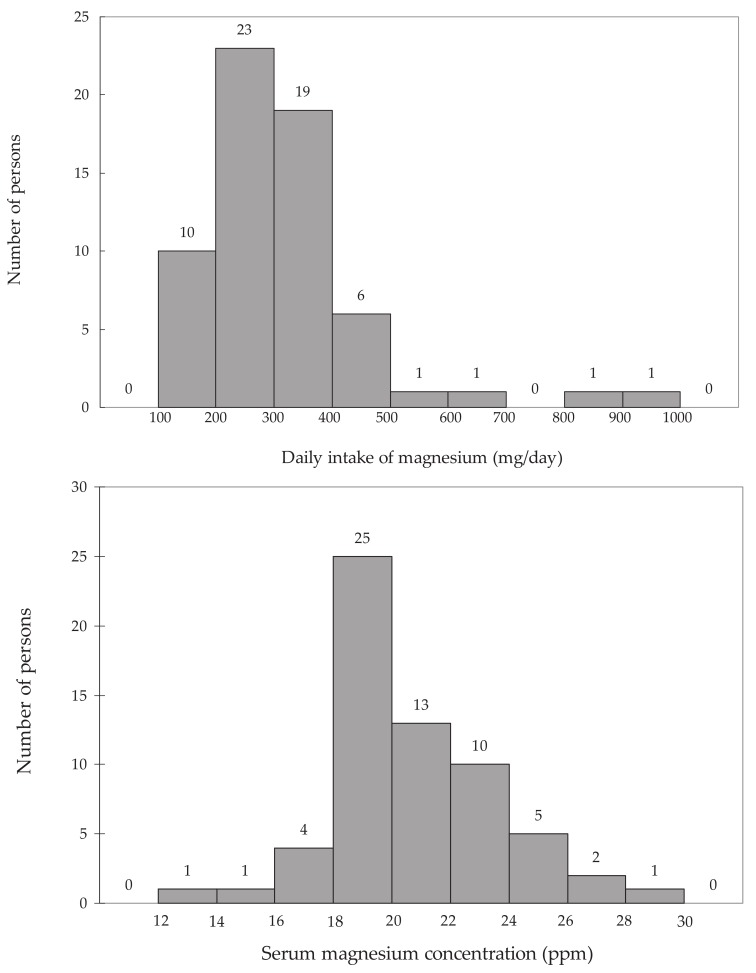
The mean (+/-standard deviation) daily magnesium intake was 322 (+/-132), 323 (+/-163), and 322 (+/-147) mg/day for men, women, and the entire group, respectively. The mean (+/-standard deviation) serum magnesium concentration was 20.69 (+/-2.83), 20.69 (+/-2.88), and 20.69 (+/-2.83) ppm for men, women, and the entire group, respectively. The distribution of serum magnesium concentration was normal. Dietary magnesium intake showed a log-normal distribution, which was then transformed by logarithmic conversion for examining the regression coefficients. The slope of the regression line between the serum magnesium concentration (Y ppm) and daily magnesium intake (X mg) was determined using the formula Y = 4.93 (log(10)X) + 8.49. The coefficient of correlation (r) was 0.29. A regression line (Y = 14.65X + 19.31) was observed between the daily intake of magnesium (Y mg) and serum magnesium concentration (X ppm). The coefficient of correlation was 0.28.
The daily magnesium intake correlated with serum magnesium concentration, and a linear regression model between them was proposed.
正常成年人日常饮食中缺乏哪些维生素和矿物质仍不清楚。为回答这个问题,我们进行了一项针对膳食镁摄入量与血清镁水平之间关系的人群调查。
研究对象为来自福井县参加1998年全国营养调查的62人。该调查对研究对象的身体状况、营养状况和饮食数据进行了调查。避开节假日和特殊场合,选择人们最可能正常饮食的一天作为调查日期。
男性、女性及全体研究对象的每日镁摄入量均值(±标准差)分别为322(±132)、323(±163)和322(±147)mg/天。男性、女性及全体研究对象的血清镁浓度均值(±标准差)分别为20.69(±2.83)、20.69(±2.88)和20.69(±2.83)ppm。血清镁浓度分布呈正态分布。膳食镁摄入量呈对数正态分布,为检验回归系数对其进行对数转换。血清镁浓度(Y ppm)与每日镁摄入量(X mg)之间的回归线斜率用公式Y =4.93(log₁₀X) + 8.49确定。相关系数(r)为0.29。观察到每日镁摄入量(Y mg)与血清镁浓度(X ppm)之间存在回归线(Y = 14.65X + 19.31)。相关系数为0.28。
每日镁摄入量与血清镁浓度相关,并提出了二者之间的线性回归模型。