Mabuchi Fumihiko, Sakurada Yoichi, Kashiwagi Kenji, Yamagata Zentaro, Iijima Hiroyuki, Tsukahara Shigeo
Department of Ophthalmology, University of Yamanashi, Yamanashi, Japan.
Mol Vis. 2008 Jul 14;14:1303-8.
To assess whether lysyl oxidase-like 1 (LOXL1) polymorphisms are associated with primary open-angle glaucoma (POAG) and exfoliation syndrome (XFS).
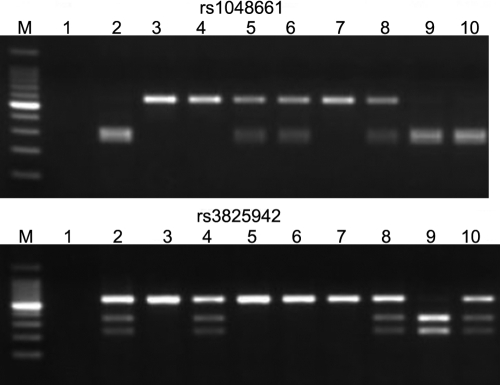
Japanese patients with POAG (n=213) or XFS (n=89) and 191 control subjects were analyzed for LOXL1 polymorphisms (rs1048661: 758G/T, Arg141Leu and rs3825942: 794G/A, Gly153Asp). Demographic and clinical features of POAG patients and control subjects were compared in terms of the TT/GG compound genotype of rs1048661 and rs3825942.
There was a significant difference in the genotype frequencies between XFS patients and control subjects (p<0.0001). Frequencies of the T allele of rs1048661 and the G allele of rs3825942 were significantly higher in XFS patients than in control subjects (rs1048661: 99.4% versus 55.0%; rs3825942: 99.4% versus 85.3%; p<0.0001). Except for one who had the TG/AG compound genotype, all XFS patients had the TT/GG compound genotype. An almost 250 fold increase in the risk of XFS (p<0.0001; odds ratio: 252.2; 95% confidence interval: 32.7 to more than 1000) was found in patients with the TT/GG compound genotype compared to those without the genotype. There were no significant differences in the genotype and allele frequencies between POAG patients and control subjects. Furthermore, no significant differences were noted in the demographic and clinical features of POAG patients as well as control subjects with and without the TT/GG high-risk compound genotype.
LOXL1 polymorphisms were associated with XFS. However, the frequencies of the polymorphisms differed between Japanese and Caucasian XFS patients. These polymorphisms had no influence on the phenotypic features of POAG patients.
评估赖氨酰氧化酶样1(LOXL1)基因多态性是否与原发性开角型青光眼(POAG)和剥脱综合征(XFS)相关。
对213例POAG日本患者、89例XFS日本患者以及191例对照者进行LOXL1基因多态性分析(rs1048661:758G/T,Arg141Leu和rs3825942:794G/A,Gly153Asp)。根据rs1048661和rs3825942的TT/GG复合基因型,比较POAG患者和对照者的人口统计学和临床特征。
XFS患者与对照者的基因型频率存在显著差异(p<0.0001)。rs1048661的T等位基因频率和rs3825942的G等位基因频率在XFS患者中显著高于对照者(rs1048661:99.4%对55.0%;rs3825942:99.4%对85.3%;p<0.0001)。除1例具有TG/AG复合基因型外,所有XFS患者均具有TT/GG复合基因型。与非TT/GG复合基因型患者相比,TT/GG复合基因型患者发生XFS的风险增加近250倍(p<0.0001;比值比:252.2;95%置信区间:32.7至超过1000)。POAG患者与对照者的基因型和等位基因频率无显著差异。此外,有无TT/GG高风险复合基因型的POAG患者和对照者的人口统计学和临床特征也无显著差异。
LOXL1基因多态性与XFS相关。然而,日本和白种人XFS患者的多态性频率有所不同。这些多态性对POAG患者的表型特征没有影响。