Karlsson Jenny, Pütsep Katrin, Chu Hiutung, Kays Robert J, Bevins Charles L, Andersson Mats
Department of Microbiology, Tumor and Cell Biology, Karolinska Institutet, Stockholm, Sweden.
BMC Immunol. 2008 Jul 17;9:37. doi: 10.1186/1471-2172-9-37.
Enteric antimicrobial peptides secreted from Paneth cells, including alpha-defensins (in mice named cryptdins), are key effector molecules of innate immunity in the small intestine. The importance of Paneth cells alpha-defensins emerged from studies of enteric bacterial infection in genetically modified mice, as well as from recent studies linking reduced levels of these alpha-defensins to Crohn's disease localized to the ileum. However, analysis of expression of Paneth cell alpha-defensins is incomplete. We therefore performed a comprehensive evaluation of the distribution of antimicrobial molecules along the mouse small intestinal tract to identify potential variations in regional expression.
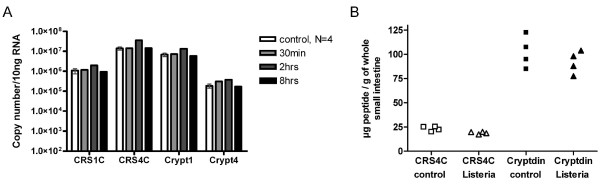
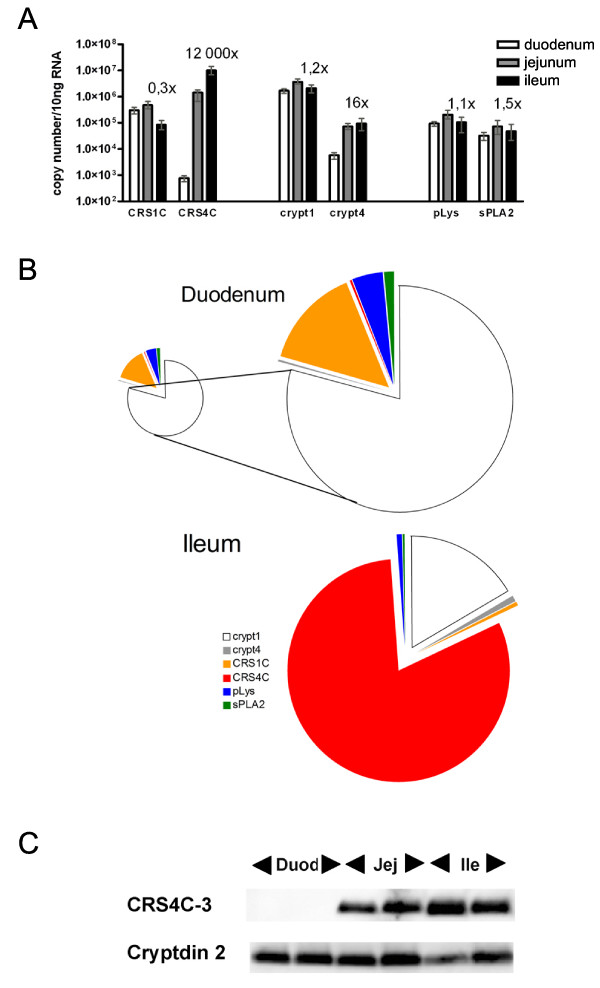
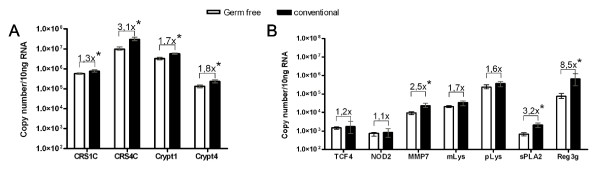
In conventionally reared mice, the repertoire of Paneth cell antimicrobials differs between duodenum and ileum. In contrast to the uniform expression of most Paneth cell antimicrobials, both cryptdin 4 and cryptdin-related sequences (CRS) 4C peptides were expressed at progressively increasing amounts (101- and 104-fold, respectively) comparing duodenum and ileum. In tissues other than the small intestine, expression of CRS peptides was noted in thymus and caecum. Most Paneth cell products were also produced in the small intestine of germ-free mice at levels similar to those in controls, however CRS4C and RegIIIgamma had reduced levels in the former (3- and 8-fold, respectively). No significant changes in expression levels of Paneth cell antimicrobial peptides was observed after oral challenge with either Salmonella enterica serovar typhimurium or Listeria monocytogenes, supporting current notions on the constitutive nature of this defensive system.
The repertoire of antimicrobial peptides changes along the small intestinal tract, and a subset of these molecules are up-regulated upon colonization, but not in response to enteric bacterial pathogens. The changes detected upon colonization suggest that Paneth cell antimicrobial peptides may play an important role in commensal microbial homeostasis, in addition to their proposed role in protection against infection. In addition, the differential expression of CRS4C along the small intestine suggests mechanisms of regulation that are distinct from other Paneth cell derived antimicrobial peptides.
潘氏细胞分泌的肠道抗菌肽,包括α-防御素(在小鼠中称为隐窝素),是小肠固有免疫的关键效应分子。潘氏细胞α-防御素的重要性源于对转基因小鼠肠道细菌感染的研究,以及最近将这些α-防御素水平降低与局限于回肠的克罗恩病联系起来的研究。然而,对潘氏细胞α-防御素表达的分析并不完整。因此,我们对小鼠小肠中抗菌分子的分布进行了全面评估,以确定区域表达的潜在差异。
在常规饲养的小鼠中,十二指肠和回肠中潘氏细胞抗菌物质的组成不同。与大多数潘氏细胞抗菌物质的均匀表达不同,与十二指肠和回肠相比,隐窝素4和隐窝素相关序列(CRS)4C肽的表达量逐渐增加(分别为101倍和104倍)。在小肠以外的组织中,在胸腺和盲肠中发现了CRS肽的表达。大多数潘氏细胞产物在无菌小鼠的小肠中也有产生,其水平与对照组相似,然而CRS4C和RegIIIγ在前者中的水平降低(分别为3倍和8倍)。用鼠伤寒沙门氏菌或单核细胞增生李斯特菌进行口服攻击后,未观察到潘氏细胞抗菌肽表达水平的显著变化,这支持了关于该防御系统组成性质的当前观点。
抗菌肽的组成沿小肠发生变化,这些分子中的一部分在定殖时上调,但不是对肠道细菌病原体的反应。定殖时检测到的变化表明,潘氏细胞抗菌肽除了在预防感染中发挥作用外可能在共生微生物稳态中起重要作用。此外,CRS4C在小肠中的差异表达表明其调节机制与其他潘氏细胞衍生的抗菌肽不同。