Oberlander Tim F, Grunau Ruth, Mayes Linda, Riggs Wayne, Rurak Dan, Papsdorf Michael, Misri Shaila, Weinberg Joanne
Department of Pediatrics, UBC, Vancouver, BC, Canada V6H 3V4.
Early Hum Dev. 2008 Oct;84(10):689-97. doi: 10.1016/j.earlhumdev.2008.06.008. Epub 2008 Jul 18.
Prenatal exposure to stress and selective serotonin reuptake inhibitors (SSRIs) alter hypothalamic-pituitary-adrenal (HPA) stress reactivity in offspring, however, the effects of combined exposure to HPA activity in human infants is unknown.
To examine HPA basal levels and stress responsiveness in 3-month olds with prenatal exposure to SSRIs.
Salivary cortisol levels in infants of SSRI treated mothers (n=31, mean exposure 230.2+/-72.2 days) were compared with non-SSRI exposed (n=45) infants in response to a challenge (infant-controlled habituation task) and under basal conditions in the late afternoon/early evening. Mode of feeding, to account for possible postnatal drug exposure via breast milk, as well as measures of pre and postnatal maternal mood, were included as covariates.
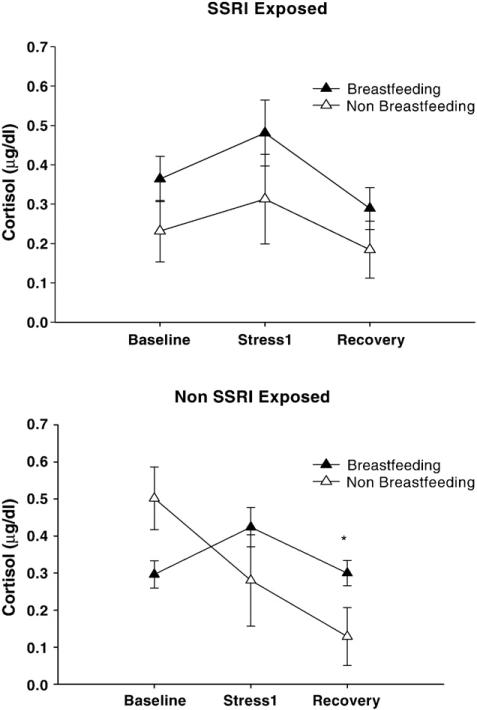
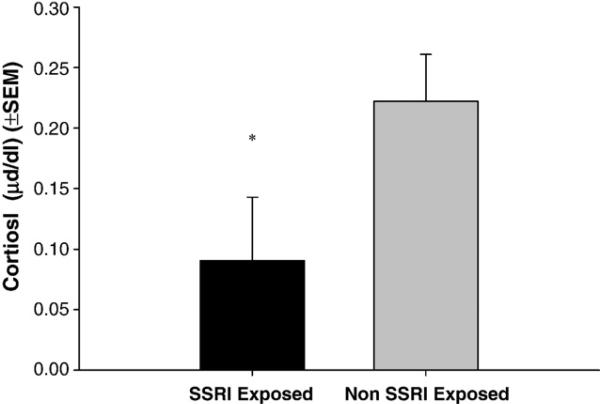
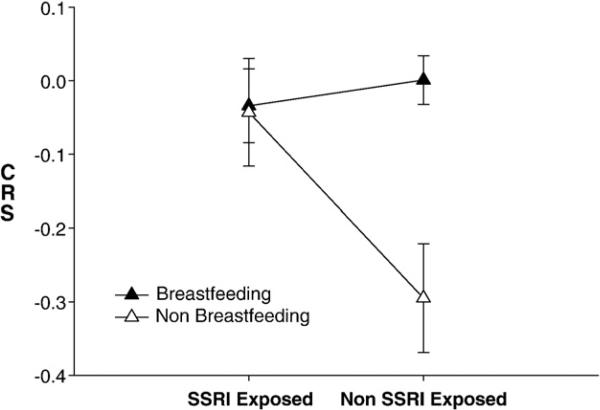
Lower post-stress cortisol levels were observed in non-SSRI exposed/non-breastfed infants compared with non-SSRI exposed infants who were breastfed at 3 months of age. Stress reactivity patterns among SSRI exposed infants did not differ with mode of feeding. The cortisol reactivity slope (CRS) was significantly lower among non-SSRI exposed non-breastfed infants compared with non-SSRI exposed breastfed infants. Early evening basal cortisol levels were lower in SSRI exposed infants than in non-SSRI exposed infants, controlling for maternal mood and mode of feeding. Postnatal SSRI exposure (infant SSRI drug levels) via breast milk was not associated with stress or basal cortisol levels. Total cortisol, reflected by the AUC measure, did not differ significantly between exposure groups.
Prenatal SSRI exposure altered HPA stress response patterns and reduced early evening basal cortisol levels. Stress challenge HPA response differences only became apparent when the moderating effect of method of feeding was accounted for. These findings suggest an early "programming" effect of antenatal maternal mood, prenatal SSRI exposure and postnatal maternal care giving on the HPA system.
产前暴露于应激和选择性5-羟色胺再摄取抑制剂(SSRI)会改变后代下丘脑-垂体-肾上腺(HPA)应激反应性,然而,人类婴儿联合暴露对HPA活性的影响尚不清楚。
研究产前暴露于SSRI的3个月大婴儿的HPA基础水平和应激反应性。
将接受SSRI治疗母亲的婴儿(n = 31,平均暴露230.2±72.2天)与未暴露于SSRI的婴儿(n = 45)在应对挑战(婴儿控制的习惯化任务)时以及傍晚/傍晚早期的基础条件下的唾液皮质醇水平进行比较。纳入喂养方式(以解释可能通过母乳进行的产后药物暴露)以及产前和产后母亲情绪测量作为协变量。
与3个月大时进行母乳喂养的未暴露于SSRI的婴儿相比,未暴露于SSRI/未进行母乳喂养的婴儿在应激后皮质醇水平较低。暴露于SSRI的婴儿中的应激反应模式与喂养方式无关。与未暴露于SSRI的母乳喂养婴儿相比,未暴露于SSRI的未进行母乳喂养婴儿的皮质醇反应斜率(CRS)显著更低。在控制母亲情绪和喂养方式后,暴露于SSRI的婴儿傍晚早期基础皮质醇水平低于未暴露于SSRI的婴儿。通过母乳进行的产后SSRI暴露(婴儿SSRI药物水平)与应激或基础皮质醇水平无关。暴露组之间由曲线下面积测量反映的总皮质醇没有显著差异。
产前SSRI暴露改变了HPA应激反应模式并降低了傍晚早期基础皮质醇水平。只有在考虑喂养方式的调节作用时,应激挑战HPA反应差异才变得明显。这些发现表明产前母亲情绪、产前SSRI暴露和产后母亲护理对HPA系统有早期“编程”作用。