Giesbrecht Gerald F, Ejaredar Maede, Liu Jiaying, Thomas Jenna, Letourneau Nicole, Campbell Tavis, Martin Jonathan W, Dewey Deborah
Department of Paediatrics, University of Calgary, 2500 University Drive, Calgary, AB, T2N 1N4, Canada.
Department of Community Health Sciences, University of Calgary, Calgary, AB, Canada.
Environ Health. 2017 May 19;16(1):47. doi: 10.1186/s12940-017-0259-8.
Animal models show that prenatal bisphenol A (BPA) exposure leads to sexually dimorphic disruption of the neuroendocrine system in offspring, including the hypothalamic-pituitary-adrenal (HPA) neuroendocrine system, but human data are lacking. In humans, prenatal BPA exposure is associated with sex-specific behavioural problems in children, and HPA axis dysregulation may be a biological mechanism. The objective of the current study was to examine sex differences in associations between prenatal maternal urinary BPA concentration and HPA axis function in 3 month old infants.
Mother-infant pairs (n = 132) were part of the Alberta Pregnancy Outcomes and Nutrition study, a longitudinal birth cohort recruited (2010-2012) during pregnancy. Maternal spot urine samples collected during the 2nd trimester were analyzed for total BPA and creatinine. Infant saliva samples collected prior to and after a blood draw were analyzed for cortisol. Linear growth curve models were used to characterize changes in infant cortisol as a function of prenatal BPA exposure.
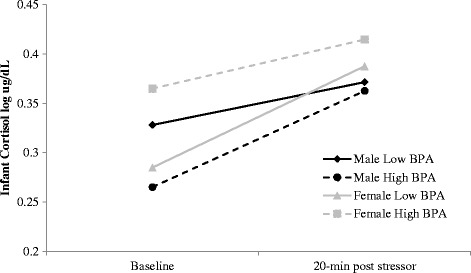
Higher maternal BPA was associated with increases in baseline cortisol among females (β = 0.13 log μg/dL; 95% CI: 0.01, 0.26), but decreases among males (β = -0.22 log μg/dL; 95% CI: -0.39, -0.05). In contrast, higher BPA was associated with increased reactivity in males (β = .30 log μg/dL; 95% CI: 0.04, 0.56) but decreased reactivity in females (β = -0.15 log μg/dL; 95% CI: -0.35, 0.05). Models adjusting for creatinine yielded similar results.
Prenatal BPA exposure is associated with sex-specific changes in infant HPA axis function. The biological plausibility of these findings is supported by their consistency with evidence in rodent models. Furthermore, these data support the hypotheses that sexually dimorphic changes in children's behaviour following prenatal BPA exposure are mediated by sexually dimorphic changes in HPA axis function.
动物模型显示,孕期双酚A(BPA)暴露会导致后代神经内分泌系统出现性别差异的破坏,包括下丘脑-垂体-肾上腺(HPA)神经内分泌系统,但缺乏人类数据。在人类中,孕期BPA暴露与儿童特定性别的行为问题有关,HPA轴功能失调可能是一种生物学机制。本研究的目的是探讨3个月大婴儿的产前母体尿BPA浓度与HPA轴功能之间关联的性别差异。
母婴对(n = 132)是艾伯塔省妊娠结局与营养研究的一部分,这是一个在孕期招募(2010 - 2012年)的纵向出生队列。分析孕中期收集的母体随机尿样中的总BPA和肌酐。分析采血前后收集的婴儿唾液样本中的皮质醇。使用线性生长曲线模型来描述婴儿皮质醇随产前BPA暴露的变化。
母体BPA水平较高与女性基线皮质醇升高有关(β = 0.13 log μg/dL;95% CI:0.01,0.26),但与男性基线皮质醇降低有关(β = -0.22 log μg/dL;95% CI:-0.39,-0.05)。相比之下,较高的BPA与男性反应性增加有关(β = 0.30 log μg/dL;95% CI:0.04,0.56),但与女性反应性降低有关(β = -0.15 log μg/dL;95% CI:-0.35,0.05)。调整肌酐后的模型得出了类似的结果。
产前BPA暴露与婴儿HPA轴功能的性别特异性变化有关。这些发现的生物学合理性得到了与啮齿动物模型证据一致性的支持。此外,这些数据支持以下假设:产前BPA暴露后儿童行为的性别差异变化是由HPA轴功能的性别差异变化介导的。