Gu Peili, Reid Jeffrey G, Gao Xiaolian, Shaw Chad A, Creighton Chad, Tran Peter L, Zhou Xiaochuan, Drabek Rafal B, Steffen David L, Hoang David M, Weiss Michelle K, Naghavi Arash O, El-daye Jad, Khan Mahjabeen F, Legge Glen B, Wheeler David A, Gibbs Richard A, Miller Jonathan N, Cooney Austin J, Gunaratne Preethi H
Department of Molecular & Cellular Biology, Baylor College of Medicine, Houston, Texas, United States of America.
PLoS One. 2008 Jul 2;3(7):e2548. doi: 10.1371/journal.pone.0002548.
MicroRNAS (miRNAS: a class of short non-coding RNAs) are emerging as important agents of post transcriptional gene regulation and integral components of gene networks. MiRNAs have been strongly linked to stem cells, which have a remarkable dual role in development. They can either continuously replenish themselves (self-renewal), or differentiate into cells that execute a limited number of specific actions (pluripotence).
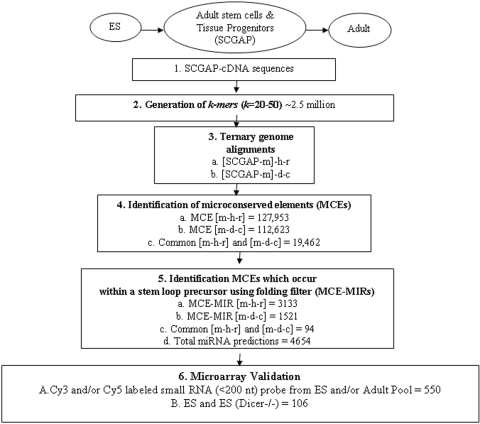
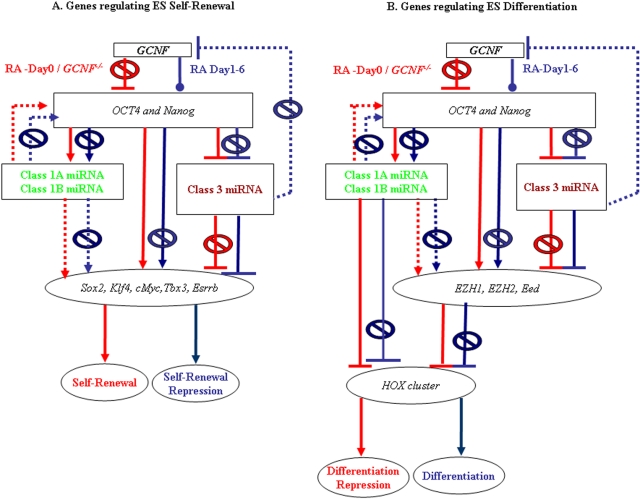
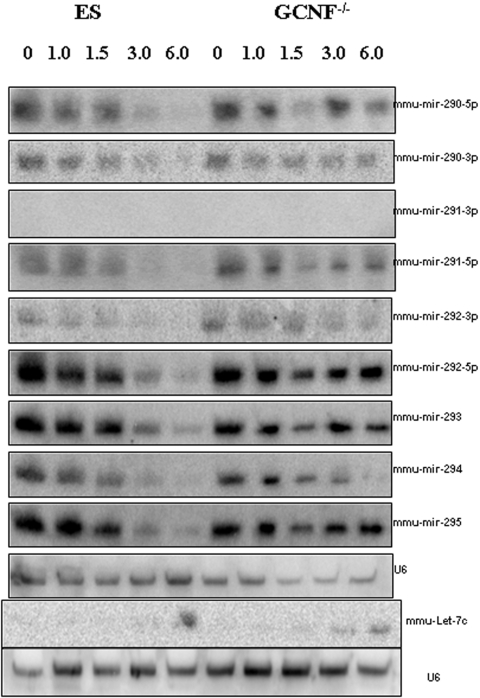
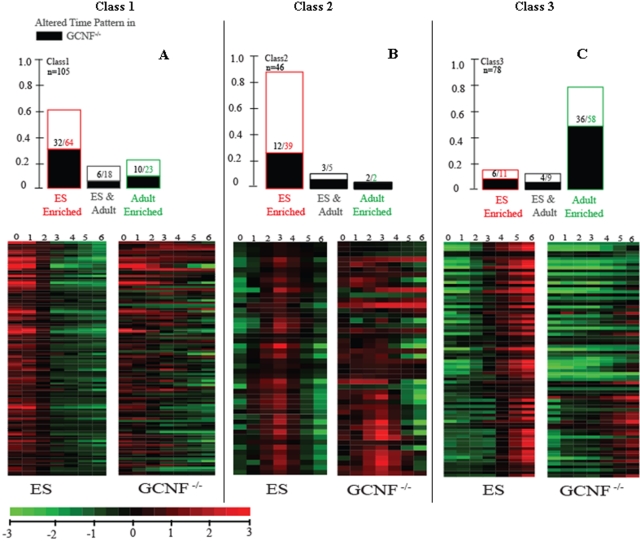
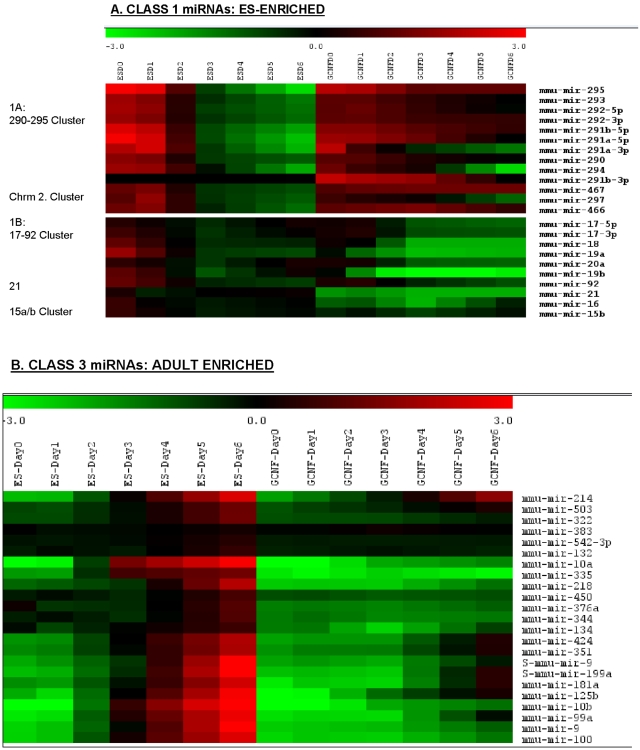
METHODOLOGY/PRINCIPAL FINDINGS: In order to identify novel miRNAs from narrow windows of development we carried out an in silico search for micro-conserved elements (MCE) in adult tissue progenitor transcript sequences. A plethora of previously unknown miRNA candidates were revealed including 545 small RNAs that are enriched in embryonic stem (ES) cells over adult cells. Approximately 20% of these novel candidates are down-regulated in ES (Dicer(-/-)) ES cells that are impaired in miRNA maturation. The ES-enriched miRNA candidates exhibit distinct and opposite expression trends from mmu-mirs (an abundant class in adult tissues) during retinoic acid (RA)-induced ES cell differentiation. Significant perturbation of trends is found in both miRNAs and novel candidates in ES (GCNF(-/-)) cells, which display loss of repression of pluripotence genes upon differentiation.
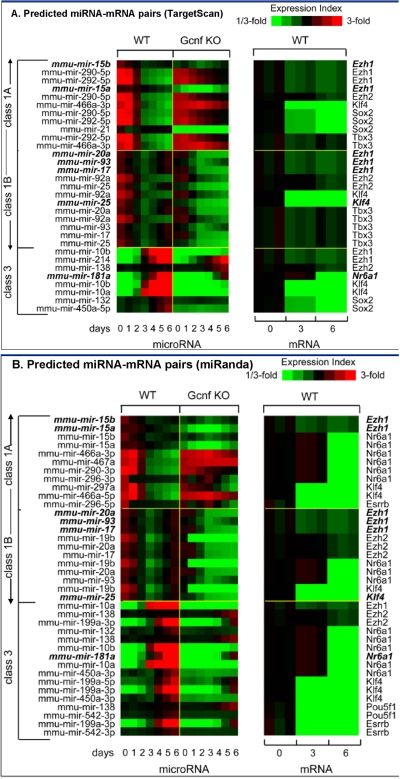
CONCLUSION/SIGNIFICANCE: Combining expression profile information with miRNA target prediction, we identified miRNA-mRNA pairs that correlate with ES cell pluripotence and differentiation. Perturbation of these pairs in the ES (GCNF(-/-)) mutant suggests a role for miRNAs in the core regulatory networks underlying ES cell self-renewal, pluripotence and differentiation.
微小RNA(miRNA:一类短的非编码RNA)正成为转录后基因调控的重要因子以及基因网络的组成部分。miRNA与干细胞密切相关,干细胞在发育过程中具有显著的双重作用。它们既可以不断自我更新,也可以分化为执行有限数量特定功能的细胞(多能性)。
方法/主要发现:为了从狭窄的发育阶段中鉴定新的miRNA,我们对成年组织祖细胞转录本序列进行了计算机模拟搜索,以寻找微保守元件(MCE)。结果发现了大量此前未知的miRNA候选物,包括545种在胚胎干细胞(ES)中比成年细胞中更丰富的小RNA。这些新候选物中约20%在miRNA成熟受损的ES(Dicer(-/-))ES细胞中表达下调。在视黄酸(RA)诱导的ES细胞分化过程中,富含ES的miRNA候选物表现出与mmu - mirs(成年组织中丰富的一类)不同且相反的表达趋势。在ES(GCNF(-/-))细胞中,miRNA和新候选物的表达趋势均出现显著扰动,这些细胞在分化时表现出多能性基因抑制的丧失。
结论/意义:结合表达谱信息与miRNA靶标预测,我们鉴定出了与ES细胞多能性和分化相关的miRNA - mRNA对。在ES(GCNF(-/-))突变体中这些对的扰动表明miRNA在ES细胞自我更新、多能性和分化的核心调控网络中发挥作用。