Lünemann Jan D, Jelcić Ilijas, Roberts Susanne, Lutterotti Andreas, Tackenberg Björn, Martin Roland, Münz Christian
Laboratory of Viral Immunobiology, Christopher H. Browne Center for Immunology and Immune Diseases, The Rockefeller University, New York, NY 10065, USA.
J Exp Med. 2008 Aug 4;205(8):1763-73. doi: 10.1084/jem.20072397. Epub 2008 Jul 28.
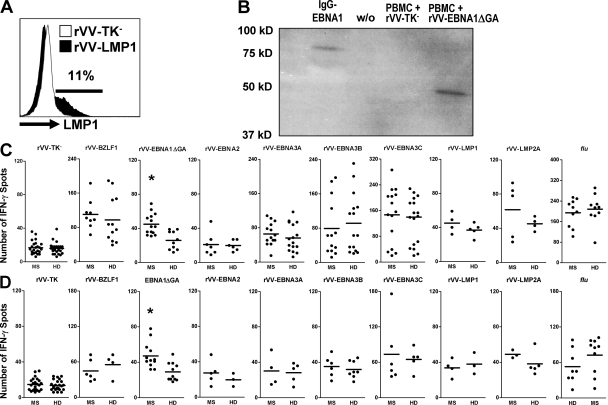
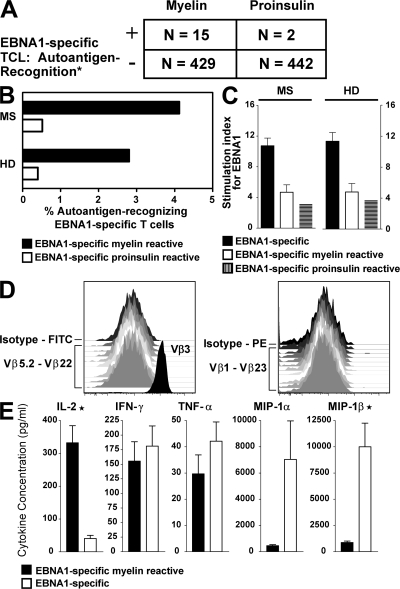
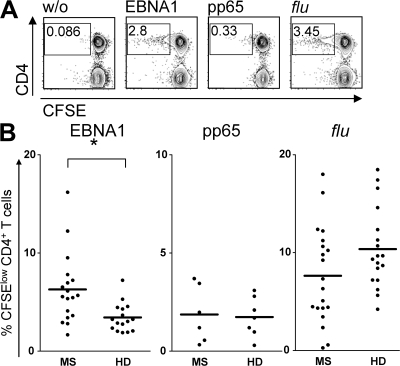
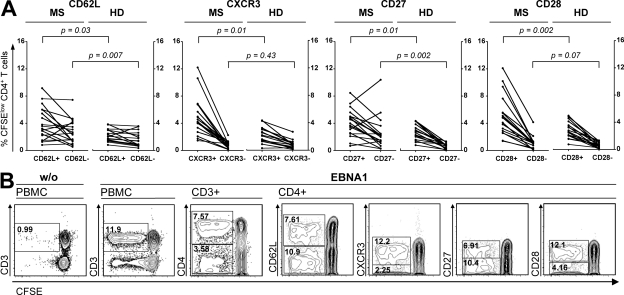
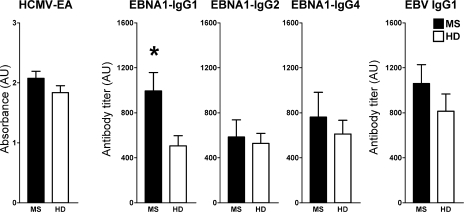
Symptomatic primary Epstein-Barr virus (EBV) infection and elevated humoral immune responses to EBV are associated with an increased risk of developing multiple sclerosis (MS). We explored mechanisms leading to this change in EBV-specific immunity in untreated patients with MS and healthy virus carriers matched for MS-associated HLA alleles. MS patients showed selective increase of T cell responses to the EBV nuclear antigen 1 (EBNA1), the most consistently recognized EBV-derived CD4(+) T cell antigen in healthy virus carriers, but not to other EBV-encoded proteins. In contrast, influenza and human cytomegalovirus-specific immune control was unchanged in MS. The enhanced response to EBNA1 was mediated by an expanded reservoir of EBNA1-specific central memory CD4(+) T helper 1 (Th1) precursors and Th1 (but not Th17) polarized effector memory cells. In addition, EBNA1-specific T cells recognized myelin antigens more frequently than other autoantigens that are not associated with MS. Myelin cross-reactive T cells produced IFN-gamma, but differed from EBNA1-monospecific cells in their capability to produce interleukin-2, indicative of a polyfunctional phenotype as found in controlled chronic viral infections. Our data support the concept that clonally expanded EBNA1-specific CD4(+) T cells potentially contribute to the development of MS by cross-recognition of myelin antigens.
有症状的原发性爱泼斯坦-巴尔病毒(EBV)感染以及对EBV的体液免疫反应增强与多发性硬化症(MS)发病风险增加相关。我们探讨了未经治疗的MS患者和与MS相关HLA等位基因匹配的健康病毒携带者中EBV特异性免疫发生这种变化的机制。MS患者对EBV核抗原1(EBNA1)的T细胞反应选择性增加,EBNA1是健康病毒携带者中最常被识别的EBV衍生的CD4(+) T细胞抗原,但对其他EBV编码蛋白的反应未增加。相比之下,MS患者对流感和人巨细胞病毒的特异性免疫控制未发生改变。对EBNA1反应增强是由EBNA1特异性中枢记忆CD4(+) T辅助细胞1(Th1)前体和Th1(而非Th17)极化效应记忆细胞库的扩大介导的。此外,EBNA1特异性T细胞比其他与MS无关的自身抗原更频繁地识别髓鞘抗原。髓鞘交叉反应性T细胞产生干扰素-γ,但在产生白细胞介素-2的能力方面与EBNA1单特异性细胞不同,这表明其具有在受控慢性病毒感染中发现的多功能表型。我们的数据支持这样的概念,即克隆扩增的EBNA1特异性CD4(+) T细胞可能通过对髓鞘抗原的交叉识别促进MS的发展。