Urbanucci Alfonso, Waltering Kati K, Suikki Hanna E, Helenius Merja A, Visakorpi Tapio
Institute of Medical Technology, University of Tampere and Tampere University Hospital, FI-33014 University of Tampere, Tampere, Finland.
BMC Cancer. 2008 Aug 1;8:219. doi: 10.1186/1471-2407-8-219.
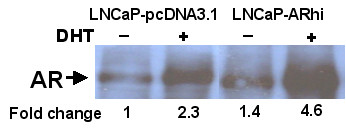
The critical role of the androgen receptor (AR) in the development of prostate cancer is well recognized. The transcriptional activity of AR is partly regulated by coregulatory proteins. It has been suggested that these coregulators could also be important in the progression of prostate cancer. The aim of this study was to identify coregulators whose expression is regulated by either the androgens and/or by the expression level of AR.
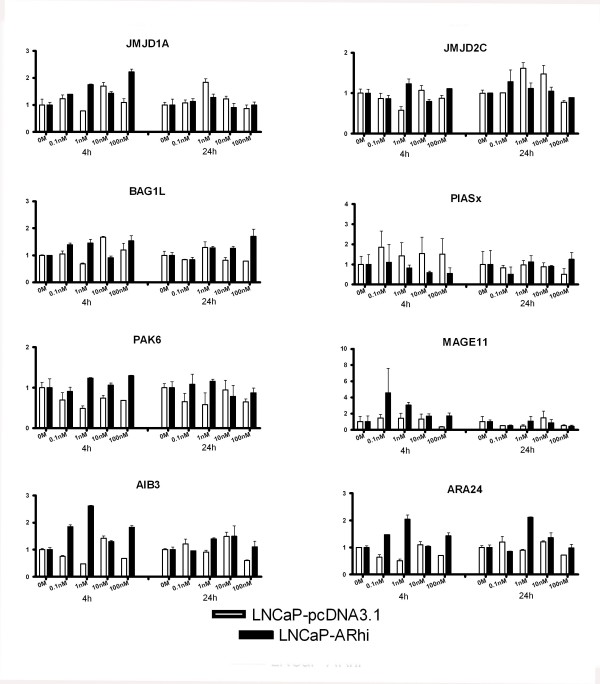
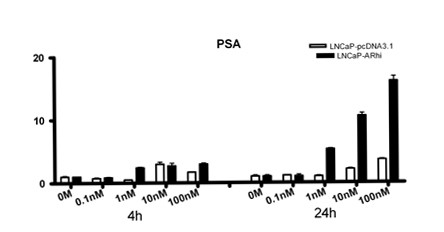
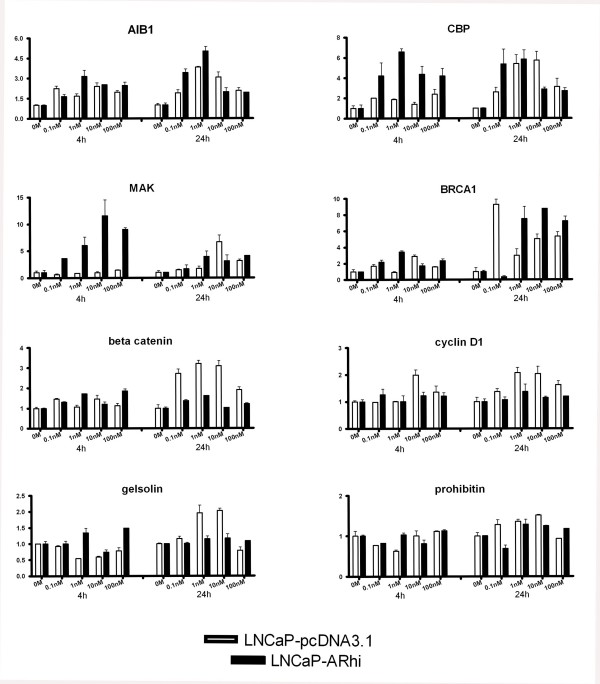
We used empty vector and AR cDNA-transfected LNCaP cells (LNCaP-pcDNA3.1, and LNCaP-ARhi, respectively), and grew them for 4 and 24 hours in the presence of dihydrotestosterone (DHT) at various concentrations. The expression of 25 AR coregulators (SRC1, TIF2, PIAS1, PIASx, ARIP4, BRCA1, beta-catenin, AIB3, AIB1, CBP, STAT1, NCoR1, AES, cyclin D1, p300, ARA24, LSD1, BAG1L, gelsolin, prohibitin, JMJD2C, JMJD1A, MAK, PAK6 and MAGE11) was then measured by using real-time quantitative RT-PCR (Q-RT-PCR).
Five of the coregulators (AIB1, CBP, MAK, BRCA1 and beta-catenin) showed more than 2-fold induction and 5 others (cyclin D1, gelsolin, prohibitin, JMJD1A, and JMJD2C) less than 2-fold induction. Overexpression of AR did not affect the expression of the coregulators alone. However, overexpression of AR enhanced the DHT-stimulated expression of MAK, BRCA1, AIB1 and CBP and reduced the level of expression of beta-catenin, cyclinD1 and gelsolin.
In conclusion, we identified 5 coactivators whose expression was induced by androgens suggesting that they could potentiate AR signaling. Overexpression of AR seems to sensitize cells for low levels of androgens.
雄激素受体(AR)在前列腺癌发生发展中的关键作用已得到充分认识。AR的转录活性部分受共调节蛋白调控。有人提出这些共调节因子在前列腺癌进展中也可能起重要作用。本研究的目的是鉴定其表达受雄激素和/或AR表达水平调控的共调节因子。
我们使用空载体和AR cDNA转染的LNCaP细胞(分别为LNCaP-pcDNA3.1和LNCaP-ARhi),并在不同浓度的二氢睾酮(DHT)存在下培养4小时和24小时。然后使用实时定量RT-PCR(Q-RT-PCR)检测25种AR共调节因子(SRC1、TIF2、PIAS1、PIASx、ARIP4、BRCA1、β-连环蛋白、AIB3、AIB1、CBP、STAT1、NCoR1、AES、细胞周期蛋白D1、p300、ARA24、LSD1、BAG1L、凝溶胶蛋白、抑制素、JMJD2C、JMJD1A、MAK、PAK6和MAGE11)的表达。
5种共调节因子(AIB1、CBP、MAK、BRCA1和β-连环蛋白)显示出超过2倍的诱导,另外5种(细胞周期蛋白D1、凝溶胶蛋白、抑制素、JMJD1A和JMJD2C)诱导倍数小于2倍。AR的过表达单独不影响共调节因子的表达。然而,AR的过表达增强了DHT刺激的MAK、BRCA1、AIB1和CBP的表达,并降低了β-连环蛋白、细胞周期蛋白D1和凝溶胶蛋白的表达水平。
总之,我们鉴定出5种共激活因子,其表达受雄激素诱导,提示它们可能增强AR信号传导。AR的过表达似乎使细胞对低水平雄激素敏感。