Dib Chadi, Prasad Abhiram, Friedman Paul A, Ahmad Elesber, Rihal Charanjit S, Hammill Stephen C, Asirvatham Samuel J
Division of Cardiovascular Diseases, Department of Internal Medicine, Mayo Clinic,Rochester, Minnesota, USA.
Indian Pacing Electrophysiol J. 2008 Aug 1;8(3):182-92.
We sought to determine the frequency and outcomes with symptomatic arrhythmia in patients with apical ballooning syndrome (ABS).
A retrospective review of the Mayo Clinic Angiography database was conducted to identify patients who met the Mayo criteria for ABS. Patients with documented arrhythmias formed the study group, and 31 randomly selected patients with ABS but without arrhythmia formed the control group.
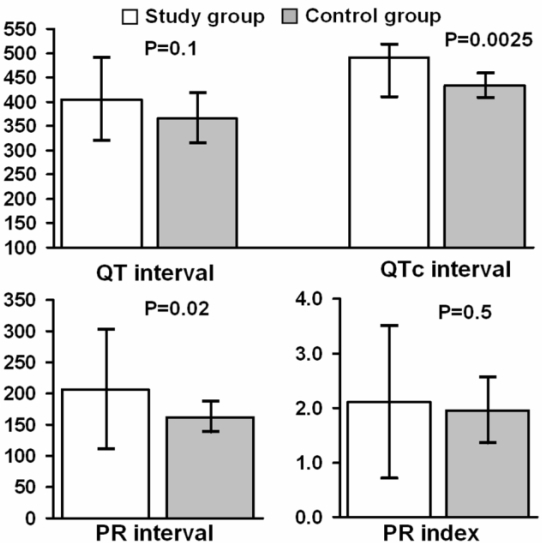
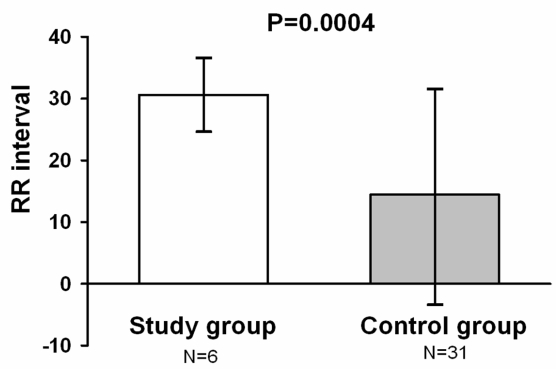
Out of 105 patients identified with ABS, 6 (5.7%) women aged 69 +/- 9 years experienced significant arrhythmia (ventricular fibrillation, asystole), 2 patients died, and 1 required permanent pacemaker implantation. When compared with controls, the study group showed no significant difference with respect to ECG characteristics (QT, QRS duration or axis) except for R-R interval variability (see comments below) (30.6+/-6 vs 14.5+/-17 p = 0.0004), QTc, and P-R interval. Patients without arrhythmia were more likely to be on beta-blocker therapy than the study population (33% vs 80.6% p = 0.02).
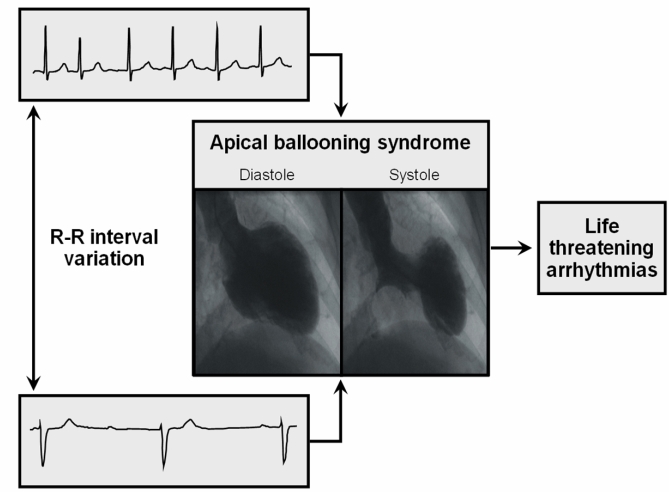
Life-threatening arrhythmia is uncommon (5.7%) with ABS despite marked, structural abnormalities. When arrhythmias do occur, the outcome is poor. Prominent variability in R-R intervals appears to be predictive of significant arrhythmias in ABS. The role of beta-blocker therapy in preventing arrhythmia with ABS requires further investigation.
我们试图确定心尖气球样综合征(ABS)患者出现症状性心律失常的频率及预后情况。
对梅奥诊所血管造影数据库进行回顾性研究,以确定符合梅奥ABS标准的患者。有记录心律失常的患者组成研究组,31名随机选择的无心律失常的ABS患者组成对照组。
在105例确诊为ABS的患者中,6例(5.7%)69±9岁的女性出现严重心律失常(室颤、心搏停止),2例死亡,1例需要植入永久性起搏器。与对照组相比,研究组在心电图特征(QT、QRS时限或电轴)方面无显著差异,但在R-R间期变异性(见下文注释)(30.6±6对14.5±17,p = 0.0004)、QTc及P-R间期方面存在差异。无心律失常的患者比研究人群更可能接受β受体阻滞剂治疗(33%对80.6%,p = 0.02)。
尽管存在明显的结构异常,但危及生命的心律失常在ABS患者中并不常见(5.7%)。当心律失常确实发生时,预后较差。R-R间期的显著变异性似乎可预测ABS患者的严重心律失常。β受体阻滞剂治疗在预防ABS患者心律失常方面的作用需要进一步研究。