Voss Martin, Ingram James N, Wolpert Daniel M, Haggard Patrick
Sobell Department of Motor Neuroscience, Institute of Neurology, London, United Kingdom.
PLoS One. 2008 Aug 6;3(8):e2866. doi: 10.1371/journal.pone.0002866.
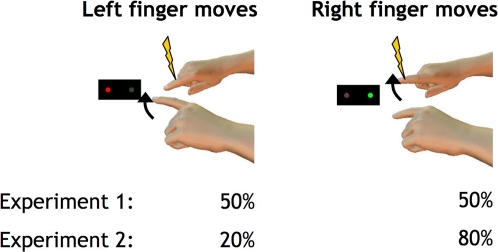
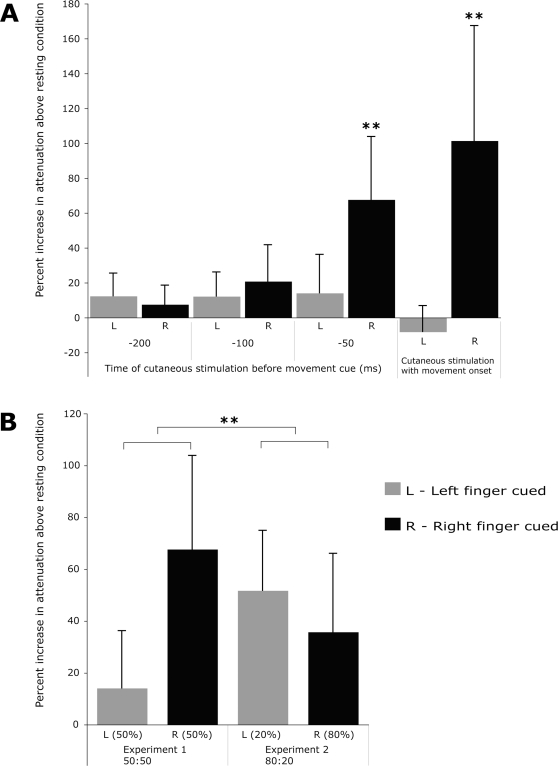
When a part of the body moves, the sensation evoked by a probe stimulus to that body part is attenuated. Two mechanisms have been proposed to explain this robust and general effect. First, feedforward motor signals may modulate activity evoked by incoming sensory signals. Second, reafferent sensation from body movements may mask the stimulus. Here we delivered probe stimuli to the right index finger just before a cue which instructed subjects to make left or right index finger movements. When left and right cues were equiprobable, we found attenuation for stimuli to the right index finger just before this finger was cued (and subsequently moved). However, there was no attenuation in the right finger just before the left finger was cued. This result suggests that the movement made in response to the cue caused 'postdictive' attenuation of a sensation occurring prior to the cue. In a second experiment, the right cue was more frequent than the left. We now found attenuation in the right index finger even when the left finger was cued and moved. This attenuation linked to a movement that was likely but did not in fact occur, suggests a new expectation-based mechanism, distinct from both feedforward motor signals and postdiction. Our results suggest a new mechanism in motor-sensory interactions in which the motor system tunes the sensory inputs based on expectations about future possible actions that may not, in fact, be implemented.
当身体的某一部分移动时,对该身体部位进行探测刺激所诱发的感觉会减弱。人们提出了两种机制来解释这种强大而普遍的效应。第一,前馈运动信号可能会调节传入感觉信号所诱发的活动。第二,身体运动产生的再传入感觉可能会掩盖刺激。在这里,我们在提示受试者进行左手或右手食指运动的提示之前,将探测刺激施加到右手食指上。当左右提示的可能性相等时,我们发现在提示(随后移动)右手食指之前,对该手指的刺激会减弱。然而,在提示左手食指之前,右手并没有减弱。这一结果表明,对提示做出的反应所产生的运动导致了在提示之前出现的感觉的“后预测性”减弱。在第二个实验中,右手提示比左手提示更频繁。现在我们发现,即使提示并移动左手食指,右手食指也会出现减弱。这种与可能但实际上并未发生的运动相关的减弱,提示了一种新的基于预期的机制,这与前馈运动信号和后预测都不同。我们的结果提示了运动-感觉相互作用中的一种新机制,即运动系统根据对未来可能不会实际实施的动作的预期来调整感觉输入。