Buschmann A, Jooss B, Rupp A, Feldhusen F, Pietz J, Philippi H
Department of Paediatric Neurology, Children's Hospital, University of Heidelberg, Im Neuenheimer Feld 150, D-69120 Heidelberg, Germany.
Arch Dis Child. 2009 Feb;94(2):110-6. doi: 10.1136/adc.2008.141572. Epub 2008 Aug 14.
The aim of this randomised controlled trial was to evaluate the effectiveness of a short, highly structured parent based language intervention group programme for 2-year-old children with specific expressive language delay (SELD, without deficits in receptive language).
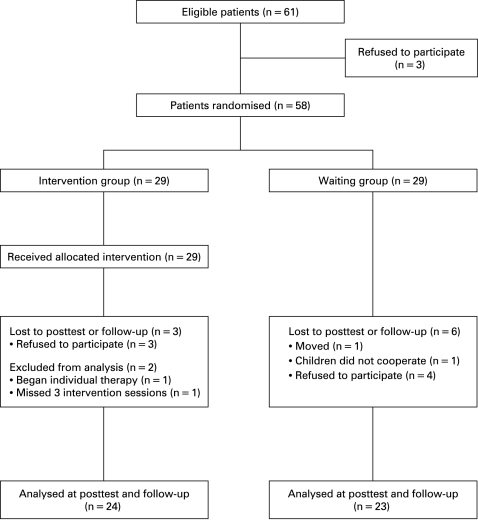
61 children with SELD (mean age 24.7 months, SD 0.9) were selected between October 2003 and February 2006 during routine developmental check-ups in general paediatric practices, using a German parent-report screening questionnaire (adapted from the MacArthur Communicative Development Inventories). Standardised instruments were used to assess the language and non-verbal cognitive abilities of these children and of 36 other children with normal language development (reference group; mean age 24.6 months, SD 0.8). 58 children with SELD were sequentially randomly assigned to an intervention group (n = 29) or a 12-month waiting group (n = 29). In the intervention group, mothers participated in the 3-month Heidelberg Parent-based Language Intervention (HPLI). All children were reassessed 6 and 12 months after pretest. Assessors were blind to allocation and previous results.
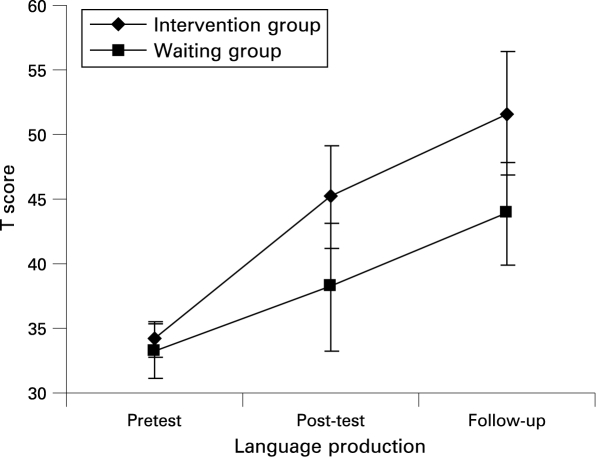
47 children were included in the analysis. At the age of 3 years, 75% of the children in the intervention group showed normal expressive language abilities in contrast to 44% in the waiting group. Only 8% of the children in the intervention group versus 26% in the waiting group met the criteria for specific language impairment (t score < or =35).
By applying the short, highly structured HPLI in children with SELD, the rate of treatment for language impairment at the age of 3 years can be significantly reduced.
这项随机对照试验的目的是评估一项简短、高度结构化的基于家长的语言干预小组计划对患有特定表达性语言延迟(SELD,接受性语言无缺陷)的2岁儿童的有效性。
2003年10月至2006年2月期间,在普通儿科诊所进行常规发育检查时,使用一份德国家长报告筛查问卷(改编自麦克阿瑟沟通发展量表),选取了61名患有SELD的儿童(平均年龄24.7个月,标准差0.9)。使用标准化工具评估这些儿童以及另外36名语言发育正常的儿童(对照组;平均年龄24.6个月,标准差0.8)的语言和非语言认知能力。58名患有SELD的儿童被依次随机分配到干预组(n = 29)或12个月的等待组(n = 29)。在干预组中,母亲们参与了为期3个月的海德堡家长语言干预(HPLI)。所有儿童在预测试后6个月和12个月进行重新评估。评估人员对分组情况和先前结果不知情。
47名儿童纳入分析。3岁时,干预组75%的儿童表现出正常的表达性语言能力,而等待组为44%。干预组只有8%的儿童符合特定语言障碍标准(t分数≤35),而等待组为26%。
对患有SELD的儿童应用简短、高度结构化的HPLI,可以显著降低3岁时语言障碍的治疗率。