Graham John S, Gerlach Travis W, Logan Thomas P, Bonar James P, Fugo Richard J, Lee Robyn B, Coatsworth Matthew A
Medical Toxicology Branch, US Army Medical Research Institute of Chemical Defense, Aberdeen Proving Ground, MD, USA.
Eplasty. 2008 Jul 21;8:e34.
Chemical warfare agents are potential threats to military personnel and civilians. The potential for associated traumatic injuries is significant. Damage control surgery could expose medical personnel to agents contaminating the wounds. The objectives of this study were to demonstrate efficacy of surgical decontamination and assess exposure risk to attending personnel.
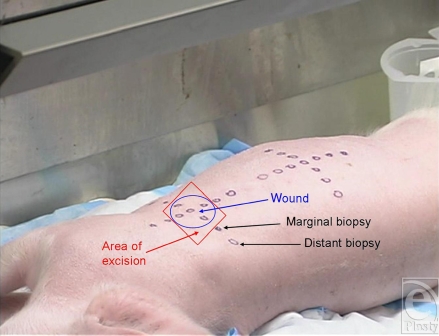
Weanling pigs were randomly assigned to 2 of 4 debridement tools (scalpel, Bovie knife, Fugo Blade, and Versajet Hydrosurgery System). Penetrating traumatic wounds were created over the shoulder and thigh and then exposed to liquid sulfur mustard (HD) for 60 minutes. Excisional debridement of the injuries was performed while vapors over each site were collected. Gas chromatography was used to measure HD in samples of collected vapors. Unbound HD was quantified in presurgical wound swabs, excised tissues, and peripheral tissue biopsies following solvent extraction.
Excisional debridement produced agent-free wound beds (surgical decontamination). A significant amount of HD vapor was detected above the surgical fields with each tool. Apart from the Versajet producing significantly lower levels of HD detected over thigh wounds compared with those treated using the scalpel, there were no differences in the amount of agent detected among the tools. All measured levels significantly exceeded established safety limits. Vesicating levels of unbound HD were extracted from excised tissue. There was no measured lateral spreading of HD beyond the surgical margins.
There is significant occupational exposure risk to HD during surgical procedures designed to stabilize agent-contaminated wounds. If appropriate protective measures are taken, surgical decontamination is both effective and safe.
化学战剂对军事人员和平民构成潜在威胁。相关创伤性损伤的可能性很大。损伤控制手术可能会使医务人员接触到污染伤口的战剂。本研究的目的是证明手术去污的有效性,并评估医护人员的暴露风险。
将断奶仔猪随机分配至4种清创工具(手术刀、高频电刀、富戈刀片和Versajet水刀手术系统)中的2种。在肩部和大腿处制造穿透性创伤,然后暴露于液态芥子气(HD)中60分钟。对损伤进行切除清创,同时收集每个部位上方的蒸汽。使用气相色谱法测量收集蒸汽样本中的HD。在溶剂萃取后,对术前伤口拭子、切除组织和外周组织活检中的游离HD进行定量。
切除清创产生了无战剂的伤口床(手术去污)。使用每种工具时,在手术区域上方均检测到大量HD蒸汽。除了Versajet处理的大腿伤口上方检测到的HD水平明显低于使用手术刀处理的伤口外,各工具检测到的战剂含量没有差异。所有测量水平均显著超过既定安全限值。从切除组织中提取出有起疱作用水平的游离HD。未检测到HD超出手术边缘的横向扩散。
在旨在稳定战剂污染伤口的手术过程中,医护人员有显著的HD职业暴露风险。如果采取适当的防护措施,手术去污既有效又安全。