Wijbrandts C A, van Leuven S I, Boom H D, Gerlag D M, Stroes E G S, Kastelein J J P, Tak P P
Department of Clinical Immunology and Rheumatology, Academic Medical Center/University of Amsterdam, Amsterdam, The Netherlands.
Ann Rheum Dis. 2009 Aug;68(8):1316-21. doi: 10.1136/ard.2007.086728. Epub 2008 Aug 22.
Macrophage migration inhibitory factor (MIF) has recently emerged as an important cytokine possibly linking rheumatoid arthritis (RA) and atherogenesis. Because atherogenesis is accelerated in RA this study was conducted to investigate whether anti-tumour necrosis factor (TNF) therapy could lead to sustained downregulation of systemic MIF levels and improvement in lipid profiles.
Fifty RA patients with active disease (disease activity score in 28 joints (DAS28) >or=3.2), who started adalimumab therapy at 40 mg every other week, were included. At baseline, weeks 16 and 52 serum levels of MIF and lipids were assessed. In addition, the DAS28 and serum C-reactive protein (CRP) levels and erythrocyte sedimentation rate (ESR) were determined.
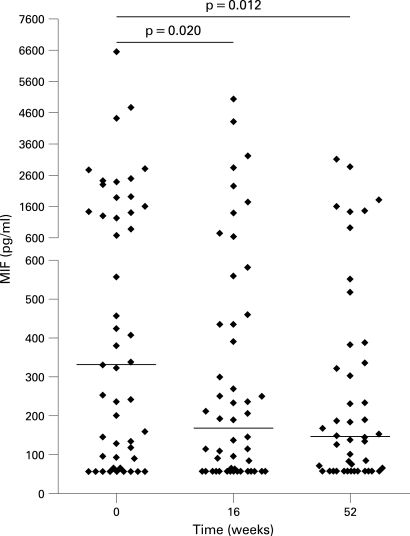
After 16 weeks of adalimumab therapy, both DAS28 and MIF levels were significantly decreased (p<0.001 and p = 0.020, respectively). This was sustained up to week 52 (p<0.001 and p = 0.012, respectively). CRP levels and ESR were significantly reduced after 16 and 52 weeks of adalimumab therapy (p<0.001). High-density lipoprotein cholesterol levels increased at week 16 (p<0.001), but returned to baseline at week 52. Apolipoprotein (apo) A-I levels increased at week 16 (p<0.001) and remained stable (p = 0.005). This resulted in an improved apo B/A-I ratio.
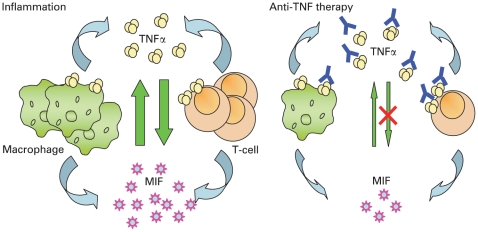
The results underline the sustained downregulation of MIF as a potential new mechanism by which anti-TNF therapy might reduce vascular inflammation, and as such perhaps cardiovascular morbidity in RA patients. This hypothesis is supported by an improved apo B/A-I ratio as well as reduced CRP levels in these patients.
巨噬细胞移动抑制因子(MIF)最近已成为一种重要的细胞因子,可能与类风湿关节炎(RA)和动脉粥样硬化的发生有关。由于RA患者的动脉粥样硬化进程加速,因此开展本研究以调查抗肿瘤坏死因子(TNF)治疗是否能导致全身MIF水平持续下调并改善血脂谱。
纳入50例活动性疾病(28个关节疾病活动评分(DAS28)≥3.2)的RA患者,这些患者开始接受每两周一次40mg阿达木单抗治疗。在基线、第16周和第52周评估血清MIF和血脂水平。此外,测定DAS28、血清C反应蛋白(CRP)水平和红细胞沉降率(ESR)。
阿达木单抗治疗16周后,DAS28和MIF水平均显著降低(分别为p<0.001和p = 0.020)。这种情况一直持续到第52周(分别为p<0.001和p = 0.012)。阿达木单抗治疗16周和52周后,CRP水平和ESR显著降低(p<0.001)。高密度脂蛋白胆固醇水平在第16周升高(p<0.001),但在第52周恢复至基线水平。载脂蛋白(apo)A-I水平在第16周升高(p<0.001)并保持稳定(p = 0.005)。这导致apo B/A-I比值得到改善。
结果强调了MIF的持续下调是抗TNF治疗可能减轻血管炎症的一种潜在新机制,也可能因此降低RA患者的心血管发病率。这些患者apo B/A-I比值的改善以及CRP水平的降低支持了这一假说。