Xu Guilian, Karch Celeste, Li Ning, Lin Nianwei, Fromholt David, Gonzales Victoria, Borchelt David R
Department of Neuroscience, McKnight Brain Institute, Santa Fe Health Alzheimer's Disease Research Center, University of Florida, Gainesville, Florida, United States of America.
PLoS One. 2008 Sep 8;3(9):e3159. doi: 10.1371/journal.pone.0003159.
Receptor associated protein (RAP) functions in the endoplasmic reticulum (ER) to assist in the maturation of several membrane receptor proteins, including low density lipoprotein receptor-related protein (LRP) and lipoprotein receptor 11 (SorLA/LR11). Previous studies in cell and mouse model systems have demonstrated that these proteins play roles in the metabolism of the amyloid precursor protein (APP), including processes involved in the generation, catabolism and deposition of beta-amyloid (Abeta) peptides.
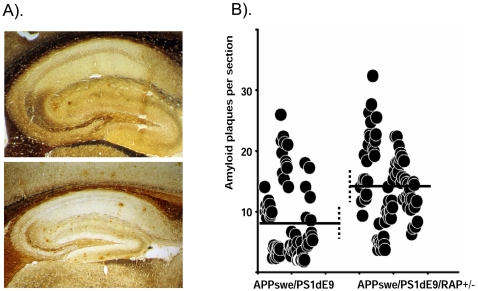
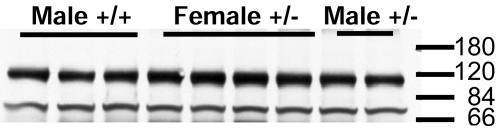
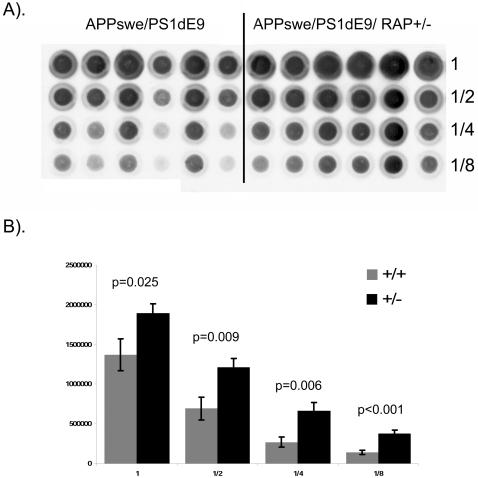
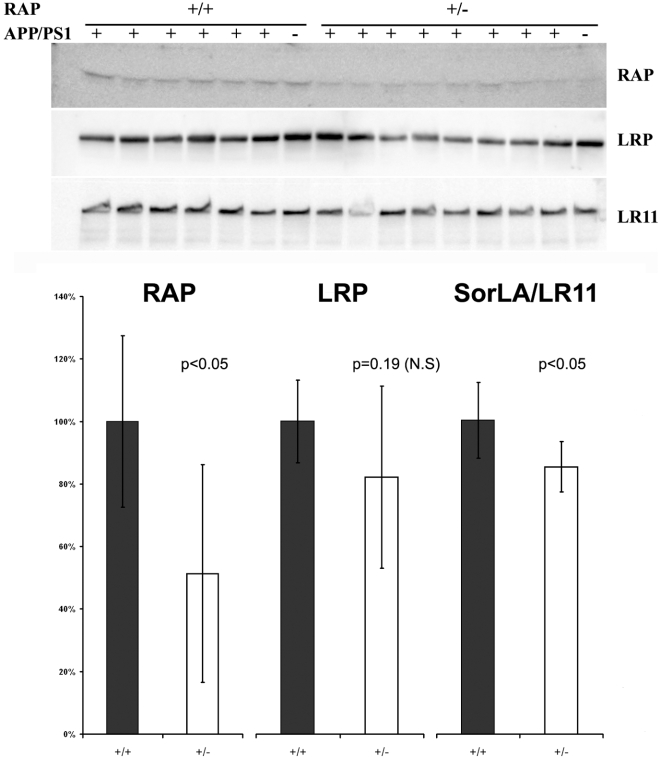
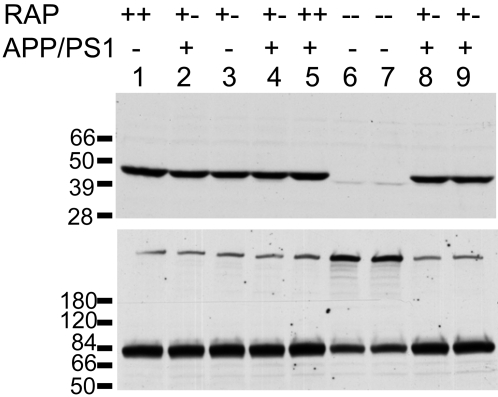
METHODOLOGY/PRINCIPAL FINDINGS: Mice transgenic for mutant APPswe and mutant presenilin 1 (PS1dE9) were mated to mice with homozygous deletion of RAP. Unexpectedly, mice that were homozygous null for RAP and transgenic for APPswe/PS1dE9 showed high post-natal mortality, necessitating a shift in focus to examine the levels of amyloid deposition in APPswe/PS1dE9 that were hemizygous null for RAP. Immunoblot analysis confirmed 50% reductions in the levels of RAP with modest reductions in the levels of proteins dependent upon RAP for maturation [LRP trend towards a 20% reduction ; SorLA/LR11 statistically significant 15% reduction (p<0.05)]. Changes in the levels of these proteins in the brains of APPswe/PS1dE9/RAP(+/-) mice correlated with 30-40% increases in amyloid deposition by 9 months of age.
CONCLUSIONS/SIGNIFICANCE: Partial reductions in the ER chaperone RAP enhance amyloid deposition in the APPswe/PS1dE9 model of Alzheimer amyloidosis. Partial reductions in RAP also affect the maturation of LRP and SorLA/LR11, which are each involved in several different aspects of APP processing and Abeta catabolism. Together, these findings suggest a central role for RAP in Alzheimer amyloidogenesis.
受体相关蛋白(RAP)在内质网(ER)中发挥作用,协助多种膜受体蛋白成熟,包括低密度脂蛋白受体相关蛋白(LRP)和脂蛋白受体11(SorLA/LR11)。先前在细胞和小鼠模型系统中的研究表明,这些蛋白在淀粉样前体蛋白(APP)的代谢中发挥作用,包括与β-淀粉样蛋白(Aβ)肽的生成、分解代谢和沉积相关的过程。
方法/主要发现:将携带突变型APPswe和突变型早老素1(PS1dE9)的转基因小鼠与RAP基因纯合缺失的小鼠交配。出乎意料的是,RAP基因纯合缺失且携带APPswe/PS1dE9转基因的小鼠出生后死亡率很高,因此需要将研究重点转向检查RAP基因半合子缺失的APPswe/PS1dE9小鼠中的淀粉样蛋白沉积水平。免疫印迹分析证实RAP水平降低了50%,而依赖RAP成熟的蛋白水平略有降低[LRP有降低20%的趋势;SorLA/LR11有15%的统计学显著降低(p<0.05)]。APPswe/PS1dE9/RAP(+/-)小鼠大脑中这些蛋白水平的变化与9月龄时淀粉样蛋白沉积增加30-40%相关。
结论/意义:内质网伴侣蛋白RAP的部分减少会增强阿尔茨海默病淀粉样变性APPswe/PS1dE9模型中的淀粉样蛋白沉积。RAP的部分减少还会影响LRP和SorLA/LR11的成熟,这两种蛋白分别参与APP加工和Aβ分解代谢的几个不同方面。这些发现共同表明RAP在阿尔茨海默病淀粉样蛋白生成中起核心作用。