Cho Young-Seok, Chae Hiun-Suk, Jang Se Na, Kim Jin-Soo, Son Hye Suk, Kim Hyung-Keun, Kim Byung-Wook, Han Sok-Won, Choi Kyu-Yong, Lee Hae Kyung, Chang Eun Deok
Department of Internal Medicine, Division of Gastroenterology, College of Medicine, The Catholic University of Korea, Seoul, Korea.
Korean J Intern Med. 2008 Sep;23(3):134-9. doi: 10.3904/kjim.2008.23.3.134.
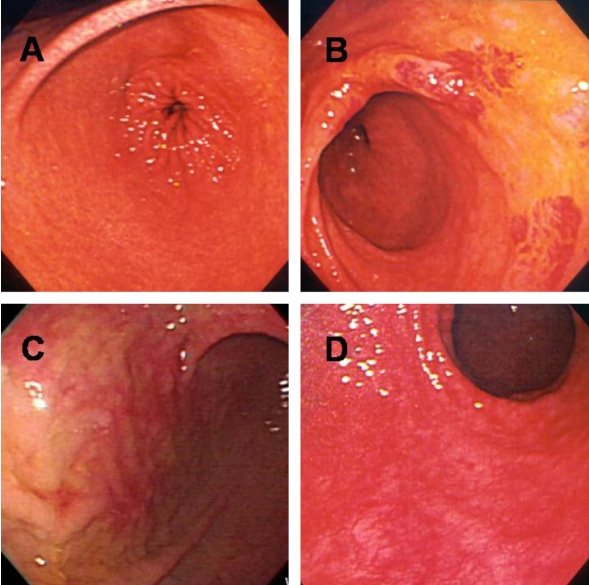
BACKGROUND/AIMS: The (13)C-urea breath test (UBT) is a semiquantitative test for measuring Helicobacter pylori infection loading. H. pylori produces ammonia, which elevates the pH of the gastric mucosa and is detectable via endoscopy using a phenol red indicator. We evaluated whether this test could be used to diagnose H. pylori infection and whether phenol red staining was correlated with (13)C-UBT results.
One hundred and twenty-three patients participated. The UBT was performed after ingestion of a capsule containing urea. A change in (13)C-UBT >2 ppt was selected as the cutoff value for diagnosing infection. After spraying evenly with a 0.1% phenol red solution, the pH of the gastric mucosal surface was measured using an antimony electrode through the biopsy channel.
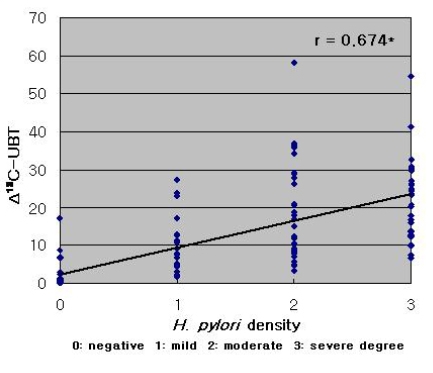
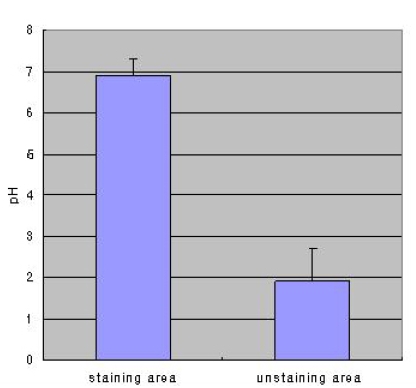
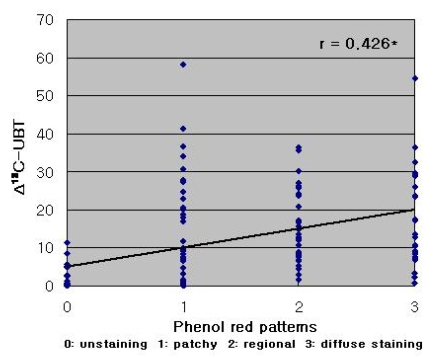
The pH of stained mucosa (6.9+/-0.4) was significantly higher than that of unstained mucosa (1.9+/-0.8; p<0.001), and the H. pylori detection rate confirmed via histology was higher in stained versus unstained mucosa (p<0.01). Extensive mucosal staining resulted in a higher detection rate (p<0.001). The UBT produced results were very similar to those obtained via histological detection in stained mucosa (p<0.001). The extent of staining, expressed as a staining score, was positively correlated with the change in (13)C-UBT (r=0.426, p<0.001). A significant correlation was also observed between the histologically determined H. pylori density and (13)C-UBT results (r=0.674, p<0.001).
H. pylori infection elevates gastric mucosal surface pH, and endoscopic phenol red staining may be an alternative method for the diagnosis of H. pylori infection.
背景/目的:¹³C尿素呼气试验(UBT)是一种用于测量幽门螺杆菌感染负荷的半定量检测方法。幽门螺杆菌产生氨,可使胃黏膜pH值升高,通过使用酚红指示剂的内镜检查可检测到。我们评估了该检测方法是否可用于诊断幽门螺杆菌感染,以及酚红染色是否与¹³C-UBT结果相关。
123例患者参与研究。口服含尿素胶囊后进行UBT检测。将¹³C-UBT变化>2‰作为诊断感染的临界值。用0.1%酚红溶液均匀喷洒后,通过活检通道用锑电极测量胃黏膜表面pH值。
染色黏膜的pH值(6.9±0.4)显著高于未染色黏膜(1.9±0.8;p<0.001),且经组织学证实,染色黏膜中幽门螺杆菌的检出率高于未染色黏膜(p<0.01)。广泛的黏膜染色导致更高的检出率(p<0.001)。UBT检测结果与染色黏膜组织学检测结果非常相似(p<0.001)。以染色评分表示的染色程度与¹³C-UBT变化呈正相关(r=0.426,p<0.001)。组织学确定的幽门螺杆菌密度与¹³C-UBT结果之间也观察到显著相关性(r=0.674,p<0.001)。
幽门螺杆菌感染可使胃黏膜表面pH值升高,内镜下酚红染色可能是诊断幽门螺杆菌感染的一种替代方法。