Barr Margo, Raphael Beverley, Taylor Melanie, Stevens Garry, Jorm Louisa, Giffin Michael, Lujic Sanja
Centre for Epidemiology and Research, New South Wales Department of Health, Sydney, Australia.
BMC Infect Dis. 2008 Sep 15;8:117. doi: 10.1186/1471-2334-8-117.
Baseline data is necessary for monitoring how a population perceives the threat of pandemic influenza, and perceives how it would behave in the event of pandemic influenza. Our aim was to develop a module of questions for use in telephone health surveys on perceptions of threat of pandemic influenza, and on preparedness to comply with specific public health behaviours in the event of pandemic influenza.
A module of questions was developed and field tested on 192 adults using the New South Wales Department of Health's in-house Computer Assisted Telephone Interviewing (CATI) facility. The questions were then modified and re field tested on 202 adults. The module was then incorporated into the New South Wales Population Health Survey in the first quarter of 2007. A representative sample of 2,081 adults completed the module. Their responses were weighted against the state population.
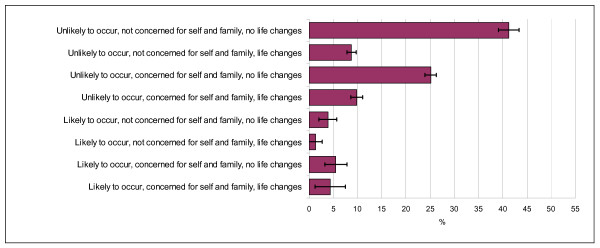
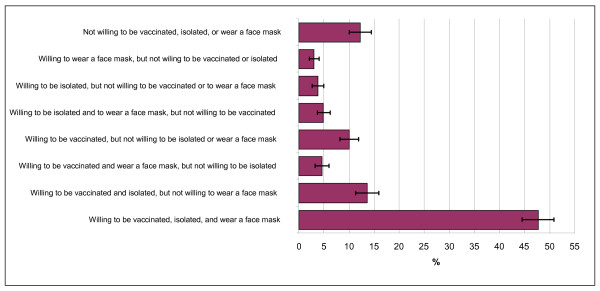
The reliability of the questions was acceptable with kappa ranging between 0.25 and 0.51. Overall 14.9% of the state population thought pandemic influenza was very or extremely likely to occur; 45.5% were very or extremely concerned that they or their family would be affected by pandemic influenza if it occurred; and 23.8% had made some level of change to the way they live their life because of the possibility of pandemic influenza. In the event of pandemic influenza, the majority of the population were willing to: be vaccinated (75.4%), be isolated (70.2%), and wear a face mask (59.9%). People with higher levels of threat perception are significantly more likely to be willing to comply with specific public health behaviours.
While only 14.9% of the state population thought pandemic influenza was very or extremely likely to occur, a significantly higher proportion were concerned for self and family should a pandemic actually occur. The baseline data collected in this survey will be useful for monitoring changes over time in the population's perceptions of threat, and preparedness to comply with specific public health behaviours.
基线数据对于监测人群如何看待大流行性流感的威胁以及在大流行性流感发生时他们的行为表现至关重要。我们的目的是开发一套问题模块,用于电话健康调查,以了解人们对大流行性流感威胁的认知以及在大流行性流感发生时遵守特定公共卫生行为的准备情况。
开发了一套问题模块,并利用新南威尔士州卫生部内部的计算机辅助电话访谈(CATI)设施,对192名成年人进行了现场测试。随后对问题进行了修改,并在202名成年人中重新进行了现场测试。该模块随后于2007年第一季度被纳入新南威尔士州人口健康调查。2081名成年人的代表性样本完成了该模块的调查。他们的回答根据该州人口进行了加权处理。
问题的可靠性可以接受,kappa值在0.25至0.51之间。总体而言,该州14.9%的人口认为大流行性流感非常或极有可能发生;45.5%的人非常或极其担心自己或家人会在大流行性流感发生时受到影响;23.8%的人因为大流行性流感的可能性而在一定程度上改变了生活方式。在大流行性流感发生时,大多数人愿意:接种疫苗(75.4%)、隔离(70.2%)和戴口罩(59.9%)。威胁感知水平较高的人更有可能愿意遵守特定的公共卫生行为。
虽然该州只有14.9%的人口认为大流行性流感非常或极有可能发生,但如果大流行实际发生,担心自己和家人的比例要高得多。本次调查收集的基线数据将有助于监测人群对威胁的认知以及遵守特定公共卫生行为的准备情况随时间的变化。