Li Chris Ka-fai, Wu Hao, Yan Huiping, Ma Shiwu, Wang Lili, Zhang Mingxia, Tang Xiaoping, Temperton Nigel J, Weiss Robin A, Brenchley Jason M, Douek Daniel C, Mongkolsapaya Juthathip, Tran Bac-Hai, Lin Chen-lung Steve, Screaton Gavin R, Hou Jin-lin, McMichael Andrew J, Xu Xiao-Ning
MRC Human Immunology Unit, Weatherall Institute of Molecular Medicine, University of Oxford, Oxford, UK.
J Immunol. 2008 Oct 15;181(8):5490-500. doi: 10.4049/jimmunol.181.8.5490.
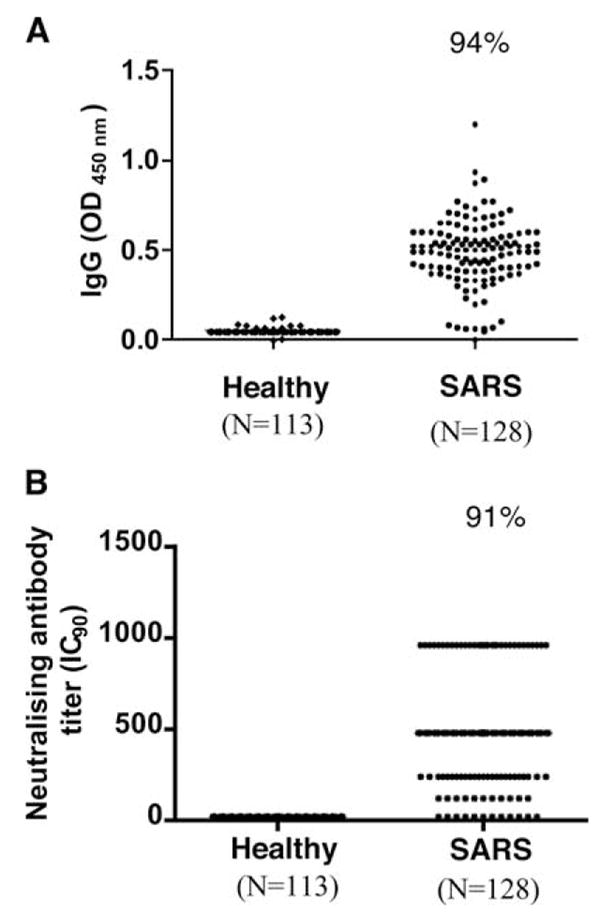
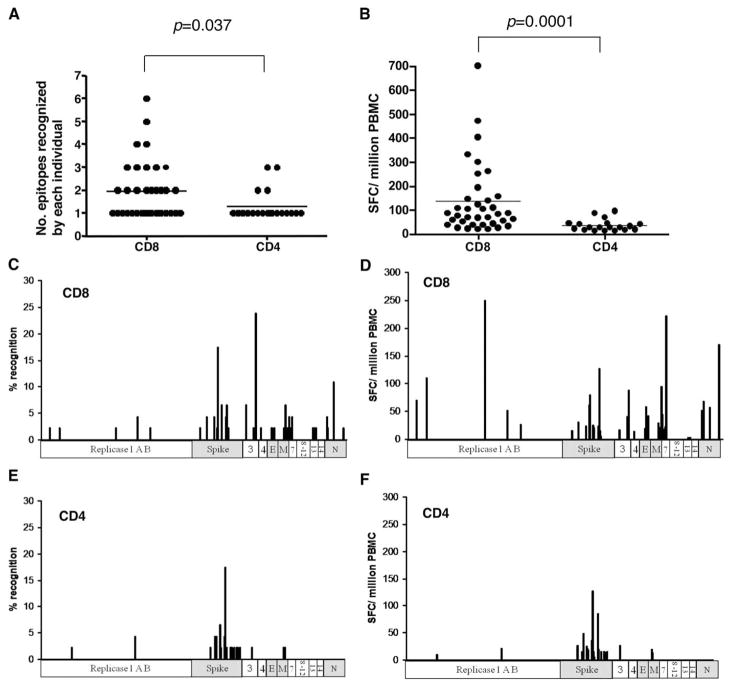
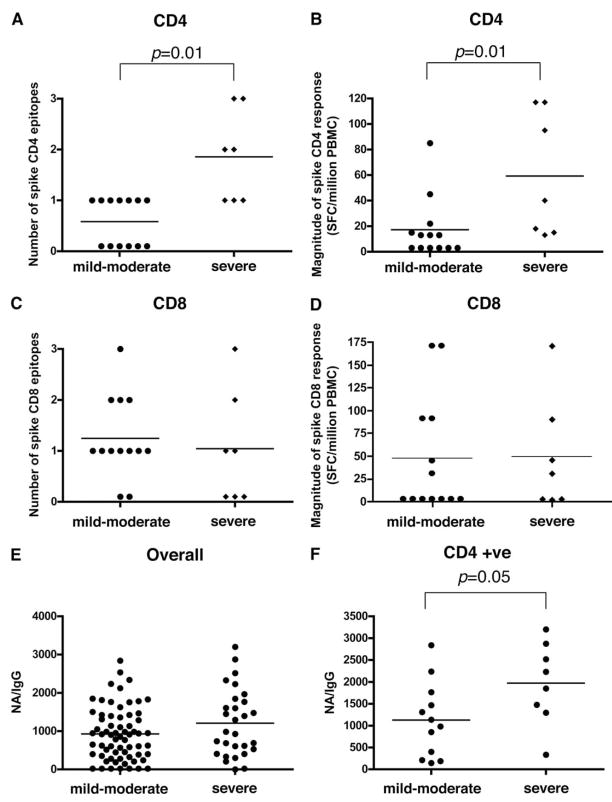
Effective vaccines should confer long-term protection against future outbreaks of severe acute respiratory syndrome (SARS) caused by a novel zoonotic coronavirus (SARS-CoV) with unknown animal reservoirs. We conducted a cohort study examining multiple parameters of immune responses to SARS-CoV infection, aiming to identify the immune correlates of protection. We used a matrix of overlapping peptides spanning whole SARS-CoV proteome to determine T cell responses from 128 SARS convalescent samples by ex vivo IFN-gamma ELISPOT assays. Approximately 50% of convalescent SARS patients were positive for T cell responses, and 90% possessed strongly neutralizing Abs. Fifty-five novel T cell epitopes were identified, with spike protein dominating total T cell responses. CD8(+) T cell responses were more frequent and of a greater magnitude than CD4(+) T cell responses (p < 0.001). Polychromatic cytometry analysis indicated that the virus-specific T cells from the severe group tended to be a central memory phenotype (CD27(+)/CD45RO(+)) with a significantly higher frequency of polyfunctional CD4(+) T cells producing IFN-gamma, TNF-alpha, and IL-2, and CD8(+) T cells producing IFN-gamma, TNF-alpha, and CD107a (degranulation), as compared with the mild-moderate group. Strong T cell responses correlated significantly (p < 0.05) with higher neutralizing Ab. The serum cytokine profile during acute infection indicated a significant elevation of innate immune responses. Increased Th2 cytokines were observed in patients with fatal infection. Our study provides a roadmap for the immunogenicity of SARS-CoV and types of immune responses that may be responsible for the virus clearance, and should serve as a benchmark for SARS-CoV vaccine design and evaluation.
有效的疫苗应能提供长期保护,预防由一种新型人畜共患冠状病毒(SARS-CoV)引发的严重急性呼吸综合征(SARS)未来疫情爆发,该病毒的动物宿主尚不清楚。我们开展了一项队列研究,检测对SARS-CoV感染的免疫反应的多个参数,旨在确定保护的免疫相关因素。我们使用了覆盖整个SARS-CoV蛋白质组的重叠肽矩阵,通过体外干扰素-γ酶联免疫斑点试验来确定128份SARS康复样本的T细胞反应。约50%的SARS康复患者T细胞反应呈阳性,90%拥有强效中和抗体。鉴定出55个新的T细胞表位,其中刺突蛋白主导了总的T细胞反应。CD8(+) T细胞反应比CD4(+) T细胞反应更频繁、强度更大(p < 0.001)。多色流式细胞术分析表明,与轻-中度组相比,重症组的病毒特异性T细胞倾向于中央记忆表型(CD27(+)/CD45RO(+)),产生干扰素-γ、肿瘤坏死因子-α和白细胞介素-2的多功能CD4(+) T细胞以及产生干扰素-γ、肿瘤坏死因子-α和CD107a(脱颗粒)的CD8(+) T细胞的频率显著更高。强烈的T细胞反应与更高的中和抗体显著相关(p < 0.05)。急性感染期间的血清细胞因子谱表明先天免疫反应显著升高。在致命感染患者中观察到Th2细胞因子增加。我们的研究为SARS-CoV的免疫原性以及可能负责病毒清除的免疫反应类型提供了路线图,应为SARS-CoV疫苗的设计和评估提供基准。