Kim Hyun-Jin, Baek Kwang-Hyun, Lee Seung-Won, Kim JungEun, Lee Bong-Woo, Cho Hye-Sun, Kim Woo Taek, Choi Doil, Hur Cheol-Goo
Omics Integration Research Center, KRIBB, Yuseong-gu, Daejeon, Korea.
BMC Plant Biol. 2008 Oct 9;8:101. doi: 10.1186/1471-2229-8-101.
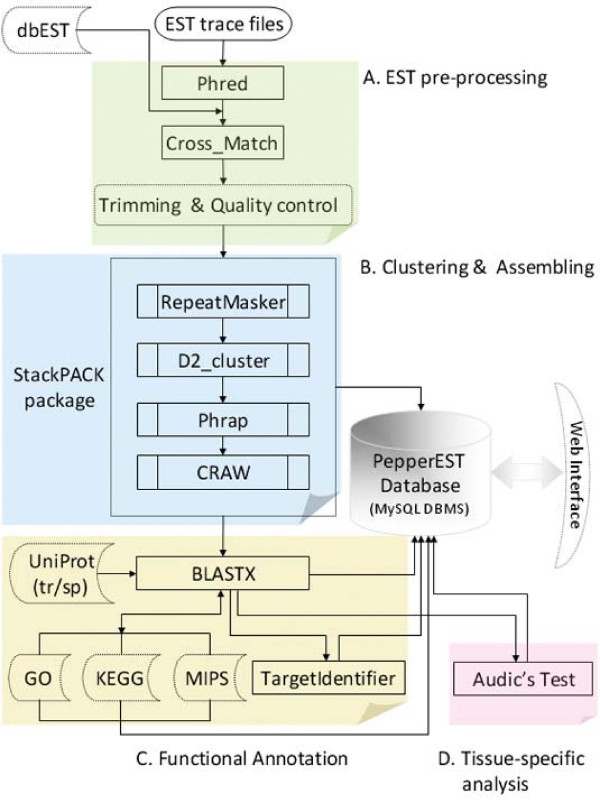
There is no dedicated database available for Expressed Sequence Tags (EST) of the chili pepper (Capsicum annuum), although the interest in a chili pepper EST database is increasing internationally due to the nutritional, economic, and pharmaceutical value of the plant. Recent advances in high-throughput sequencing of the ESTs of chili pepper cv. Bukang have produced hundreds of thousands of complementary DNA (cDNA) sequences. Therefore, a chili pepper EST database was designed and constructed to enable comprehensive analysis of chili pepper gene expression in response to biotic and abiotic stresses.
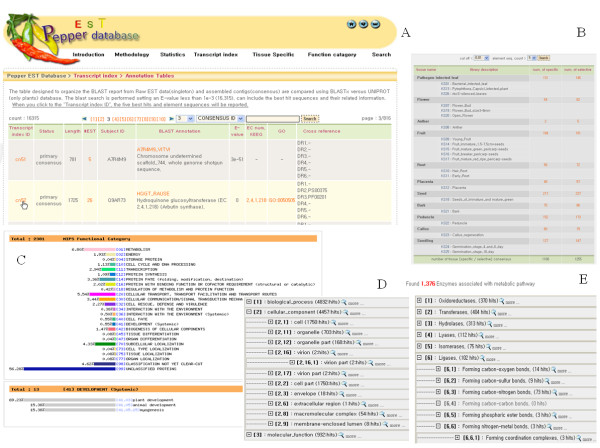
We built the Pepper EST database to mine the complexity of chili pepper ESTs. The database was built on 122,582 sequenced ESTs and 116,412 refined ESTs from 21 pepper EST libraries. The ESTs were clustered and assembled into virtual consensus cDNAs and the cDNAs were assigned to metabolic pathway, Gene Ontology (GO), and MIPS Functional Catalogue (FunCat). The Pepper EST database is designed to provide a workbench for (i) identifying unigenes in pepper plants, (ii) analyzing expression patterns in different developmental tissues and under conditions of stress, and (iii) comparing the ESTs with those of other members of the Solanaceae family. The Pepper EST database is freely available at http://genepool.kribb.re.kr/pepper/.
The Pepper EST database is expected to provide a high-quality resource, which will contribute to gaining a systemic understanding of plant diseases and facilitate genetics-based population studies. The database is also expected to contribute to analysis of gene synteny as part of the chili pepper sequencing project by mapping ESTs to the genome.
尽管由于辣椒(Capsicum annuum)的营养、经济和药用价值,国际上对辣椒表达序列标签(EST)数据库的兴趣与日俱增,但目前尚无专门的辣椒EST数据库。辣椒品种Bukang的EST高通量测序的最新进展已产生了数十万条互补DNA(cDNA)序列。因此,设计并构建了一个辣椒EST数据库,以全面分析辣椒在生物和非生物胁迫下的基因表达。
我们构建了辣椒EST数据库,以挖掘辣椒EST的复杂性。该数据库基于来自21个辣椒EST文库的122,582条测序EST和116,412条优化EST构建而成。这些EST被聚类并组装成虚拟一致性cDNA,然后将这些cDNA分配到代谢途径、基因本体论(GO)和MIPS功能目录(FunCat)中。辣椒EST数据库旨在提供一个工作平台,用于(i)鉴定辣椒植株中的单基因,(ii)分析不同发育组织和胁迫条件下的表达模式,以及(iii)将这些EST与茄科其他成员的EST进行比较。辣椒EST数据库可在http://genepool.kribb.re.kr/pepper/免费获取。
辣椒EST数据库有望提供高质量的资源,这将有助于系统地了解植物病害并促进基于遗传学的群体研究。该数据库还有望通过将EST定位到基因组,作为辣椒测序项目的一部分,为基因共线性分析做出贡献。