Garcin Elsa D, Arvai Andrew S, Rosenfeld Robin J, Kroeger Matt D, Crane Brian R, Andersson Gunilla, Andrews Glen, Hamley Peter J, Mallinder Philip R, Nicholls David J, St-Gallay Stephen A, Tinker Alan C, Gensmantel Nigel P, Mete Antonio, Cheshire David R, Connolly Stephen, Stuehr Dennis J, Aberg Anders, Wallace Alan V, Tainer John A, Getzoff Elizabeth D
The Scripps Research Institute, Department of Molecular Biology and Skaggs Institute for Chemical Biology, 10550 North Torrey Pines Road, MB4, La Jolla, California 92037, USA.
Nat Chem Biol. 2008 Nov;4(11):700-7. doi: 10.1038/nchembio.115. Epub 2008 Oct 12.
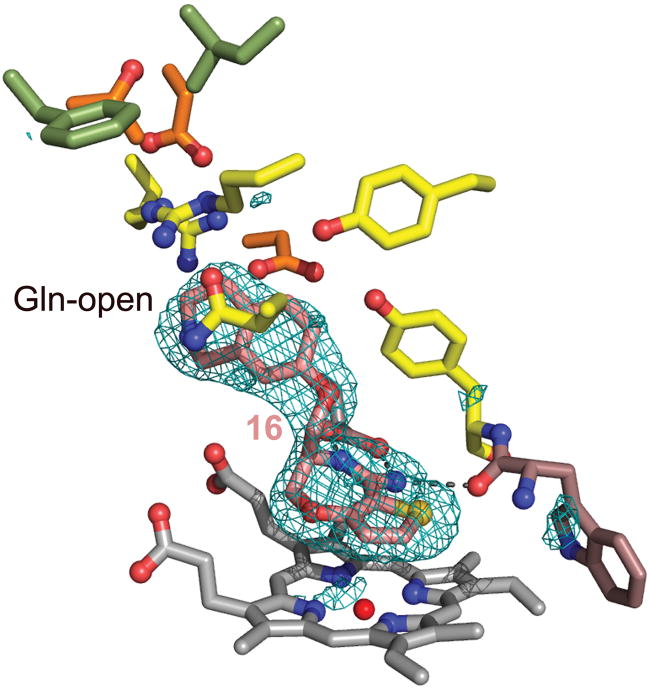
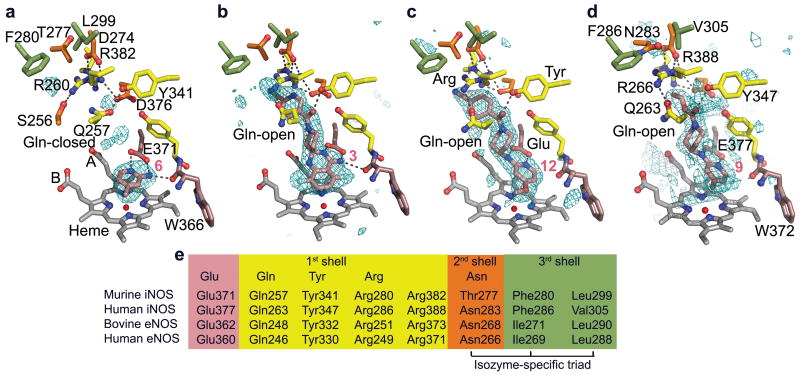
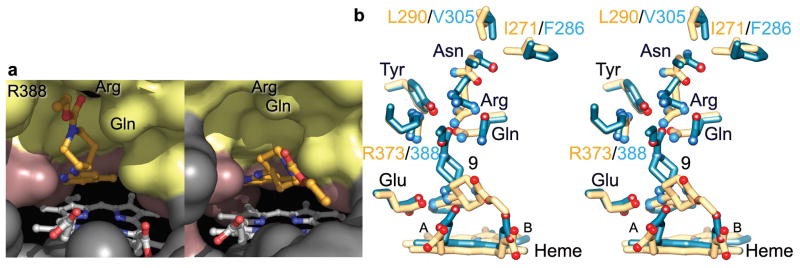
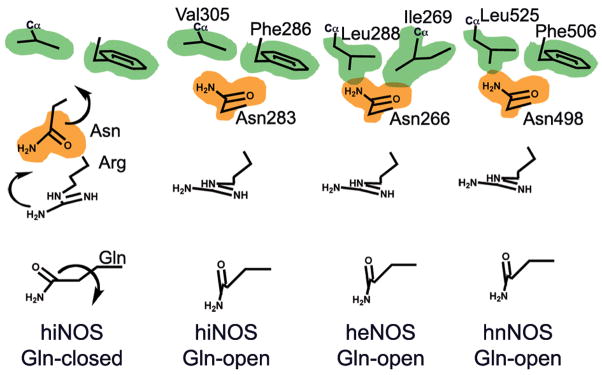
Nitric oxide synthase (NOS) enzymes synthesize nitric oxide, a signal for vasodilatation and neurotransmission at low concentrations and a defensive cytotoxin at higher concentrations. The high active site conservation among all three NOS isozymes hinders the design of selective NOS inhibitors to treat inflammation, arthritis, stroke, septic shock and cancer. Our crystal structures and mutagenesis results identified an isozyme-specific induced-fit binding mode linking a cascade of conformational changes to a new specificity pocket. Plasticity of an isozyme-specific triad of distant second- and third-shell residues modulates conformational changes of invariant first-shell residues to determine inhibitor selectivity. To design potent and selective NOS inhibitors, we developed the anchored plasticity approach: anchor an inhibitor core in a conserved binding pocket, then extend rigid bulky substituents toward remote specificity pockets, which become accessible upon conformational changes of flexible residues. This approach exemplifies general principles for the design of selective enzyme inhibitors that overcome strong active site conservation.
一氧化氮合酶(NOS)能够合成一氧化氮,低浓度时它是血管舒张和神经传递的信号,高浓度时则是一种防御性细胞毒素。三种NOS同工酶之间高度保守的活性位点阻碍了用于治疗炎症、关节炎、中风、败血症性休克和癌症的选择性NOS抑制剂的设计。我们的晶体结构和诱变结果确定了一种同工酶特异性的诱导契合结合模式,该模式将一系列构象变化与一个新的特异性口袋联系起来。由远距离的第二和第三层残基组成的同工酶特异性三联体的可塑性调节不变的第一层残基的构象变化,以确定抑制剂的选择性。为了设计强效且选择性的NOS抑制剂,我们开发了锚定可塑性方法:将抑制剂核心锚定在保守的结合口袋中,然后向远程特异性口袋延伸刚性大取代基,这些口袋在柔性残基发生构象变化时变得可及。这种方法例证了克服强活性位点保守性的选择性酶抑制剂设计的一般原则。