Upadhyaya Hari D, Dwivedi Sangam L, Baum Michael, Varshney Rajeev K, Udupa Sripada M, Gowda Cholenahalli L L, Hoisington David, Singh Sube
International Crops Research Institute for the Semi-Arid Tropics (ICRISAT), Patancheru PO, 502324, AP, India.
BMC Plant Biol. 2008 Oct 16;8:106. doi: 10.1186/1471-2229-8-106.
Plant genetic resources (PGR) are the basic raw materials for future genetic progress and an insurance against unforeseen threats to agricultural production. An extensive characterization of PGR provides an opportunity to dissect structure, mine allelic variations, and identify diverse accessions for crop improvement. The Generation Challenge Program http://www.generationcp.org conceptualized the development of "composite collections" and extraction of "reference sets" from these for more efficient tapping of global crop-related genetic resources. In this study, we report the genetic structure, diversity and allelic richness in a composite collection of chickpea using SSR markers, and formation of a reference set of 300 accessions.
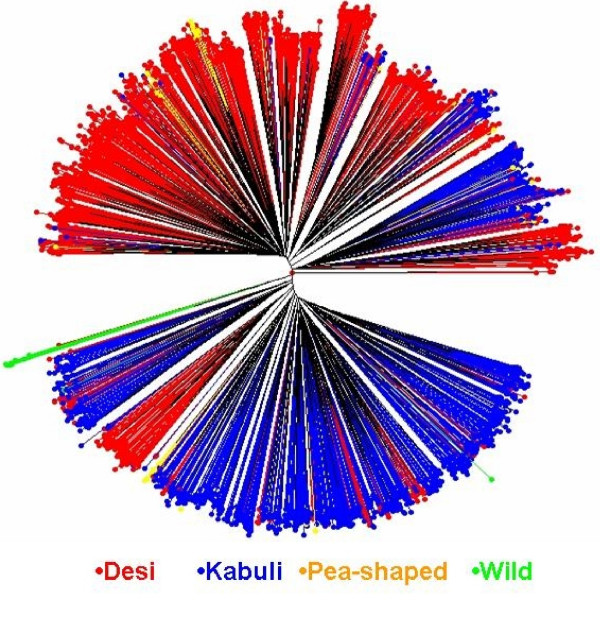
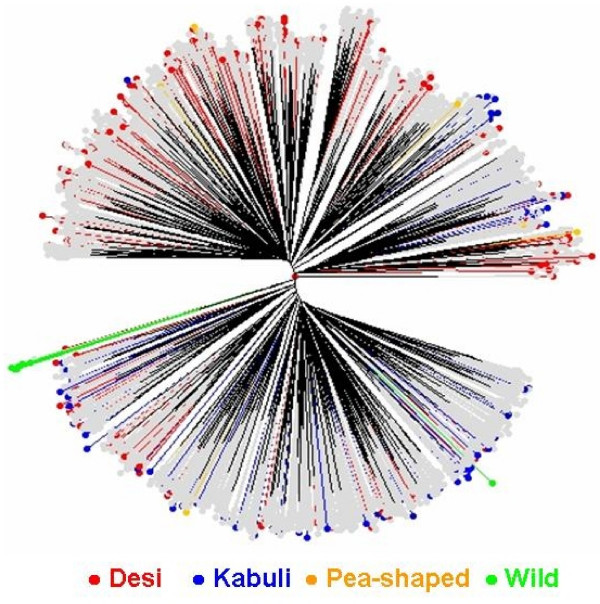
The 48 SSR markers detected 1683 alleles in 2915 accessions, of which, 935 were considered rare, 720 common and 28 most frequent. The alleles per locus ranged from 14 to 67, averaged 35, and the polymorphic information content was from 0.467 to 0.974, averaged 0.854. Marker polymorphism varied between groups of accessions in the composite collection and reference set. A number of group-specific alleles were detected: 104 in Kabuli, 297 in desi, and 69 in wild Cicer; 114 each in Mediterranean and West Asia (WA), 117 in South and South East Asia (SSEA), and 10 in African region accessions. Desi and kabuli shared 436 alleles, while wild Cicer shared 17 and 16 alleles with desi and kabuli, respectively. The accessions from SSEA and WA shared 74 alleles, while those from Mediterranean 38 and 33 alleles with WA and SSEA, respectively. Desi chickpea contained a higher proportion of rare alleles (53%) than kabuli (46%), while wild Cicer accessions were devoid of rare alleles. A genotype-based reference set captured 1315 (78%) of the 1683 composite collection alleles of which 463 were rare, 826 common, and 26 the most frequent alleles. The neighbour-joining tree diagram of this reference set represents diversity from all directions of the tree diagram of the composite collection.
The genotype-based reference set, reported here, is an ideal set of germplasm for allele mining, association genetics, mapping and cloning gene(s), and in applied breeding for the development of broad-based elite breeding lines/cultivars with superior yield and enhanced adaptation to diverse environments.
植物遗传资源(PGR)是未来遗传进展的基本原材料,也是应对农业生产中不可预见威胁的一种保障。对植物遗传资源进行广泛的特征描述,为剖析其结构、挖掘等位基因变异以及识别用于作物改良的不同种质提供了机会。“世代挑战计划”(http://www.generationcp.org)提出了“复合种质库”的概念,并从这些种质库中提取“参考集”,以便更有效地利用全球与作物相关的遗传资源。在本研究中,我们利用SSR标记报告了鹰嘴豆复合种质库的遗传结构、多样性和等位基因丰富度,并构建了一个包含300份种质的参考集。
48个SSR标记在2915份种质中检测到1683个等位基因,其中935个被认为是稀有等位基因,720个是常见等位基因,28个是最常见等位基因。每个位点的等位基因数从14个到67个不等,平均为35个,多态性信息含量从0.467到0.974不等,平均为0.854。复合种质库和参考集中不同种质组之间的标记多态性存在差异。检测到许多组特异性等位基因:卡布利类型中有104个,迪西类型中有297个,野生鹰嘴豆中有69个;地中海地区和西亚(WA)的种质各有114个,南亚和东南亚(SSEA)的种质有117个,非洲地区的种质有10个。迪西类型和卡布利类型共有436个等位基因,而野生鹰嘴豆与迪西类型和卡布利类型分别共有17个和16个等位基因。来自SSEA和WA的种质共有74个等位基因,而来自地中海地区的种质与WA和SSEA分别共有38个和33个等位基因。迪西鹰嘴豆中稀有等位基因的比例(53%)高于卡布利类型(46%),而野生鹰嘴豆种质中没有稀有等位基因。基于基因型的参考集涵盖了1683个复合种质库等位基因中的1315个(78%),其中463个是稀有等位基因,826个是常见等位基因,26个是最常见等位基因。该参考集的邻接树状图代表了复合种质库树状图各个方向的多样性。
本文报道的基于基因型的参考集是用于等位基因挖掘、关联遗传学研究、基因定位与克隆以及应用于培育具有高产和更强环境适应性的广泛优良育种系/品种的理想种质集合。