Ye Jing, Han Jun, Shi Qi, Zhang Bao-Yun, Wang Gui-Rong, Tian Chan, Gao Chen, Chen Jian-Min, Li Cun-Jiang, Liu Zheng, Li Xian-Zhang, Zhang Lai-Zhong, Dong Xiao-Ping
State Key Laboratory for Infectious Disease Prevention and Control, National Institute for Viral Disease Control and Prevention, Chinese Center for Disease Control and Prevention, Ying-Xin Rd, Beijing 100052, PR China.
J Med Case Rep. 2008 Oct 17;2:331. doi: 10.1186/1752-1947-2-331.
Transmissible spongiform encephalopathies are a group of neurodegenerative diseases of humans and animals. Genetic Creutzfeldt-Jakob diseases, in which mutations in the PRNP gene predispose to disease by causing the expression of abnormal PrP protein, include familial Creutzfeldt-Jakob disease, Gerstmann-Straussler-Scheinker syndrome and fatal familial insomnia.
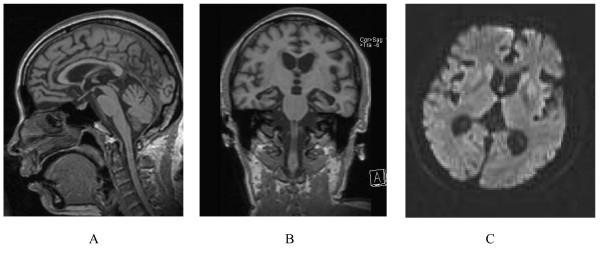
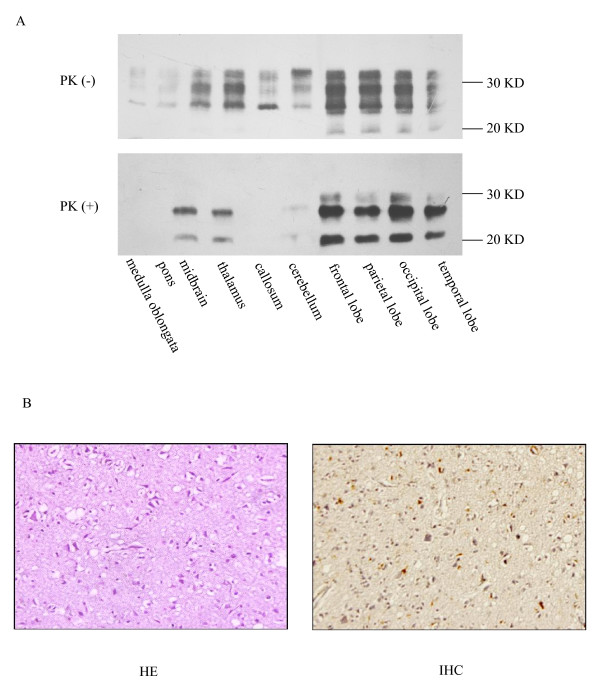
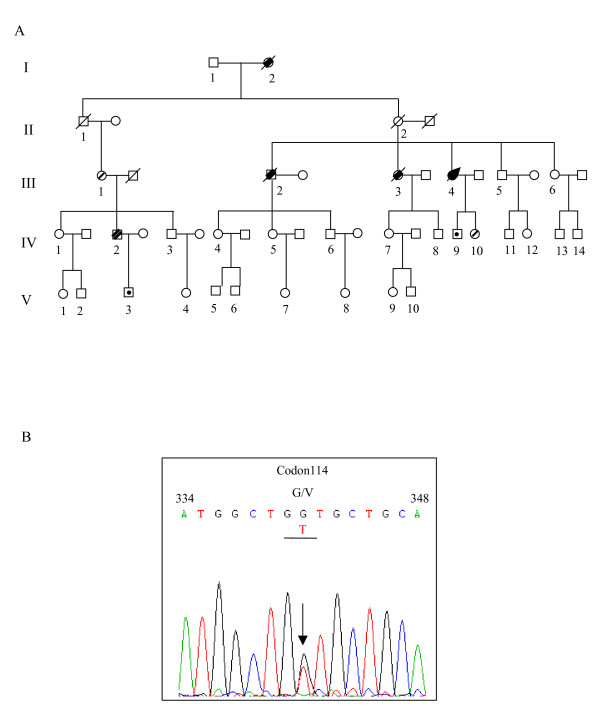
A 47-year-old Han-Chinese woman was hospitalized with a 2-year history of progressive dementia, tiredness, lethargy and mild difficulty in falling asleep. On neurological examination, there was severe apathy, spontaneous myoclonus of the lower limbs, generalized hyperreflexia and bilateral Babinski signs. A missense mutation (T to G) was identified at the position of nt 341 in one PRNP allele, leading to a change from glycine (Gly) to valine (Val) at codon 114. PK-resistant PrPSc was detected in brain tissues by Western blotting and immunohistochemical assays. Information on pedigree was collected notably by interviews with family members. A further four suspected patients in five consecutive generations of the family have been identified. One of them was hospitalized for progressive memory impairment at the age of 32. On examination, he had impairment of memory, calculation and comprehension, mild ataxia of the limbs, tremor and a left Babinski sign. He is still alive.
This family with G114V inherited prion disease is the first to be described in China and represents the second family worldwide in which this mutation has been identified. Three other suspected cases have been retrospectively identified in this family, and a further case with suggestive clinical manifestations has been shown by gene sequencing to have the causal mutation.
传染性海绵状脑病是一组人类和动物的神经退行性疾病。遗传性克雅氏病是由PRNP基因突变导致异常PrP蛋白表达而引发疾病,包括家族性克雅氏病、格斯特曼-施特劳斯勒-谢inker综合征和致死性家族性失眠症。
一名47岁的汉族女性因进行性痴呆、疲劳、嗜睡及轻度入睡困难2年入院。神经系统检查发现严重淡漠、下肢自发性肌阵挛、全身反射亢进及双侧巴宾斯基征。在一个PRNP等位基因的第341位核苷酸处鉴定出一个错义突变(T到G),导致密码子114处的甘氨酸(Gly)变为缬氨酸(Val)。通过蛋白质印迹法和免疫组织化学检测在脑组织中检测到抗蛋白酶K的PrPSc。通过与家庭成员访谈显著收集了家系信息。在该家族连续五代中又发现了另外四名疑似患者。其中一名在32岁时因进行性记忆障碍住院。检查发现他有记忆、计算和理解能力障碍,轻度肢体共济失调、震颤及左侧巴宾斯基征。他仍然活着。
这个携带G114V遗传性朊病毒病的家族是中国首次报道的,也是全球第二个鉴定出该突变的家族。在这个家族中另外回顾性鉴定出三例疑似病例,并且通过基因测序显示另外一例具有提示性临床表现的病例存在致病突变。