Johns Hopkins Bloomberg School of Public Health, Baltimore, MD, USA.
Confl Health. 2008 Oct 17;2:13. doi: 10.1186/1752-1505-2-13.
An HIV behavioral surveillance survey was undertaken in November 2005 at Lugufu refugee camp and surrounding host villages, located near western Tanzania's border with the Democratic Republic of Congo (DRC).
The sample size was 1,743 persons based on cluster survey methodology. All members of selected households between 15-49 years old were eligible respondents. Questions included HIV-related behaviors, population displacement, mobility, networking and forced sex. Data was analyzed using Stata to measure differences in proportions (chi-square) and differences in means (t-test) between gender, age groups, and settlement location for variables of interest.
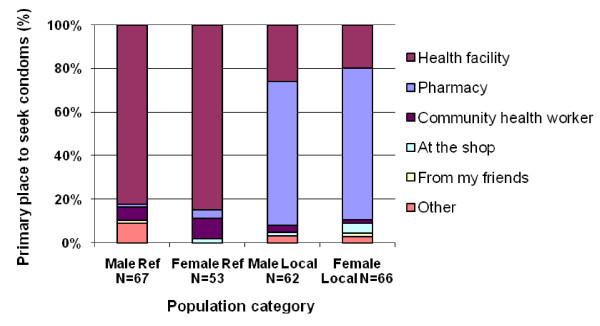
Study results reflect the complexity of factors that may promote or inhibit HIV transmission in conflict-affected and displaced populations. Within this setting, factors that may increase the risk of HIV infections among refugees compared to the population in surrounding villages include young age of sexual initiation among males (15.9 years vs. 19.8 years, p = .000), high-risk sex partners in the 15-24 year age group (40% vs. 21%, chi2 33.83, p = .000), limited access to income (16% vs. 51% chi2 222.94, p = .000), and the vulnerability of refugee women, especially widowed, divorced and never-married women, to transactional sex (married vs. never married, divorced, widowed: for 15-24 age group, 4% and 18% respectively, chi2 8.07, p = .004; for 25-49 age group, 4% and 23% respectively, chi2 21.46, p = .000). A majority of both refugee and host village respondents who experienced forced sex in the past 12 months identified their partner as perpetrator (64% camp and 87% in villages). Although restrictions on movements in and out of the camp exist, there was regular interaction between communities. Condom use was found to be below 50%, and expanded population networks may also increase opportunities for HIV transmission. Availability of refugee health services may be a protective factor. Most respondents knew where to go for HIV testing (84% of refugee respondents and 78% of respondents in surrounding villages), while more refugees than respondents from villages had ever been tested (42% vs. 22%, chi2 63.69, p = .000).
This research has important programmatic implications. Regardless of differences between camp and village populations, study results point to the need for targeted activities within each population. Services should include youth education and life skills programs emphasizing the benefits of delayed sexual initiation and the risks involved in transactional sex, especially in the camp where greater proportions of youth are affected by these issues relative to the surrounding host villages. As well, programs should stress the importance of correct and consistent condom use to increase usage in both populations. Further investigation into forced sex within regular partnerships, and programs that encourage male involvement in addressing this issue are needed. Program managers should verify that current commodity distribution systems ensure vulnerable women's access to resources, and consider additional program responses.
2005 年 11 月,在位于坦桑尼亚西部边境附近的卢古富难民营和周边的收容村进行了艾滋病毒行为监测调查。
采用整群抽样方法,样本量为 1743 人。所有年龄在 15-49 岁之间的被选中家庭的成员都是合格的受访者。问题包括与艾滋病毒相关的行为、人口流离失所、流动、网络和被迫性行为。使用 Stata 分析数据,以衡量变量之间的差异(卡方检验)和性别、年龄组和定居点之间的差异(t 检验)。
研究结果反映了可能促进或抑制受冲突影响和流离失所人口中艾滋病毒传播的各种因素的复杂性。在这种情况下,与周围村庄的人口相比,难民中艾滋病毒感染风险增加的因素包括男性性开始年龄较小(15.9 岁对 19.8 岁,p =.000),15-24 岁年龄组的高风险性伴侣(40%对 21%,卡方检验 33.83,p =.000),获得收入的机会有限(16%对 51%,卡方检验 222.94,p =.000),以及难民妇女,特别是寡妇、离婚和未婚妇女,易受交易性性行为的影响(已婚对未婚、离婚、丧偶:15-24 岁年龄组分别为 4%和 18%,卡方检验 8.07,p =.004;25-49 岁年龄组分别为 4%和 23%,卡方检验 21.46,p =.000)。过去 12 个月内经历过强迫性行为的难民和收容村受访者中,大多数人都认为他们的伴侣是施暴者(营地为 64%,村庄为 87%)。尽管对进出营地的限制存在,但社区之间仍有定期互动。发现避孕套使用率低于 50%,扩大的人口网络也可能增加艾滋病毒传播的机会。难民保健服务的提供可能是一个保护因素。大多数受访者知道去哪里进行艾滋病毒检测(84%的难民受访者和 78%的收容村受访者),而比收容村的受访者更多的难民曾经接受过检测(42%对 22%,卡方检验 63.69,p =.000)。
这项研究具有重要的计划意义。无论营地和村庄人口之间存在差异,研究结果都表明需要在每个群体中开展有针对性的活动。服务应包括青年教育和生活技能方案,强调延迟性开始的好处和交易性性行为的风险,特别是在营地,相对于周边收容村,更多的青年受到这些问题的影响。此外,方案应强调正确和持续使用避孕套的重要性,以增加两个群体的使用率。还需要进一步调查定期伴侣关系中的强迫性行为,以及鼓励男性参与解决这一问题的方案。方案管理人员应核实当前的商品分配系统是否确保弱势妇女获得资源,并考虑采取其他方案应对措施。
