Lau-Barraco Cathy, Skewes Monica C, Stasiewicz Paul R
Research Institute on Addictions, University at Buffalo, 1021 Main Street, Buffalo, NY 14203, United States.
Addict Behav. 2009 Jan;34(1):68-74. doi: 10.1016/j.addbeh.2008.09.002. Epub 2008 Sep 17.
The purpose of the present study was to examine gender differences in the frequency of high-risk drinking situations and to investigate the extent to which depressive symptoms mediate the relationship.
Participants were 143 outpatient alcohol treatment seekers. Each participant completed the Beck Depression Inventory-II and Inventory of Drug-Taking Situations (IDTS) at baseline prior to treatment.
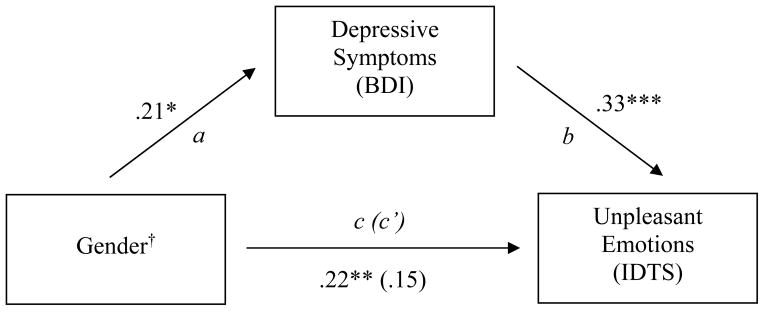
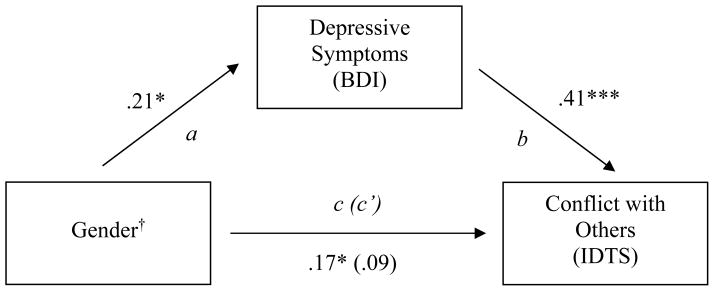
Multivariate analysis of variance was used to examine gender differences in drinking across eight categories of situations assessed on the IDTS. Mediational analyses tested whether gender differences on these IDTS subscales may be mediated by depressive symptoms. We found support for the hypothesis that women report drinking more than men in response to unpleasant emotions and conflict with others, and that these associations are significantly mediated by depression severity.
The current findings have important implications for appropriate treatment for alcohol-dependent women. In particular, such treatment should include training in affect regulation and interpersonal skills, as well as treatment for depression, when appropriate.
本研究旨在探讨高风险饮酒情境频率中的性别差异,并调查抑郁症状在这种关系中所起的中介作用程度。
参与者为143名寻求门诊酒精治疗的患者。每位参与者在治疗前的基线阶段完成了贝克抑郁量表第二版(Beck Depression Inventory-II)和吸毒情境量表(Inventory of Drug-Taking Situations,IDTS)。
采用多变量方差分析来检验在IDTS评估的八类情境中饮酒的性别差异。中介分析测试了这些IDTS分量表上的性别差异是否可能由抑郁症状介导。我们发现有证据支持以下假设:女性在应对不愉快情绪和与他人冲突时报告的饮酒量多于男性,并且这些关联由抑郁严重程度显著介导。
当前研究结果对酒精依赖女性的适当治疗具有重要意义。特别是,此类治疗应包括情感调节和人际交往技能培训,以及在适当时对抑郁症的治疗。