Tsai Shirling, Butler Jason, Rafii Shahin, Liu Bo, Kent K Craig
Department of Surgery, Division of Vascular Surgery, New York Presbyterian Hospital and Weill Medical College of Cornell University, New York, NY 10021, USA.
J Vasc Surg. 2009 Feb;49(2):502-10. doi: 10.1016/j.jvs.2008.07.060. Epub 2008 Oct 22.
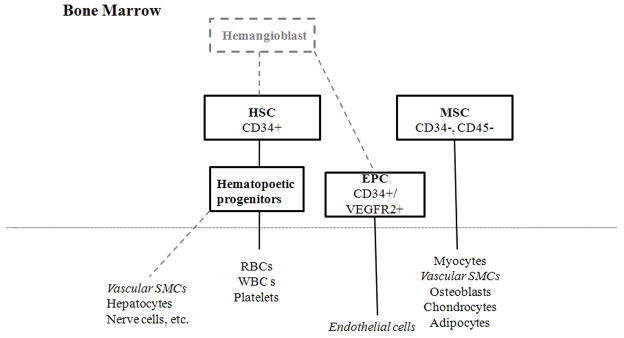
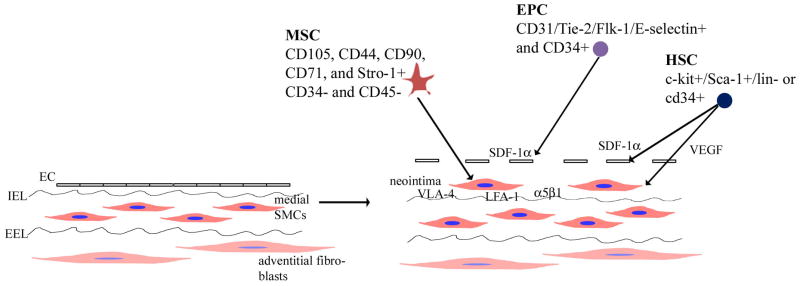
Recent evidence has suggested that bone marrow derived progenitor cells may contribute to the development of intimal hyperplasia after arterial injury, a process that classically has been believed to involve extracellular matrix deposition and the migration and proliferation of cells within the arterial wall. The first studies demonstrating the existence of bone marrow derived cells in the neointima employed mouse models of arterial injury in conjunction with whole bone marrow transplant. Later studies have shown specifically that bone marrow derived hematopoietic or mesenchymal stem cells can be recruited to the neointima and differentiate into smooth muscle cells or endothelial cells. Although the data vary widely depending on different animal models of arterial injury and methods of labeling bone marrow derived cells, it appears that progenitor cells do indeed contribute to intimal hyperplasia, at least in mouse models of arterial injury. To date, signaling molecules such as c-kit and c-kit ligand, and stromal derived factor-1alpha, in addition to matrix metalloproteinase-9, have emerged as critical factors that recruit progenitor cells to sites of arterial injury. While much progress has been made, several tasks remain, including the need for a more in-depth understanding of the mechanisms underlying progenitor cell recruitment, characterization of the involved progenitor cells, and finally validation that the observations made in these mouse models of disease are also applicable to human arterial restenosis.
最近的证据表明,骨髓来源的祖细胞可能在动脉损伤后内膜增生的发展中起作用,传统上认为这一过程涉及细胞外基质沉积以及动脉壁内细胞的迁移和增殖。最早证明新生内膜中存在骨髓来源细胞的研究采用了动脉损伤小鼠模型并结合全骨髓移植。后来的研究特别表明,骨髓来源的造血干细胞或间充质干细胞可被募集到新生内膜并分化为平滑肌细胞或内皮细胞。尽管根据不同的动脉损伤动物模型和标记骨髓来源细胞的方法,数据差异很大,但至少在动脉损伤小鼠模型中,祖细胞似乎确实对内膜增生有贡献。迄今为止,除基质金属蛋白酶-9外,诸如c-kit和c-kit配体以及基质衍生因子-1α等信号分子已成为将祖细胞募集到动脉损伤部位的关键因素。虽然已经取得了很大进展,但仍有几项任务有待完成,包括需要更深入地了解祖细胞募集的潜在机制、对所涉及的祖细胞进行表征,以及最终验证在这些疾病小鼠模型中所做的观察结果也适用于人类动脉再狭窄。