Department of Neuroscience, University of Pennsylvania Philadelphia, PA, USA.
Front Mol Neurosci. 2008 May 30;1:7. doi: 10.3389/neuro.02.007.2008. eCollection 2008.
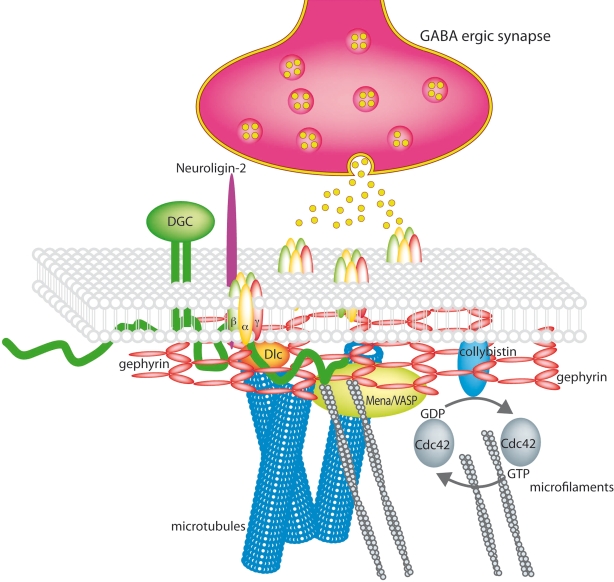
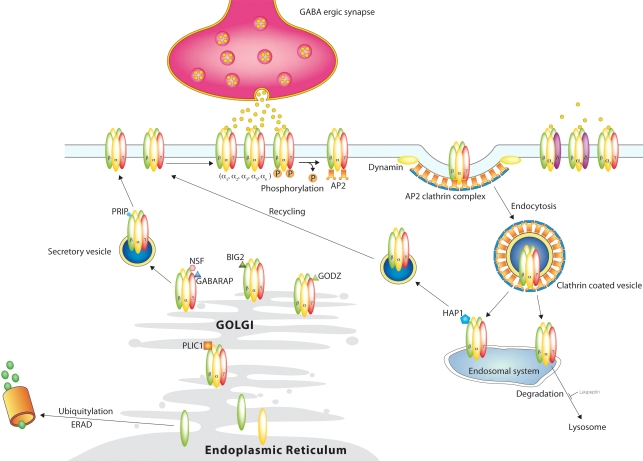
GABA(A) receptors are located on the majority of neurons in the central and peripheral nervous system, where they mediate important actions of the neurotransmitter gamma-aminobutyric acid. Early in development the trophic properties of GABA allow a healthy development of the nervous system. Most neurons have a high intracellular Cl-concentration early in life due to the late functional expression of the Cl-pump KCC2, therefore GABA has excitatory effects at this stage. Upon higher expression and activation of KCC2 GABA takes on its inhibitory effects while glutamate functions as the major excitatory neurotransmitter. Like all multisubunit membrane proteins the GABA(A) receptor is assembled in the ER and travels through the Golgi and remaining secretory pathway to the cell surface, where it mediates GABA actions either directly at the synapses or at extrasynaptic sites responding to ambient GABA to provide a basal tonic inhibitory state. In order to adapt to changing needs and information states, the GABAergic system is highly dynamic. That includes subtype specific trafficking to different locations in the cell, regulation of mobility by interaction with scaffold molecules, posttranslational modifications, that either directly affect channel function or the interaction with other proteins and finally the dynamic exchange between surface and intracellular receptor pools, that either prepare receptors for recycling to the surface or degradation. Here we give an overview of the current understanding of GABA(A) receptor functional and molecular dynamics that play a major part in maintaining the balance between excitation and inhibition and in changes in network activity.
GABA(A) 受体位于中枢和周围神经系统的大多数神经元上,在那里它们介导神经递质 γ-氨基丁酸的重要作用。在早期发育过程中,GABA 的营养特性允许神经系统的健康发育。由于 Cl-泵 KCC2 的功能表达较晚,大多数神经元在生命早期具有高细胞内 Cl-浓度,因此 GABA 在这个阶段具有兴奋作用。随着 KCC2 的表达和激活增加,GABA 发挥其抑制作用,而谷氨酸则作为主要的兴奋性神经递质发挥作用。像所有多亚基膜蛋白一样,GABA(A) 受体在 ER 中组装,并通过高尔基体和剩余的分泌途径到达细胞表面,在那里它通过直接在突触处或响应周围 GABA 的突触外位点发挥 GABA 作用,提供基础紧张性抑制状态。为了适应不断变化的需求和信息状态,GABA 能系统具有高度动态性。这包括特定于亚型的向细胞内不同位置的转运、与支架分子相互作用的流动性调节、直接影响通道功能或与其他蛋白质相互作用的翻译后修饰,以及表面和细胞内受体库之间的动态交换,这些交换要么为受体的再循环到表面或降解做准备。在这里,我们概述了 GABA(A) 受体功能和分子动力学的最新理解,这些动力学在维持兴奋和抑制之间的平衡以及网络活动的变化中起着重要作用。