Hirokawa Go, Iwakura Nobuhiro, Kaji Akira, Kaji Hideko
Department of Biochemistry and Molecular Biology, Kimmel Cancer Center, Jefferson Medical College, Thomas Jefferson University, Philadelphia, PA 19107, USA.
Nucleic Acids Res. 2008 Dec;36(21):6676-87. doi: 10.1093/nar/gkn647. Epub 2008 Oct 23.
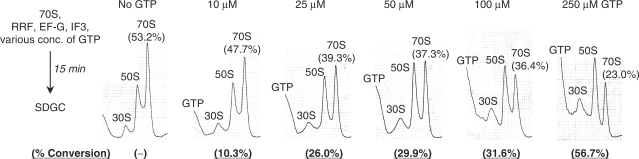
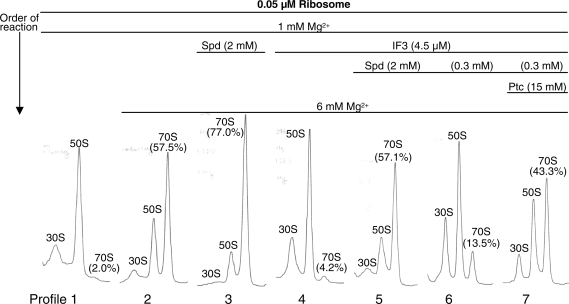
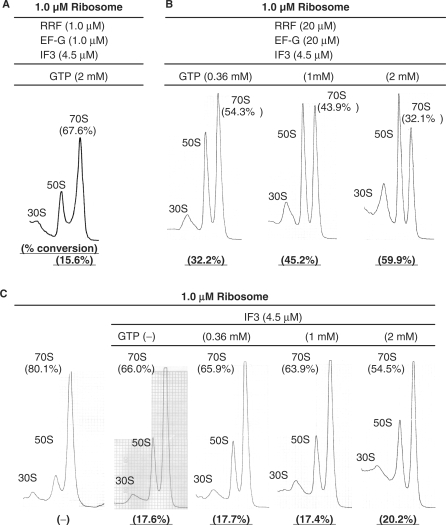
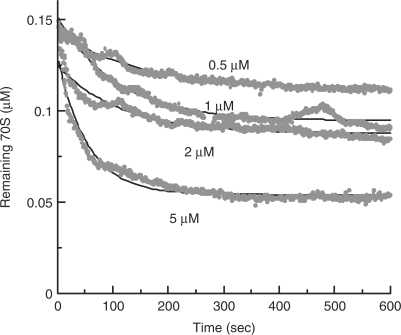
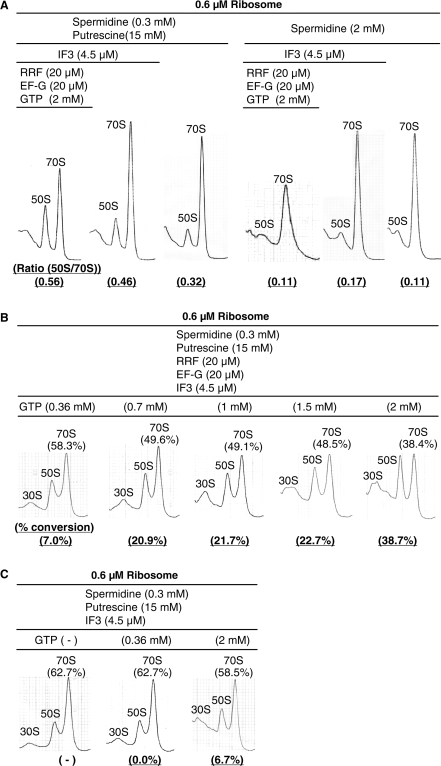
Ribosome recycling factor (RRF), elongation factor G (EF-G) and GTP split 70S ribosomes into subunits. Here, we demonstrated that the splitting was transient and the exhaustion of GTP resulted in re-association of the split subunits into 70S ribosomes unless IF3 (initiation factor 3) was present. However, the splitting was observed with sucrose density gradient centrifugation (SDGC) without IF3 if RRF, EF-G and GTP were present in the SDGC buffer. The splitting of 70S ribosomes causes the decrease of light scattering by ribosomes. Kinetic constants obtained from the light scattering studies are sufficient to account for the splitting of 70S ribosomes by RRF and EF-G/GTP during the lag phase for activation of ribosomes for the log phase. As the amount of 70S ribosomes increased, more RRF, EF-G and GTP were necessary to split 70S ribosomes. In the presence of a physiological amount of polyamines, GTP and factors, even 0.6 microM 70S ribosomes (12 times higher than the 70S ribosomes for routine assay) were split. Spermidine (2 mM) completely inhibited anti-association activity of IF3, and the RRF/EF-G/GTP-dependent splitting of 70S ribosomes.
核糖体循环因子(RRF)、延伸因子G(EF-G)和GTP可将70S核糖体裂解为亚基。在此,我们证明这种裂解是短暂的,并且GTP耗尽会导致裂解后的亚基重新缔合形成70S核糖体,除非存在起始因子3(IF3)。然而,如果在蔗糖密度梯度离心(SDGC)缓冲液中存在RRF、EF-G和GTP,在没有IF3的情况下通过蔗糖密度梯度离心也能观察到裂解现象。70S核糖体的裂解会导致核糖体引起的光散射减少。从光散射研究中获得的动力学常数足以解释在核糖体激活对数期的延迟阶段RRF和EF-G/GTP对70S核糖体的裂解作用。随着70S核糖体数量的增加,需要更多的RRF、EF-G和GTP来裂解70S核糖体。在存在生理量的多胺、GTP和因子的情况下,即使是0.6微摩尔的70S核糖体(比常规测定的70S核糖体高12倍)也会被裂解。亚精胺(2毫摩尔)完全抑制IF3的抗缔合活性以及70S核糖体的RRF/EF-G/GTP依赖性裂解。