• 文献检索
  • 文档翻译
  • 深度研究
  • 学术资讯
  • Suppr Zotero 插件Zotero 插件
  • 邀请有礼
  • 套餐&价格
  • 历史记录
应用&插件
Suppr Zotero 插件Zotero 插件浏览器插件Mac 客户端Windows 客户端微信小程序
定价
高级版会员购买积分包购买API积分包
服务
文献检索文档翻译深度研究API 文档MCP 服务
关于我们
关于 Suppr公司介绍联系我们用户协议隐私条款
关注我们

Suppr 超能文献

核心技术专利:CN118964589B侵权必究
粤ICP备2023148730 号-1Suppr @ 2026

文献检索

告别复杂PubMed语法,用中文像聊天一样搜索,搜遍4000万医学文献。AI智能推荐,让科研检索更轻松。

立即免费搜索

文件翻译

保留排版,准确专业,支持PDF/Word/PPT等文件格式,支持 12+语言互译。

免费翻译文档

深度研究

AI帮你快速写综述,25分钟生成高质量综述,智能提取关键信息,辅助科研写作。

立即免费体验

南方根结线虫分泌组的直接鉴定揭示了具有重编程宿主细胞潜力的蛋白质。

Direct identification of the Meloidogyne incognita secretome reveals proteins with host cell reprogramming potential.

作者信息

Bellafiore Stéphane, Shen Zhouxin, Rosso Marie-Noelle, Abad Pierre, Shih Patrick, Briggs Steven P

机构信息

Division of Biological Sciences, University of California, San Diego, La Jolla, CA, USA.

出版信息

PLoS Pathog. 2008 Oct;4(10):e1000192. doi: 10.1371/journal.ppat.1000192. Epub 2008 Oct 31.

DOI:10.1371/journal.ppat.1000192
PMID:18974830
原文链接:https://pmc.ncbi.nlm.nih.gov/articles/PMC2568823/
Abstract

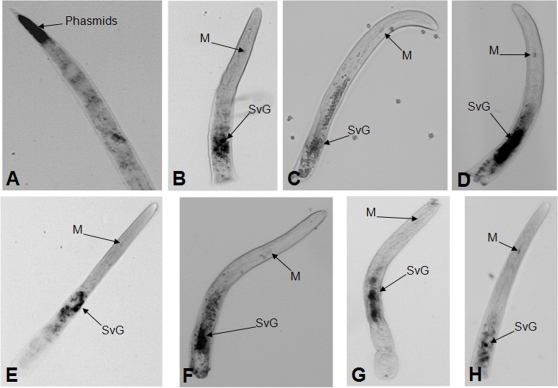
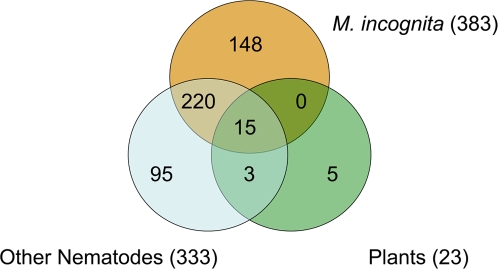
The root knot nematode, Meloidogyne incognita, is an obligate parasite that causes significant damage to a broad range of host plants. Infection is associated with secretion of proteins surrounded by proliferating cells. Many parasites are known to secrete effectors that interfere with plant innate immunity, enabling infection to occur; they can also release pathogen-associated molecular patterns (PAMPs, e.g., flagellin) that trigger basal immunity through the nematode stylet into the plant cell. This leads to suppression of innate immunity and reprogramming of plant cells to form a feeding structure containing multinucleate giant cells. Effectors have generally been discovered using genetics or bioinformatics, but M. incognita is non-sexual and its genome sequence has not yet been reported. To partially overcome these limitations, we have used mass spectrometry to directly identify 486 proteins secreted by M. incognita. These proteins contain at least segmental sequence identity to those found in our 3 reference databases (published nematode proteins; unpublished M. incognita ESTs; published plant proteins). Several secreted proteins are homologous to plant proteins, which they may mimic, and they contain domains that suggest known effector functions (e.g., regulating the plant cell cycle or growth). Others have regulatory domains that could reprogram cells. Using in situ hybridization we observed that most secreted proteins were produced by the subventral glands, but we found that phasmids also secreted proteins. We annotated the functions of the secreted proteins and classified them according to roles they may play in the development of root knot disease. Our results show that parasite secretomes can be partially characterized without cognate genomic DNA sequence. We observed that the M. incognita secretome overlaps the reported secretome of mammalian parasitic nematodes (e.g., Brugia malayi), suggesting a common parasitic behavior and a possible conservation of function between metazoan parasites of plants and animals.

摘要

根结线虫(Meloidogyne incognita)是一种专性寄生虫,会对多种寄主植物造成严重损害。感染与增殖细胞周围分泌的蛋白质有关。已知许多寄生虫会分泌效应子来干扰植物的固有免疫,从而引发感染;它们还可以通过线虫口针向植物细胞释放能触发基础免疫的病原体相关分子模式(PAMPs,如鞭毛蛋白)。这会导致固有免疫受到抑制,植物细胞重新编程以形成包含多核巨细胞的取食结构。效应子通常是通过遗传学或生物信息学方法发现的,但南方根结线虫是无性繁殖的,其基因组序列尚未见报道。为了部分克服这些限制,我们使用质谱法直接鉴定了南方根结线虫分泌的486种蛋白质。这些蛋白质与我们的3个参考数据库(已发表的线虫蛋白质;未发表的南方根结线虫ESTs;已发表的植物蛋白质)中发现的蛋白质至少具有部分序列一致性。几种分泌蛋白与植物蛋白同源,它们可能会模拟植物蛋白,并且含有表明已知效应子功能的结构域(例如,调节植物细胞周期或生长)。其他蛋白具有可使细胞重新编程的调节结构域。通过原位杂交我们观察到,大多数分泌蛋白是由腹侧下腺产生的,但我们发现尾感器也能分泌蛋白质。我们注释了分泌蛋白的功能,并根据它们在根结病发展中可能发挥的作用进行了分类。我们的结果表明,在没有同源基因组DNA序列的情况下,也可以部分表征寄生虫的分泌组。我们观察到南方根结线虫的分泌组与已报道的哺乳动物寄生线虫(如马来布鲁线虫)的分泌组有重叠,这表明动植物的后生动物寄生虫之间存在共同的寄生行为和可能的功能保守性。
https://cdn.ncbi.nlm.nih.gov/pmc/blobs/0a42/2568823/59701864662b/ppat.1000192.g004.jpg
https://cdn.ncbi.nlm.nih.gov/pmc/blobs/0a42/2568823/a70b0090c8c2/ppat.1000192.g001.jpg
https://cdn.ncbi.nlm.nih.gov/pmc/blobs/0a42/2568823/ace5ad260eb3/ppat.1000192.g002.jpg
https://cdn.ncbi.nlm.nih.gov/pmc/blobs/0a42/2568823/efc8153c9fe2/ppat.1000192.g003.jpg
https://cdn.ncbi.nlm.nih.gov/pmc/blobs/0a42/2568823/59701864662b/ppat.1000192.g004.jpg
https://cdn.ncbi.nlm.nih.gov/pmc/blobs/0a42/2568823/a70b0090c8c2/ppat.1000192.g001.jpg
https://cdn.ncbi.nlm.nih.gov/pmc/blobs/0a42/2568823/ace5ad260eb3/ppat.1000192.g002.jpg
https://cdn.ncbi.nlm.nih.gov/pmc/blobs/0a42/2568823/efc8153c9fe2/ppat.1000192.g003.jpg
https://cdn.ncbi.nlm.nih.gov/pmc/blobs/0a42/2568823/59701864662b/ppat.1000192.g004.jpg

相似文献

1
Direct identification of the Meloidogyne incognita secretome reveals proteins with host cell reprogramming potential.南方根结线虫分泌组的直接鉴定揭示了具有重编程宿主细胞潜力的蛋白质。
PLoS Pathog. 2008 Oct;4(10):e1000192. doi: 10.1371/journal.ppat.1000192. Epub 2008 Oct 31.
2
Mining novel effector proteins from the esophageal gland cells of Meloidogyne incognita.从南方根结线虫食道腺细胞中挖掘新的效应蛋白。
Mol Plant Microbe Interact. 2014 Sep;27(9):965-74. doi: 10.1094/MPMI-03-14-0076-R.
3
The 8D05 parasitism gene of Meloidogyne incognita is required for successful infection of host roots.根结线虫的 8D05 寄生基因是其成功侵染宿主根系所必需的。
Phytopathology. 2013 Feb;103(2):175-81. doi: 10.1094/PHYTO-07-12-0173-R.
4
An SXP/RAL-2 protein produced by the subventral pharyngeal glands in the plant parasitic root-knot nematode Meloidogyne incognita.南方根结线虫(Meloidogyne incognita)植物寄生性根结线虫腹下咽腺产生的一种SXP/RAL-2蛋白。
Parasitol Res. 2005 Jan;95(1):50-4. doi: 10.1007/s00436-004-1243-0. Epub 2004 Nov 25.
5
Direct identification of stylet secreted proteins from root-knot nematodes by a proteomic approach.通过蛋白质组学方法直接鉴定根结线虫口针分泌蛋白
Mol Biochem Parasitol. 2002 May;121(2):205-11. doi: 10.1016/s0166-6851(02)00034-8.
6
Peroxiredoxins from the plant parasitic root-knot nematode, Meloidogyne incognita, are required for successful development within the host.植物寄生性根结线虫(Meloidogyne incognita)的过氧化物还原酶对于在宿主内成功发育是必需的。
Int J Parasitol. 2011 Mar;41(3-4):385-96. doi: 10.1016/j.ijpara.2010.10.008. Epub 2010 Dec 8.
7
Identification of Two Meloidogyne hapla Genes and an Investigation of Their Roles in the Plant-Nematode Interaction.鉴定两个滑刃线虫基因及其在植物-线虫互作中的作用研究。
Mol Plant Microbe Interact. 2017 Feb;30(2):101-112. doi: 10.1094/MPMI-06-16-0107-R. Epub 2017 Feb 23.
8
Mining the secretome of the root-knot nematode Meloidogyne chitwoodi for candidate parasitism genes.挖掘根结线虫奇氏根结线虫的分泌蛋白质组以寻找候选寄生基因。
Mol Plant Pathol. 2008 Jan;9(1):1-10. doi: 10.1111/j.1364-3703.2007.00435.x.
9
Rice susceptibility to root-knot nematodes is enhanced by the Meloidogyne incognita MSP18 effector gene.根结线虫使水稻易感性增强的是 Meloidogyne incognita MSP18 效应基因。
Planta. 2019 Oct;250(4):1215-1227. doi: 10.1007/s00425-019-03205-3. Epub 2019 Jun 19.
10
Genomes of parasitic nematodes (Meloidogyne hapla, Meloidogyne incognita, Ascaris suum and Brugia malayi) have a reduced complement of small RNA interference pathway genes: knockdown can reduce host infectivity of M. incognita.寄生线虫(北方根结线虫、南方根结线虫、猪蛔虫和马来布鲁线虫)的基因组中小RNA干扰途径基因的数量减少:基因敲低可降低南方根结线虫对宿主的感染力。
Funct Integr Genomics. 2016 Jul;16(4):441-57. doi: 10.1007/s10142-016-0495-y. Epub 2016 Apr 28.

引用本文的文献

1
Mitochondrial Protein MjEF-Tu is Secreted into Host Plants by Nematodes Eliciting Immune Signaling and Resistance.线粒体蛋白MjEF-Tu由引发免疫信号和抗性的线虫分泌到宿主植物中。
Adv Sci (Weinh). 2025 Mar;12(11):e2412968. doi: 10.1002/advs.202412968. Epub 2025 Jan 30.
2
Integrative multi-omics analysis reveals the translational landscape of the plant-parasitic nematode Meloidogyne incognita.整合多组学分析揭示了植物寄生线虫南方根结线虫的翻译全景。
Commun Biol. 2025 Jan 28;8(1):140. doi: 10.1038/s42003-025-07533-x.
3
Evolution of parasitism genes in the plant parasitic nematodes.

本文引用的文献

1
Ultrastructure of the Phasmids of Scutellonema brachyurum.短尾盾线虫尾感器的超微结构
J Nematol. 1985 Apr;17(2):175-86.
2
A method for staining nematode secretions and structures.一种对线虫分泌物和结构进行染色的方法。
J Nematol. 1988 Jan;20(1):70-8.
3
Antioxidant enzymes in phytoparasitic nematodes.植物寄生线虫中的抗氧化酶。
寄生性线虫中寄生基因的进化。
Sci Rep. 2024 Feb 14;14(1):3733. doi: 10.1038/s41598-024-54330-3.
4
In silico secretome analyses of the polyphagous root-knot nematode Meloidogyne javanica: a resource for studying M. javanica secreted proteins.多宿主根结线虫 Meloidogyne javanica 的计算机分泌组分析:研究 M. javanica 分泌蛋白的资源。
BMC Genomics. 2023 Jun 1;24(1):296. doi: 10.1186/s12864-023-09366-6.
5
Overexpression of a soybean Globin (GmGlb1-1) gene reduces plant susceptibility to Meloidogyne incognita.过表达大豆球蛋白(GmGlb1-1)基因降低植物对南方根结线虫的易感性。
Planta. 2022 Sep 16;256(4):83. doi: 10.1007/s00425-022-03992-2.
6
Host-delivered RNAi-mediated silencing of the root-knot nematode (Meloidogyne incognita) effector genes, Mi-msp10 and Mi-msp23, confers resistance in Arabidopsis and impairs reproductive ability of the root-knot nematode.宿主介导的 RNAi 介导的根结线虫(Meloidogyne incognita)效应基因 Mi-msp10 和 Mi-msp23 的沉默赋予拟南芥抗性,并损害根结线虫的生殖能力。
Planta. 2022 Sep 9;256(4):74. doi: 10.1007/s00425-022-03977-1.
7
Nematode microRNAs can Individually Regulate Interferon Regulatory Factor 4 and mTOR in Differentiating T Helper 2 Lymphocytes and Modulate Cytokine Production in Macrophages.线虫微小RNA可分别调控分化中的辅助性T细胞2淋巴细胞中的干扰素调节因子4和雷帕霉素靶蛋白,并调节巨噬细胞中的细胞因子产生。
Front Mol Biosci. 2022 Jun 28;9:909312. doi: 10.3389/fmolb.2022.909312. eCollection 2022.
8
The Minichromosome Maintenance Complex Component 2 (MjMCM2) of Meloidogyne javanica is a potential effector regulating the cell cycle in nematode-induced galls.爪哇根结线虫的微小染色体维持复合体成分 2(MjMCM2)是一种潜在的效应因子,调节线虫诱导的根结中的细胞周期。
Sci Rep. 2022 Jun 2;12(1):9196. doi: 10.1038/s41598-022-13020-8.
9
Insights Into the Genetics of the Zhonghua 11 Resistance to and Its Molecular Determinism in Rice.对中华11水稻抗稻瘟病的遗传学及其分子机制的见解
Front Plant Sci. 2022 May 4;13:854961. doi: 10.3389/fpls.2022.854961. eCollection 2022.
10
Characterization of Five Effectors Associated with PsoRPM3.鉴定与 PsoRPM3 相关的五个效应子。
Int J Mol Sci. 2022 Jan 28;23(3):1498. doi: 10.3390/ijms23031498.
J Nematol. 1997 Jun;29(2):153-9.
4
Mining the secretome of the root-knot nematode Meloidogyne chitwoodi for candidate parasitism genes.挖掘根结线虫奇氏根结线虫的分泌蛋白质组以寻找候选寄生基因。
Mol Plant Pathol. 2008 Jan;9(1):1-10. doi: 10.1111/j.1364-3703.2007.00435.x.
5
Genome sequence of the metazoan plant-parasitic nematode Meloidogyne incognita.后生动物植物寄生线虫南方根结线虫的基因组序列。
Nat Biotechnol. 2008 Aug;26(8):909-15. doi: 10.1038/nbt.1482. Epub 2008 Jul 27.
6
The malaria secretome: from algorithms to essential function in blood stage infection.疟原虫分泌组:从算法到血液阶段感染中的基本功能
PLoS Pathog. 2008 Jun 13;4(6):e1000084. doi: 10.1371/journal.ppat.1000084.
7
Parasitism proteins in nematode-plant interactions.线虫与植物相互作用中的寄生蛋白
Curr Opin Plant Biol. 2008 Aug;11(4):360-6. doi: 10.1016/j.pbi.2008.04.003. Epub 2008 May 20.
8
The secretome of the filarial parasite, Brugia malayi: proteomic profile of adult excretory-secretory products.马来布鲁线虫丝虫寄生虫的分泌蛋白质组:成虫排泄-分泌产物的蛋白质组概况
Mol Biochem Parasitol. 2008 Jul;160(1):8-21. doi: 10.1016/j.molbiopara.2008.02.007. Epub 2008 Feb 16.
9
Silencing a candidate nematode effector gene corresponding to the tomato resistance gene Mi-1 leads to acquisition of virulence.沉默与番茄抗性基因Mi-1相对应的一个候选线虫效应基因会导致毒力的获得。
Mol Plant Microbe Interact. 2008 May;21(5):576-85. doi: 10.1094/MPMI-21-5-0576.
10
Responses of Heterodera glycines and Meloidogyne incognita to exogenously applied neuromodulators.大豆胞囊线虫和南方根结线虫对外源施用神经调节剂的反应。
J Helminthol. 2007 Dec;81(4):421-7. doi: 10.1017/S0022149X07850243. Epub 2007 Nov 16.