Wood Neil H, Feller Liviu
Department of Periodontology and Oral Medicine, School of Dentistry, University of Limpopo (Medunsa Campus) Pretoria, South Africa.
Cancer Cell Int. 2008 Oct 31;8:14. doi: 10.1186/1475-2867-8-14.
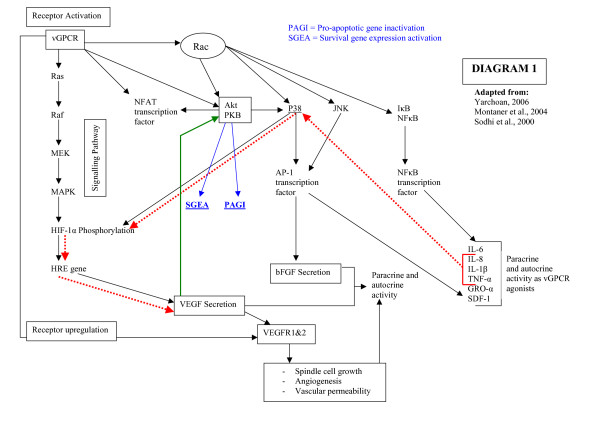
Human herpesvirus (HHV)-8 associated oncogenesis, a state of immune impairment, a local inflammatory environment, angiogenesis and HIV infection occurring concurrently are important factors for the development of HIV-associated Kaposi sarcoma (KS).Activation of the interleukin (IL)-6 receptor signalling pathway and constitutive signalling of viral G protein-coupled receptor (vGPCR) play an important role in the activation, proliferation and transformation of HHV-8 infected endothelial cells thus contributing to the initiation and progression of KS. HIV-tat protein, HIV-induced immune suppression and a hyperinflammatory state facilitate the oncogenic activity of HHV-8.In this article we reviewed some aspects of HIV-KS pathogenesis and tried to establish, according to the available information in the literature, whether HIV-KS is a monoclonal neoplasm or a benign angioproliferative disorder.From the data of this review it is evident that most of the HIV-KS lesions are oligoclonal in origin. It remains to be demonstrated whether these multiple monoclonal populations of cells are neoplastic, harbouring specific cytogenetic alterations such as mutations, rearrangements and amplifications, or are, as the current evidence shows, the result of HHV-8 induced intracellular signalling pathways that modulate the expression of cellular genes associated with cell cycle regulation, apoptosis, inflammatory response and angiogenesis, and represent a reactive angioproliferative disorder.
人疱疹病毒(HHV)-8相关的肿瘤发生、免疫损伤状态、局部炎症环境、血管生成和HIV感染同时发生是HIV相关卡波西肉瘤(KS)发生发展的重要因素。白细胞介素(IL)-6受体信号通路的激活以及病毒G蛋白偶联受体(vGPCR)的组成性信号传导在HHV-8感染的内皮细胞的激活、增殖和转化中起重要作用,从而促进KS的发生和发展。HIV- tat蛋白、HIV诱导的免疫抑制和高炎症状态促进了HHV-8的致癌活性。在本文中,我们综述了HIV-KS发病机制的一些方面,并根据文献中的现有信息试图确定HIV-KS是单克隆肿瘤还是良性血管增生性疾病。从本综述的数据可以明显看出,大多数HIV-KS病变起源于寡克隆。这些多个单克隆细胞群体是具有特定细胞遗传学改变(如突变、重排和扩增)的肿瘤性细胞,还是如目前证据所示,是HHV-8诱导的细胞内信号通路调节与细胞周期调控、细胞凋亡、炎症反应和血管生成相关的细胞基因表达的结果,代表一种反应性血管增生性疾病,仍有待证实。