Rada Balázs, Leto Thomas L
Laboratory of Host Defenses, National Institutes of Health, National Institute of Allergy and Infectious Diseases, 12441 Parklawn Drive, 20852, Rockville, MD, USA.
Immunol Res. 2009;43(1-3):198-209. doi: 10.1007/s12026-008-8071-8.
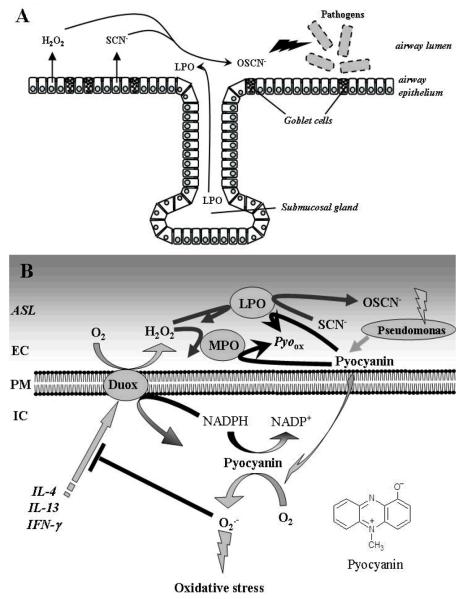
The importance of reactive oxygen species-dependent microbial killing by the phagocytic cell NADPH oxidase has been appreciated for some time, although only recently has an appreciation developed for the partnership of lactoperoxidase with related dual oxidases (Duox) within secretions of the airway surface layer. This system produces mild oxidants designed for extracellular killing that are effective against several airway pathogens, including Staphylococcus aureus, Burkholderia cepacia, and Pseudomonas aeruginosa. Establishment of chronic pseudomonas infections involves adaptations to resist oxidant-dependent killing by expression of a redox-active virulence factor, pyocyanin, that competitively inhibits epithelial Duox activity by consuming intracellular NADPH and producing superoxide, thereby inflicting oxidative stress on the host.
吞噬细胞NADPH氧化酶产生的依赖活性氧的微生物杀伤作用的重要性已被认识一段时间了,尽管直到最近才认识到乳过氧化物酶与气道表面层分泌物中的相关双氧化酶(Duox)之间的协同作用。该系统产生用于细胞外杀伤的温和氧化剂,对几种气道病原体有效,包括金黄色葡萄球菌、洋葱伯克霍尔德菌和铜绿假单胞菌。慢性铜绿假单胞菌感染的形成涉及通过表达一种氧化还原活性毒力因子绿脓菌素来适应抵抗依赖氧化剂的杀伤,该因子通过消耗细胞内NADPH并产生超氧化物来竞争性抑制上皮Duox活性,从而对宿主造成氧化应激。