Reyes-Ortiz Carlos A, Eschbach Karl, Zhang Dong D, Goodwin James S
School of Public Health, University of North Texas, Health Sciences Center, Fort Worth, TX 76107-2699, USA.
Cancer Epidemiol Biomarkers Prev. 2008 Nov;17(11):2931-6. doi: 10.1158/1055-9965.EPI-07-0430.
We have previously reported that cancer incidence for lung, female breast, and colon and rectum for Hispanics decreases with increasing percentage of Hispanics at the census tract. In contrast, cervical cancer incidence increases with increasing percentage of Hispanics at the census tract.
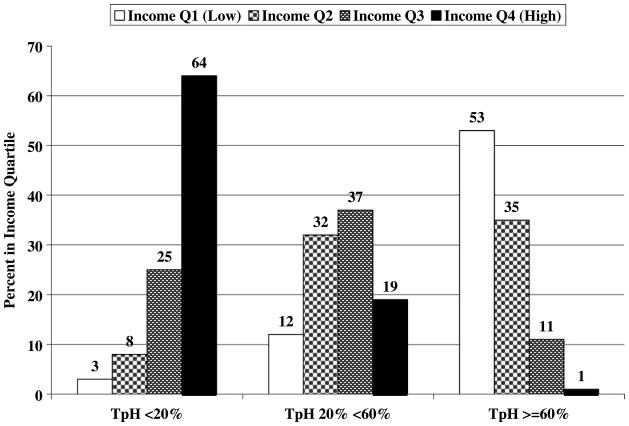
In this study, we investigate the hypothesis that Hispanics living in census tracts with high percentages of Hispanics are diagnosed with more advanced cancer, with respect to tumor size and stage of diagnosis. Data from the Surveillance, Epidemiology, and End Results registry and the U.S. Census Bureau were used to estimate the odds of diagnosis at a "late" stage (II, III, IV) versus "early" stage (I) and breast cancer tumor size among Hispanics as a function of census tract percent Hispanic. Hispanic ethnicity in the Surveillance, Epidemiology, and End Results registry was identified by medical record review and Hispanic surname lists. The study also used income of Hispanics living in the census tract and controlled for age at diagnosis and gender.
We found that Hispanics living in neighborhoods with higher density of Hispanic populations were more likely to be diagnosed with late-stage breast, cervical, or colorectal cancer, and to have a larger tumor size of breast cancer.
Our findings suggest that the benefits of lower cancer incidence in high tract percent Hispanics are partially offset by poorer access and reduced use of screening in conjunction with lower income, poorer health insurance coverage, and language barriers typical of these communities.
我们之前曾报道,西班牙裔人群中,肺部、女性乳腺以及结肠和直肠癌的发病率会随着普查区西班牙裔人口比例的增加而降低。相比之下,宫颈癌发病率则随着普查区西班牙裔人口比例的增加而上升。
在本研究中,我们调查了这样一个假设,即居住在西班牙裔人口比例高的普查区的西班牙裔人群,在肿瘤大小和诊断阶段方面,被诊断出患有更晚期癌症。利用监测、流行病学和最终结果登记处以及美国人口普查局的数据,来估计西班牙裔人群在“晚期”(II、III、IV期)与“早期”(I期)诊断的几率以及乳腺癌肿瘤大小与普查区西班牙裔人口百分比之间的函数关系。监测、流行病学和最终结果登记处中的西班牙裔种族通过病历审查和西班牙裔姓氏列表来确定。该研究还使用了居住在普查区的西班牙裔人群的收入,并对诊断时的年龄和性别进行了控制。
我们发现,居住在西班牙裔人口密度较高社区的西班牙裔人群更有可能被诊断出患有晚期乳腺癌、宫颈癌或结直肠癌,并且乳腺癌肿瘤更大。
我们的研究结果表明,在西班牙裔人口比例高的普查区癌症发病率较低的益处,部分被这些社区较差的医疗可及性、筛查使用率降低,以及低收入、较差的医疗保险覆盖范围和典型的语言障碍所抵消。