Hong Shin-Young, Seo Pil Joon, Yang Moon-Sik, Xiang Fengning, Park Chung-Mo
Department of Chemistry, Seoul National University, Seoul, 151-742, Korea.
BMC Plant Biol. 2008 Nov 7;8:112. doi: 10.1186/1471-2229-8-112.
The wild grass species Brachypodium distachyon (Brachypodium hereafter) is emerging as a new model system for grass crop genomics research and biofuel grass biology. A draft nuclear genome sequence is expected to be publicly available in the near future; an explosion of gene expression studies will undoubtedly follow. Therefore, stable reference genes are necessary to normalize the gene expression data.
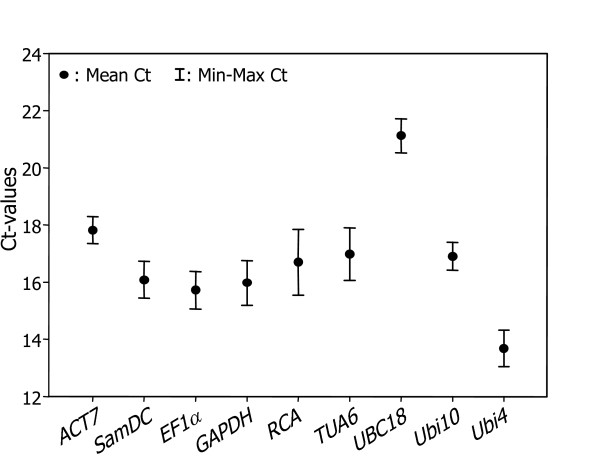
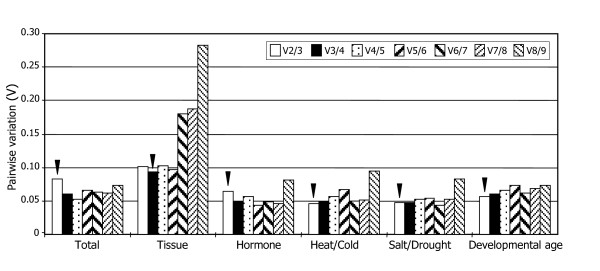
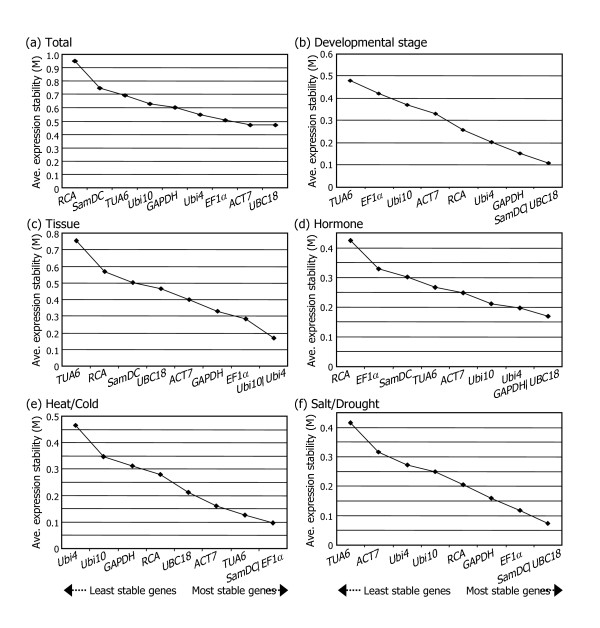
A systematic exploration of suitable reference genes in Brachypodium is presented here. Nine reference gene candidates were chosen, and their gene sequences were obtained from the Brachypodium expressed sequence tag (EST) databases. Their expression levels were examined by quantitative real-time PCR (qRT-PCR) using 21 different Brachypodium plant samples, including those from different plant tissues and grown under various growth conditions. Effects of plant growth hormones were also visualized in the assays. The expression stability of the candidate genes was evaluated using two analysis software packages, geNorm and NormFinder. In conclusion, the ubiquitin-conjugating enzyme 18 gene (UBC18) was validated as a suitable reference gene across all the plant samples examined. While the expression of the polyubiquitin genes (Ubi4 and Ubi10) was most stable in different plant tissues and growth hormone-treated plant samples, the expression of the S-adenosylmethionine decarboxylase gene (SamDC) ranked was most stable in plants grown under various environmental stresses.
This study identified the reference genes that are most suitable for normalizing the gene expression data in Brachypodium. These reference genes will be particularly useful when stress-responsive genes are analyzed in order to produce transgenic plants that exhibit enhanced stress resistance.
短柄草属野生草种(以下简称短柄草)正成为禾本科作物基因组学研究和生物燃料草生物学的新型模式系统。预计不久后将公开核基因组序列草图;随后基因表达研究无疑会大量涌现。因此,需要稳定的内参基因来标准化基因表达数据。
本文对短柄草中合适的内参基因进行了系统探索。选择了9个内参基因候选者,其基因序列从短柄草表达序列标签(EST)数据库中获取。使用21种不同的短柄草植物样本,包括来自不同植物组织以及在各种生长条件下生长的样本,通过定量实时PCR(qRT-PCR)检测它们的表达水平。实验中还观察了植物生长激素的作用。使用geNorm和NormFinder两个分析软件包评估候选基因的表达稳定性。总之,泛素结合酶18基因(UBC18)被验证为在所检测的所有植物样本中均适用的内参基因。虽然多聚泛素基因(Ubi4和Ubi10)在不同植物组织和生长激素处理的植物样本中表达最稳定,但S-腺苷甲硫氨酸脱羧酶基因(SamDC)在各种环境胁迫下生长的植物中表达稳定性排名最高。
本研究确定了最适合标准化短柄草基因表达数据的内参基因。在分析胁迫响应基因以培育具有增强抗逆性的转基因植物时,这些内参基因将特别有用。