Vlaar Annemarie M M, de Nijs Tjerk, van Kroonenburgh Marinus J P G, Mess Werner H, Winogrodzka Ania, Tromp Selma C, Weber Wim E J
Department of Neurology, University hospital Maastricht, The Netherlands.
BMC Neurol. 2008 Nov 9;8:42. doi: 10.1186/1471-2377-8-42.
Transcranial duplex sonography (TCD) of the substantia nigra has emerged as a promising, non-invasive tool to diagnose idiopathic Parkinson's disease (IPD). However, its diagnostic accuracy in patients with undefined parkinsonism remains to be determined. In this study we determined the predictive value of TCD for the clinical diagnosis in undiagnosed parkinsonian syndromes. Additionally we compared the predictive value of TCD with that of presynaptic and postsynaptic single photon emission computer tomography (SPECT) scans.
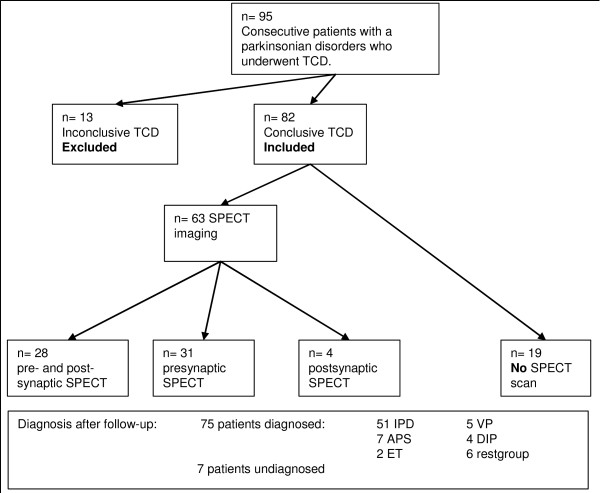
We studied 82 patients with an unclassified parkinsonian syndrome. All 82 patients were subjected to a TCD, 59 of them underwent a presynaptic SPECT scans and 32 underwent a postsynaptic SPECT scan. We determined the diagnostic accuracy of TCD and SPECT scans in differentiating: 1) IPD patients from patients without nigrostriatal degeneration and 2) IPD patients from patients with atypical parkinsonian syndromes (APS). To compare the diagnostic accuracy of TCD and SPECT scans, we used the clinical diagnosis after follow-up according to generally accepted clinical criteria as the gold standard. This clinical diagnosis was determined by a movement disorder specialist. 3) Finally, we ascertained the predictive value of the TCD for the SPECT result.
The clinical diagnoses after follow-up resulted in 51 cases of IPD, 7 patients with APS and 17 patients without nigrostriatal degeneration. In total 7 patients remained undiagnosed. 1) The accuracy of TCD, assessed by sensitivity and specificity, to differentiate IPD patients from patients without nigrostriatal degeneration was 50% and 82% respectively. For the presynaptic SPECT scans sensitivity was 97% and specificity 100%. 2) In differentiating IPD patients from APS patients, the sensitivity and specificity of TCD was 50% and 43% respectively. For presynaptic SPECT scans this was 97% and 0%. For the postsynaptic SPECT scans the sensitivity was 75% and the specificity 81%. 3) The positive predictive value (PPV) of an abnormal TCD for an abnormal presynaptic SPECT scan was 88%.
Presynaptic SPECT scanning has a higher predictive value for the clinical diagnosis than TCD. However, since the PPV of an abnormal TCD for parkinsonism with nigrostriatal degeneration is high, TCD might be used as screening tool, before ordering a presynaptic SPECT.
经颅黑质双功超声检查(TCD)已成为一种有前景的、非侵入性的诊断特发性帕金森病(IPD)的工具。然而,其在未明确帕金森综合征患者中的诊断准确性仍有待确定。在本研究中,我们确定了TCD对未诊断的帕金森综合征临床诊断的预测价值。此外,我们比较了TCD与突触前和突触后单光子发射计算机断层扫描(SPECT)的预测价值。
我们研究了82例未分类的帕金森综合征患者。所有82例患者均接受了TCD检查,其中59例接受了突触前SPECT扫描,32例接受了突触后SPECT扫描。我们确定了TCD和SPECT扫描在鉴别以下两类患者中的诊断准确性:1)IPD患者与无黑质纹状体变性的患者;2)IPD患者与非典型帕金森综合征(APS)患者。为了比较TCD和SPECT扫描的诊断准确性,我们将根据普遍接受的临床标准随访后的临床诊断作为金标准。该临床诊断由一名运动障碍专家确定。3)最后,我们确定了TCD对SPECT结果的预测价值。
随访后的临床诊断结果为51例IPD患者、7例APS患者和17例无黑质纹状体变性的患者。共有7例患者仍未确诊。1)通过敏感性和特异性评估,TCD鉴别IPD患者与无黑质纹状体变性患者的准确性分别为50%和82%。突触前SPECT扫描的敏感性为97%,特异性为100%。2)在鉴别IPD患者与APS患者时,TCD的敏感性和特异性分别为50%和43%。突触前SPECT扫描的敏感性为97%,特异性为0%。突触后SPECT扫描的敏感性为75%,特异性为81%。3)TCD异常对突触前SPECT扫描异常的阳性预测值(PPV)为88%。
突触前SPECT扫描对临床诊断的预测价值高于TCD。然而,由于TCD异常对伴有黑质纹状体变性的帕金森综合征的PPV较高,在进行突触前SPECT检查之前,TCD可作为一种筛查工具。