Stumpe Martin C, Grubmüller Helmut
Department of Theoretical and Computational Biophysics, Max-Planck-Institute for Biophysical Chemistry, Göttingen, Germany.
PLoS Comput Biol. 2008 Nov;4(11):e1000221. doi: 10.1371/journal.pcbi.1000221. Epub 2008 Nov 14.
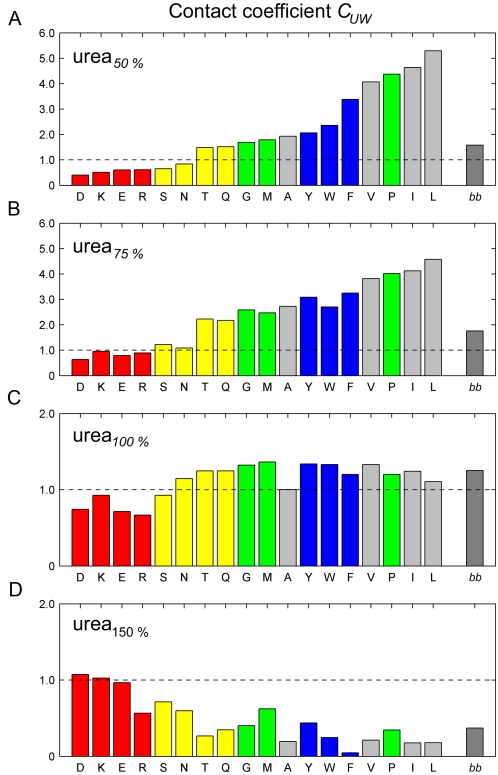
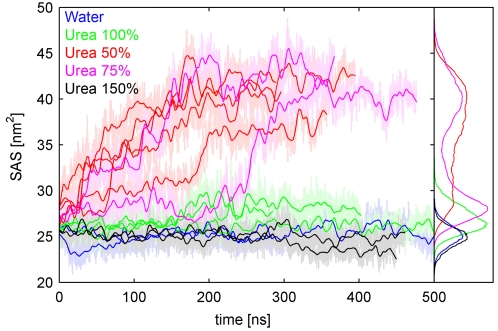
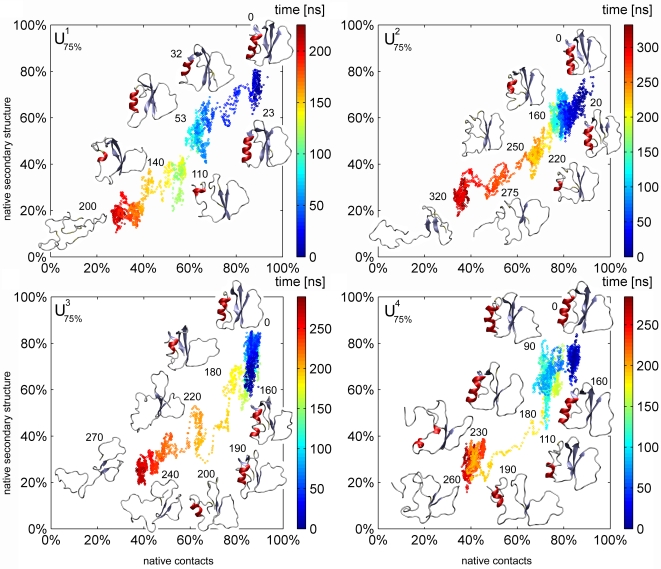
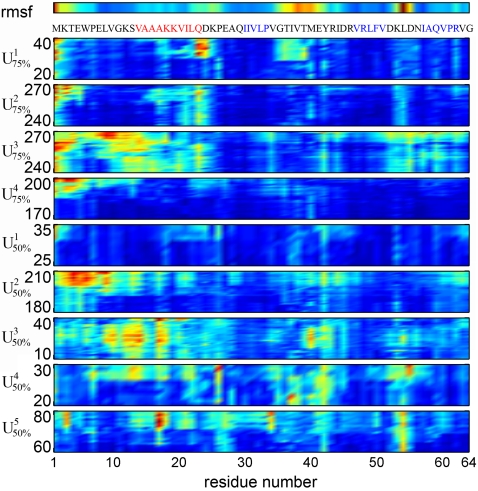
Urea-induced protein denaturation is widely used to study protein folding and stability; however, the molecular mechanism and driving forces of this process are not yet fully understood. In particular, it is unclear whether either hydrophobic or polar interactions between urea molecules and residues at the protein surface drive denaturation. To address this question, here, many molecular dynamics simulations totalling ca. 7 micros of the CI2 protein in aqueous solution served to perform a computational thought experiment, in which we varied the polarity of urea. For apolar driving forces, hypopolar urea should show increased denaturation power; for polar driving forces, hyperpolar urea should be the stronger denaturant. Indeed, protein unfolding was observed in all simulations with decreased urea polarity. Hyperpolar urea, in contrast, turned out to stabilize the native state. Moreover, the differential interaction preferences between urea and the 20 amino acids turned out to be enhanced for hypopolar urea and suppressed (or even inverted) for hyperpolar urea. These results strongly suggest that apolar urea-protein interactions, and not polar interactions, are the dominant driving force for denaturation. Further, the observed interactions provide a detailed picture of the underlying molecular driving forces. Our simulations finally allowed characterization of CI2 unfolding pathways. Unfolding proceeds sequentially with alternating loss of secondary or tertiary structure. After the transition state, unfolding pathways show large structural heterogeneity.
尿素诱导的蛋白质变性被广泛用于研究蛋白质折叠和稳定性;然而,这一过程的分子机制和驱动力尚未完全明确。特别是,尚不清楚尿素分子与蛋白质表面残基之间的疏水或极性相互作用是否驱动变性。为了解决这个问题,在此,通过总计约7微秒的CI2蛋白在水溶液中的许多分子动力学模拟进行了一项计算思维实验,其中我们改变了尿素的极性。对于非极性驱动力,低极性尿素应表现出增强的变性能力;对于极性驱动力,高极性尿素应是更强的变性剂。事实上,在所有尿素极性降低的模拟中都观察到了蛋白质展开。相比之下,高极性尿素被证明可稳定天然状态。此外,尿素与20种氨基酸之间的差异相互作用偏好对于低极性尿素增强,而对于高极性尿素则被抑制(甚至反转)。这些结果有力地表明,非极性尿素 - 蛋白质相互作用而非极性相互作用是变性的主要驱动力。此外,观察到的相互作用提供了潜在分子驱动力的详细图景。我们的模拟最终实现了对CI2展开途径的表征。展开以二级或三级结构交替丧失的方式依次进行。在过渡态之后,展开途径显示出很大的结构异质性。