Radiation Medicine Program, Princess Margaret Hospital, University Health Network, Toronto, ON.
Curr Oncol. 2008 Oct;15(5):62-9. doi: 10.3747/co.v15i5.349.
Understanding the three-dimensional (3D) volumetric relationship between imaging and functional or histopathologic heterogeneity of tumours is a key concept in the development of image-guided radiotherapy. Our aim was to develop a methodologic framework to enable the reconstruction of resected lung specimens containing non-small-cell lung cancer (NSCLC), to register the result in 3D with diagnostic imaging, and to import the reconstruction into a radiation treatment planning system.
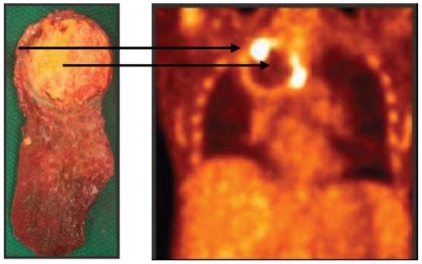
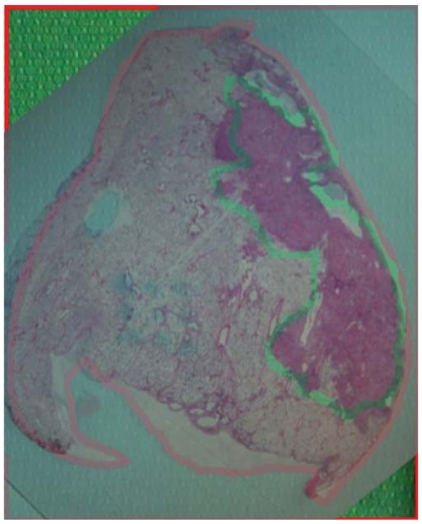
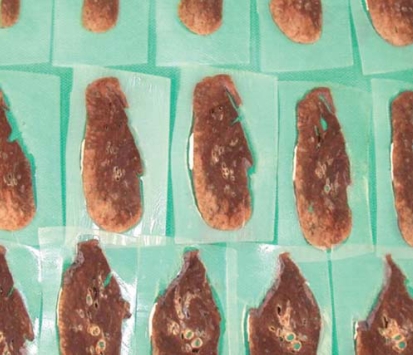
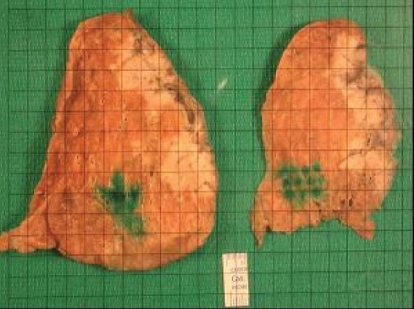
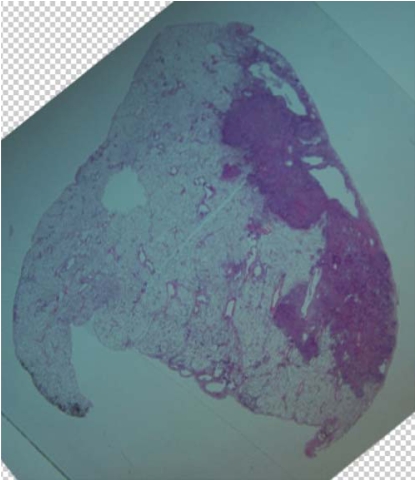
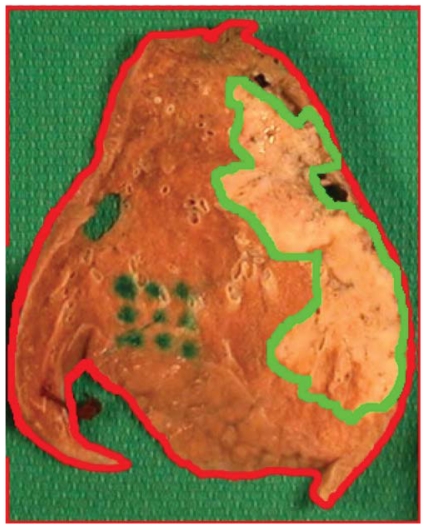
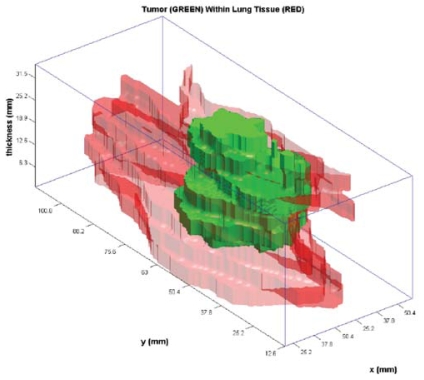
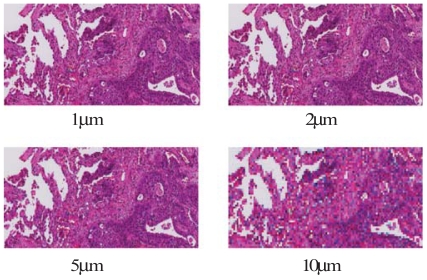
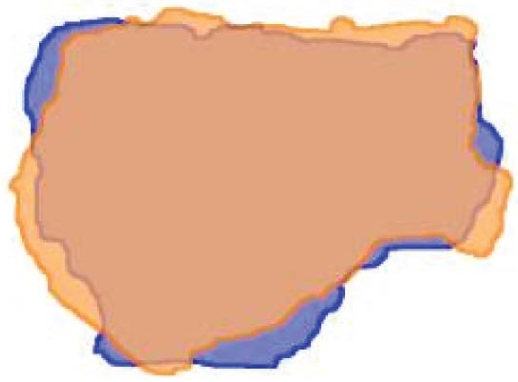
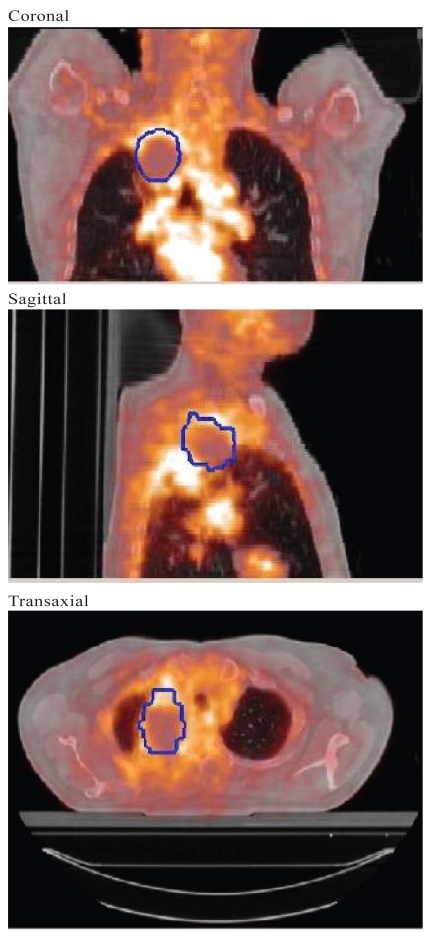
We recruited 12 patients for an investigation of radiology-pathology correlation (RPC) in nsclc. Before resection, imaging by positron emission tomography (PET) or computed tomography (CT) was obtained. Resected specimens were formalin-fixed for 1-24 hours before sectioning at 3-mm to 10-mm intervals. To try to retain the original shape, we embedded the specimens in agar before sectioning. Consecutive sections were laid out for photography and manually adjusted to maintain shape. Following embedding, the tissue blocks underwent whole-mount sectioning (4-mum sections) and staining with hematoxylin and eosin. Large histopathology slides were used to whole-mount entire sections for digitization. The correct sequence was maintained to assist in subsequent reconstruction. Using Photoshop (Adobe Systems Incorporated, San Jose, CA, U.S.A.), contours were placed on the photographic images to represent the external borders of the section and the extent of macroscopic disease. Sections were stacked in sequence and manually oriented in Photoshop. The macroscopic tumour contours were then transferred to MATLAB (The Mathworks, Natick, MA, U.S.A.) and stacked, producing 3D surface renderings of the resected specimen and embedded gross tumour. To evaluate the microscopic extent of disease, customized "tile-based" and commercial confocal panoramic laser scanning (TISSUEscope: Biomedical Photometrics, Waterloo, ON) systems were used to generate digital images of whole-mount histopathology sections. Using the digital whole-mount images and imaging software, we contoured the gross and microscopic extent of disease. Two methods of registering pathology and imaging were used. First, selected pet and ct images were transferred into Photoshop, where they were contoured, stacked, and reconstructed. After importing the pathology and the imaging contours to MATLAB, the contours were reconstructed, manually rotated, and rigidly registered. In the second method, MATLAB tumour renderings were exported to a software platform for manual registration with the original pet and ct images in multiple planes. Data from this software platform were then exported to the Pinnacle radiation treatment planning system in DICOM (Digital Imaging and Communications in Medicine) format.
There is no one definitive method for 3D volumetric RPC in nsclc. An innovative approach to the 3D reconstruction of resected nsclc specimens incorporates agar embedding of the specimen and whole-mount digital histopathology. The reconstructions can be rigidly and manually registered to imaging modalities such as ct and pet and exported to a radiation treatment planning system.
了解成像与肿瘤功能或组织病理学异质性的三维(3D)体积关系是图像引导放疗发展的关键概念。我们的目的是开发一种方法学框架,使包含非小细胞肺癌(NSCLC)的切除肺标本能够重建,并在 3D 中与诊断成像进行配准,并将重建导入放射治疗计划系统。
我们招募了 12 名患者进行 NSCLC 的放射病理学相关性(RPC)研究。在切除前,通过正电子发射断层扫描(PET)或计算机断层扫描(CT)进行成像。切除的标本在福尔马林固定 1-24 小时后,以 3-10mm 的间隔进行切片。为了尽量保持原形,我们在切片前将标本嵌入琼脂中。连续切片用于摄影,并手动调整以保持形状。包埋后,组织块进行全切片(4μm 切片)和苏木精-伊红染色。使用大的组织病理学幻灯片对整个切片进行全载片数字化。保持正确的顺序有助于随后的重建。使用 Photoshop(Adobe Systems Incorporated,美国圣何塞),在摄影图像上放置轮廓以代表切片的外部边界和大体疾病的范围。切片按顺序堆叠并在 Photoshop 中手动定向。然后将大体肿瘤轮廓转移到 MATLAB(Mathworks,美国马萨诸塞州纳蒂克)并堆叠,生成切除标本和嵌入大体肿瘤的 3D 表面渲染。为了评估疾病的微观范围,使用定制的“基于瓦片”和商业共焦全景激光扫描(TISSUEscope:Biomedical Photometrics,安大略省滑铁卢)系统生成全载片组织病理学切片的数字图像。使用数字全载片图像和成像软件,我们对大体和微观疾病范围进行了轮廓描绘。使用了两种配准病理学和成像的方法。首先,将选定的 PET 和 CT 图像传输到 Photoshop 中,在其中进行轮廓绘制、堆叠和重建。将病理学和成像轮廓导入 MATLAB 后,重建轮廓,手动旋转并刚性配准。在第二种方法中,将 MATLAB 肿瘤渲染导出到一个软件平台,用于在多个平面上与原始的 PET 和 CT 图像进行手动配准。然后,从该软件平台导出数据到 Pinnacle 放射治疗计划系统的 DICOM(医学数字成像和通信)格式。
在 NSCLC 中,没有一种确定的 3D 容积 RPC 方法。一种对切除的 NSCLC 标本进行 3D 重建的创新方法是将标本嵌入琼脂和全载片数字化组织病理学。重建可以与 CT 和 PET 等成像方式刚性和手动配准,并导出到放射治疗计划系统。