Ekesten Björn, Gouras Peter
Department of Clinical Sciences, Swedish University of Agricultural Sciences, Uppsala, Sweden.
BMC Neurosci. 2008 Nov 14;9:113. doi: 10.1186/1471-2202-9-113.
We have recorded responses from single neurons in murine visual cortex to determine the effectiveness of the input from the two murine cone photoreceptor mechanisms and whether there is any unique selectivity for cone inputs at this higher region of the visual system that would support the possibility of colour vision in mice. Each eye was stimulated by diffuse light, either 370 (strong stimulus for the ultra-violet (UV) cone opsin) or 505 nm (exclusively stimulating the middle wavelength sensitive (M) cone opsin), obtained from light emitting diodes (LEDs) in the presence of a strong adapting light that suppressed the responses of rods.
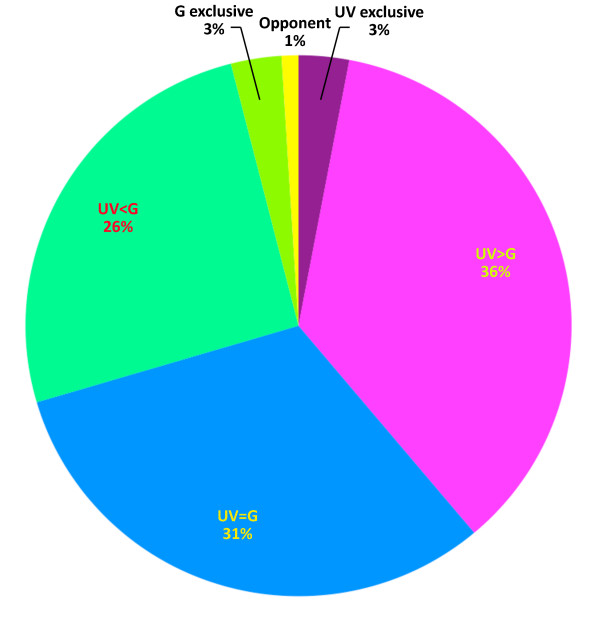
Single cells responded to these diffuse stimuli in all areas of striate cortex. Two types of responsive cells were encountered. One type (135/323-42%) had little to no spontaneous activity and responded at either the on and/or the off phase of the light stimulus with a few impulses often of relatively large amplitude. A second type (166/323-51%) had spontaneous activity and responded tonically to light stimuli with impulses often of small amplitude. Most of the cells responded similarly to both spectral stimuli. A few (18/323-6%) responded strongly or exclusively to one or the other spectral stimulus and rarely in a spectrally opponent manner.
Most cells in murine striate cortex receive excitatory inputs from both UV- and M-cones. A small fraction shows either strong selectivity for one or the other cone mechanism and occasionally cone opponent responses. Cells that could underlie chromatic contrast detection are present but extremely rare in murine striate cortex.
我们记录了小鼠视觉皮层中单个神经元的反应,以确定来自两种小鼠视锥光感受器机制的输入的有效性,以及在视觉系统的这个较高区域对视锥输入是否存在任何独特的选择性,这将支持小鼠具有色觉的可能性。每只眼睛由漫射光刺激,漫射光的波长为370nm(对紫外(UV)视锥蛋白的强刺激)或505nm(专门刺激中波敏感(M)视锥蛋白),这些光由发光二极管(LED)产生,同时存在强适应光以抑制视杆细胞的反应。
在纹状皮层的所有区域中,单个细胞对这些漫射刺激均有反应。遇到了两种类型的反应细胞。一种类型(135/323,占42%)几乎没有或没有自发活动,在光刺激的开和/或关阶段以少数通常幅度相对较大的冲动做出反应。第二种类型(166/323,占51%)有自发活动,对光刺激以通常幅度较小的冲动做出紧张性反应。大多数细胞对两种光谱刺激的反应相似。少数细胞(18/323,占6%)对一种或另一种光谱刺激有强烈反应或仅对其有反应,很少以光谱拮抗的方式反应。
小鼠纹状皮层中的大多数细胞接受来自UV视锥和M视锥的兴奋性输入。一小部分细胞对一种或另一种视锥机制表现出强烈的选择性,偶尔也有视锥拮抗反应。在小鼠纹状皮层中存在可能构成颜色对比度检测基础的细胞,但极其罕见。