An Jing, Guo Qun, Li Li, Zhang Zuoming
Department of Clinical Aerospace Medicine, Fourth Military Medical University, Xi'an, China.
ISRN Ophthalmol. 2012 May 22;2012:346297. doi: 10.5402/2012/346297. eCollection 2012.
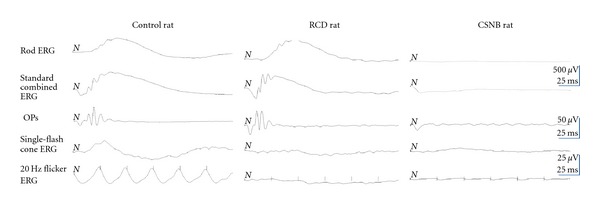
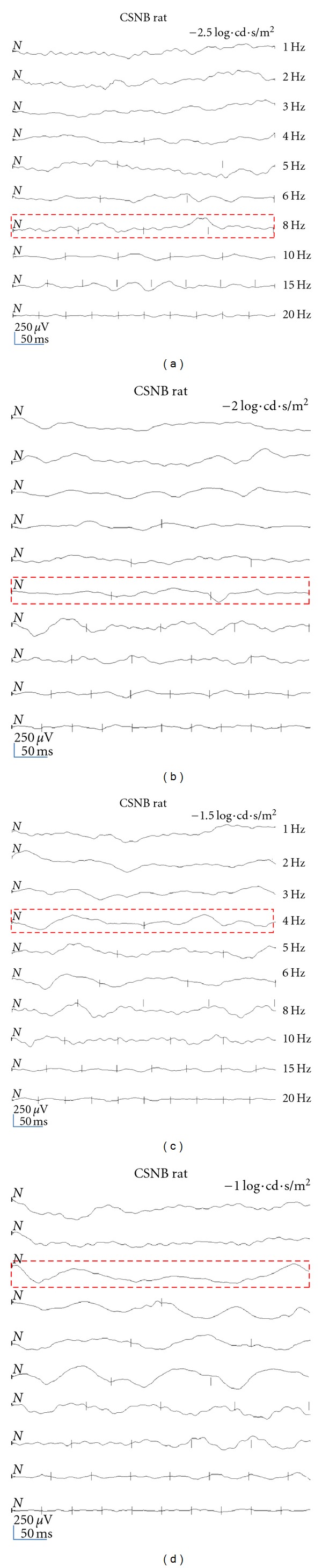
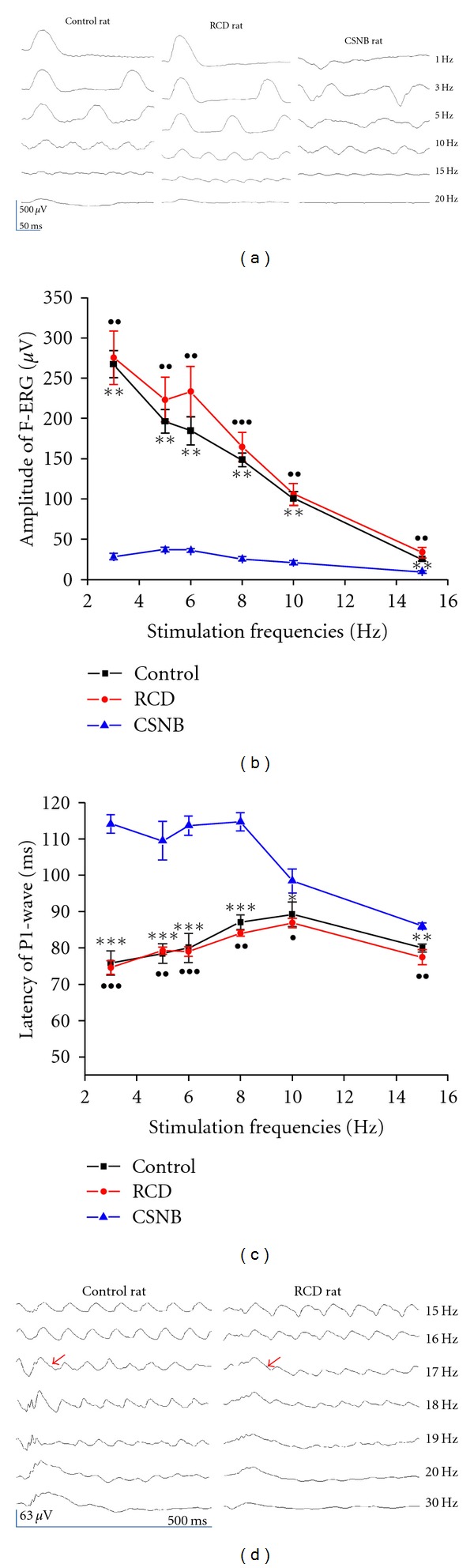
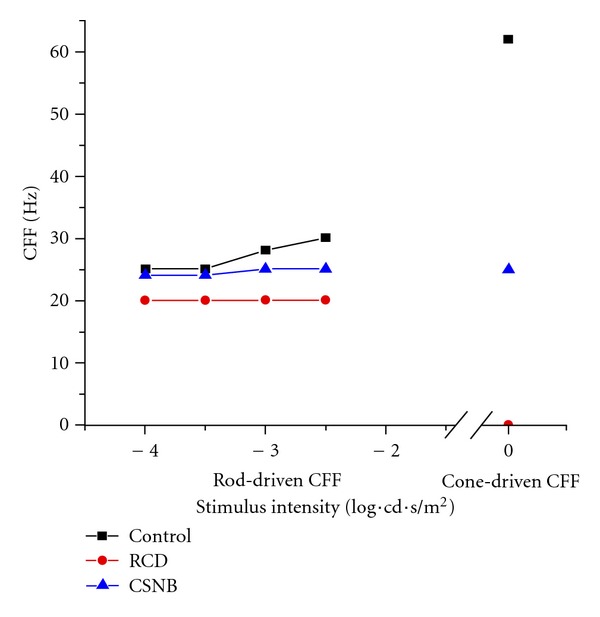
Purpose. To describe the characteristics of rod and cone functions in rat models for congenital stationary night blindness (CSNB) and retinal cone dysfunction (RCD). Methods. Rod and cone function were isolated by recording the rod-/cone-driven flicker and blue light flicker electroretinograms (ERGs). Results. During dark adaptation, the amplitudes of flicker ERGs in CSNB rats were lower than those in control rats; the responses of RCD rats were similar to control rats. During light adaptation, the amplitudes of flicker ERGs in CSNB rats were reduced; whereas the responses of RCD rats were not detected. Blue flicker ERGs were not observed in CSNB rats at lower frequencies. The cone driven critical flicker frequencies (CFFs) in control rats were 62 Hz. The rod driven CFF of RCD rats was 20 Hz; whereas the rod-/cone-driven CFF of CSNB rats both were about 25 Hz. Conclusions. The function of the rod system was damaged completely, the cones were the source of vision in CSNB rats. Rod system function is excellent in RCD rat. The rods of albinism rats are sensitive to frequencies less than 20 Hz; whereas the cones are sensitive to frequencies up to 62 Hz.
目的。描述先天性静止性夜盲(CSNB)和视网膜锥功能障碍(RCD)大鼠模型中视杆和视锥功能的特征。方法。通过记录视杆/视锥驱动的闪烁和蓝光闪烁视网膜电图(ERG)来分离视杆和视锥功能。结果。在暗适应期间,CSNB大鼠闪烁ERG的振幅低于对照大鼠;RCD大鼠的反应与对照大鼠相似。在明适应期间,CSNB大鼠闪烁ERG的振幅降低;而未检测到RCD大鼠的反应。在较低频率下,CSNB大鼠未观察到蓝色闪烁ERG。对照大鼠视锥驱动的临界闪烁频率(CFF)为62Hz。RCD大鼠视杆驱动的CFF为20Hz;而CSNB大鼠视杆/视锥驱动的CFF均约为25Hz。结论。视杆系统功能完全受损,视锥是CSNB大鼠的视觉来源。RCD大鼠视杆系统功能良好。白化病大鼠的视杆对低于20Hz的频率敏感;而视锥对高达62Hz的频率敏感。