Liu Lixiang, Foroud Tatiana, Xuei Xiaoling, Berrettini Wade, Byerley William, Coryell William, El-Mallakh Rif, Gershon Elliot S, Kelsoe John R, Lawson William B, MacKinnon Dean F, McInnis Melvin, McMahon Francis J, Murphy Dennis L, Rice John, Scheftner William, Zandi Peter P, Lohoff Falk W, Niculescu Alexander B, Meyer Eric T, Edenberg Howard J, Nurnberger John I
Indiana University, Indianapolis, Indiana 46202-3002, USA.
Psychiatr Genet. 2008 Dec;18(6):267-74. doi: 10.1097/YPG.0b013e3283060f59.
Brain-derived neurotrophic factor (BDNF) plays an important role in the survival, differentiation, and outgrowth of select peripheral and central neurons throughout adulthood. Growing evidence suggests that BDNF is involved in the pathophysiology of mood disorders.
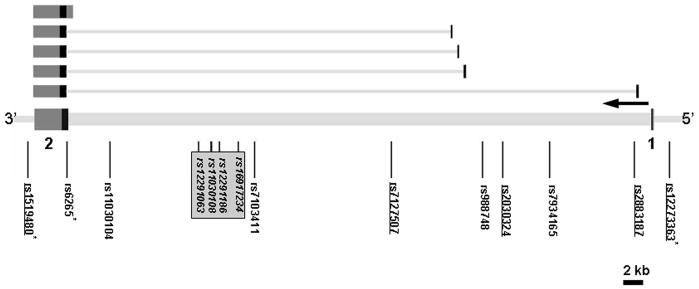
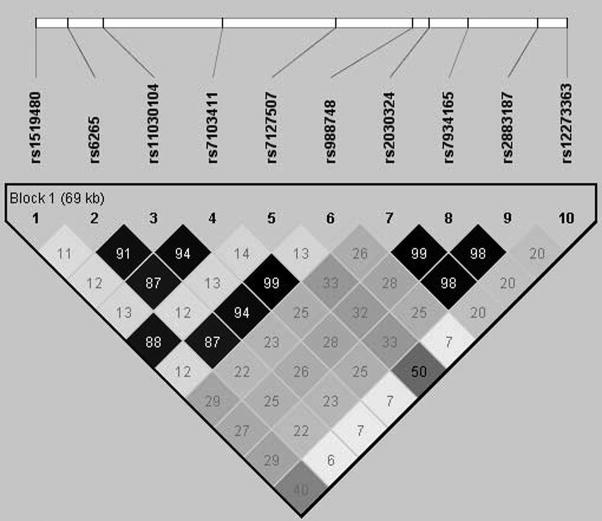
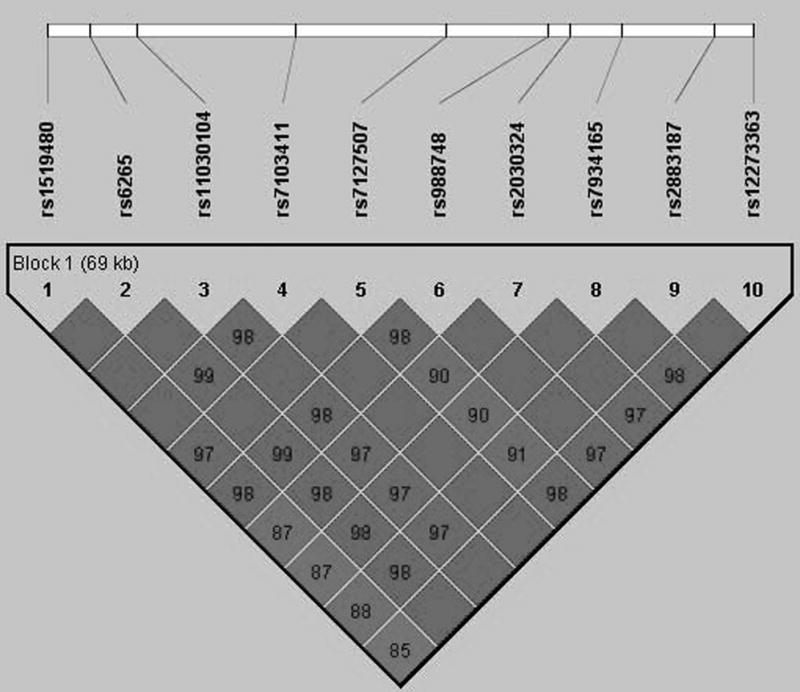
Ten single nucleotide polymorphisms (SNPs) across the BDNF gene were genotyped in a sample of 1749 Caucasian Americans from 250 multiplex bipolar families. Family-based association analysis was used with three hierarchical bipolar disorder models to test for an association between SNPs in BDNF and the risk of bipolar disorder. In addition, an exploratory analysis was performed to test for an association of the SNPs in BDNF and the phenotypes of rapid cycling and episode frequency.
Evidence of association (P<0.05) was found with several of the SNPs using multiple models of bipolar disorder; one of these SNPs also showed evidence of association (P<0.05) with rapid cycling.
These results provide further evidence that variation in BDNF affects the risk for bipolar disorder.
脑源性神经营养因子(BDNF)在成年期特定外周和中枢神经元的存活、分化及生长过程中发挥重要作用。越来越多的证据表明,BDNF参与了情绪障碍的病理生理过程。
对来自250个多重双相情感障碍家庭的1749名美籍高加索人样本中的BDNF基因上的10个单核苷酸多态性(SNP)进行基因分型。采用基于家系的关联分析,通过三种分层双相情感障碍模型来检测BDNF中的SNP与双相情感障碍风险之间的关联。此外,还进行了探索性分析,以检测BDNF中的SNP与快速循环和发作频率表型之间的关联。
使用多种双相情感障碍模型发现,几个SNP存在关联证据(P<0.05);其中一个SNP也显示出与快速循环存在关联证据(P<0.05)。
这些结果进一步证明BDNF的变异会影响双相情感障碍的风险。