Liese Angela D, Weis Kristina E, Schulz Mandy, Tooze Janet A
Department of Epidemiology and Biostatistics and Center for Research in Nutrition and Health Disparities, Arnold School of Public Health, University of South Carolina, Columbia, South Carolina, USA.
Diabetes Care. 2009 Feb;32(2):263-8. doi: 10.2337/dc08-1325. Epub 2008 Nov 25.
Markers of hemostasis and inflammation such as plasminogen activator inhibitor-1 (PAI-1) and fibrinogen have been associated with risk of type 2 diabetes. We aimed to identify food intake patterns influencing this pathway and evaluate their association with incident diabetes.
The Insulin Resistance Atherosclerosis Study cohort included 880 middle-aged adults initially free of diabetes. At the 5-year follow-up, 144 individuals had developed diabetes. Usual dietary intake was ascertained with a 114-item food frequency questionnaire. Using reduced rank regression, we identified a food pattern maximizing the explained variation in PAI-1 and fibrinogen. Subsequently, the food pattern-diabetes association was evaluated using logistic regression.
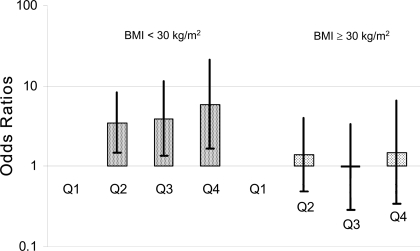
High intake of the food groups red meat, low-fiber bread and cereal, dried beans, fried potatoes, tomato vegetables, eggs, cheese, and cottage cheese and low intake of wine characterized the pattern, which was positively associated with both biomarkers. With increasing pattern score, the odds of diabetes increased significantly (Ptrend < 0.01). After multivariate adjustment, the odds ratio comparing extreme quartiles was 4.3 (95% CI 1.7-10.8). Adjustment for insulin sensitivity and secretion and other metabolic factors had little impact (4.9, 1.8-13.7).
Our findings provide support for potential behavioral prevention strategies, as we identified a food intake pattern that was strongly related to PAI-1 and fibrinogen and independently predicted type 2 diabetes.
诸如纤溶酶原激活物抑制剂-1(PAI-1)和纤维蛋白原等止血和炎症标志物与2型糖尿病风险相关。我们旨在确定影响该途径的食物摄入模式,并评估它们与糖尿病发病的关联。
胰岛素抵抗动脉粥样硬化研究队列包括880名最初无糖尿病的中年成年人。在5年随访时,144人患了糖尿病。通过一份包含114个条目的食物频率问卷确定日常饮食摄入量。使用降秩回归,我们确定了一种能使PAI-1和纤维蛋白原的解释变异最大化的食物模式。随后,使用逻辑回归评估食物模式与糖尿病的关联。
该模式的特点是红肉、低纤维面包和谷物、干豆、炸土豆、番茄类蔬菜、鸡蛋、奶酪和白软干酪的食物组摄入量高,而葡萄酒摄入量低,这与两种生物标志物均呈正相关。随着模式得分增加,糖尿病的几率显著增加(P趋势<0.01)。多变量调整后,比较极端四分位数的比值比为4.3(95%CI 1.7-10.8)。对胰岛素敏感性和分泌以及其他代谢因素进行调整影响不大(4.9,1.8-13.7)。
我们的研究结果为潜在的行为预防策略提供了支持,因为我们确定了一种与PAI-1和纤维蛋白原密切相关且能独立预测2型糖尿病的食物摄入模式。